
Chrysocharis
Förster, 1856
Species Guides
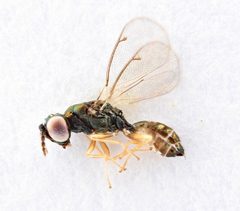
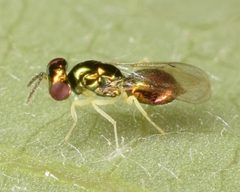
14Chrysocharis is a of small in the Eulophidae. are primarily larval parasitoids of leafmining flies (Diptera: Agromyzidae) and casebearing moths (Lepidoptera: Coleophoridae). The genus has been studied for applications, particularly against agricultural pests such as Liriomyza leafminers and the larch casebearer. At least 18 species occur in North America north of Mexico, with additional diversity in Europe and the Oriental region.

Pronunciation
How to pronounce Chrysocharis: //ˌkɹɪsəˈkɛərɪs//
These audio files are automatically generated. While they are not always 100% accurate, they are a good starting point.
Identification
Chrysocharis are small chalcid wasps, typically 1–2 mm in length. The subgenus Chrysocharis s. str. in North America includes 18 species distinguishable by morphological characters detailed in taxonomic revisions. Specific identification requires examination of wing venation, , and body using available keys.
Images
Distribution
Recorded from North America (including Arizona, California, Connecticut), Asia (Beijing, Bihar, Nepal, India, Pakistan, Sri Lanka), and Europe. The is widespread across temperate and tropical regions.
Host Associations
- Liriomyza trifolii - Larval ; studied in laboratory rearing
- Liriomyza sativae - Larval
- Phytomyza ranunculi - Larval ; patch searching studied
- Coleophora laricella - Larval of larch casebearer; prefers fourth-instar case-bearing larvae
Behavior
Chrysocharis pentheus employs a mixed foraging strategy combining fixed search-effort and area-concentrated search when seeking in patches. Females deposit on searched leaflets at rates proportional to search speed, leaving when accumulated reaches a threshold. Search effort increases markedly after first host encounter but less so at later encounters. Chrysocharis laricinellae exhibits poor searching capacity and readily superparasitizes at low host densities.
Ecological Role
agent for leafmining flies and casebearing moths in agricultural and forest . Chrysocharis pentheus is considered promising for programs due to its ability to develop under low temperature/short day conditions. Chrysocharis laricinellae contributes to suppression of larch casebearer , though its effectiveness depends on continuous availability of suitable instars.
Human Relevance
Used or considered for of agricultural pests including Liriomyza leafminers on vegetable crops and Phyllocnistis citrella on citrus. Laboratory rearing methods have been developed for mass propagation. Susceptible to applied for control, creating potential conflict with chemical pest management.
Similar Taxa
- AchrysocharoidesCongeneric in Entedoninae; distinguished by morphological characters in taxonomic keys
- KratoysmaCongeneric in Entedoninae; co-occurring in Oriental region and distinguished in regional revisions
- Agathis pumilaCompeting of larch casebearer; differs in searching and selection , with Chrysocharis laricinellae showing poorer searching capacity and greater tendency toward
More Details
Taxonomic diversity
The subgenus Chrysocharis s. str. contains at least 18 in America north of Mexico, including six species described as new in 1973: C. beckeri, C. subcircularis, C. bellincus, C. clarkae, C. truncatipennis, and C. levipectus.
Temperature tolerance
Chrysocharis laricinellae has a temperature threshold of 55°F for attacking and 40°F for development. can survive approximately 4 months at 50°F, enabling persistence through periods of low host availability.
Sex ratio variation
In C. laricinellae, female-biased sex ratios result when sufficient preferred stages are available. In C. pentheus, offspring sex ratio (% females) is low at 15°C, and female is higher from third-instar hosts than from second-instar hosts.
Sources and further reading
- BugGuide
- Wikipedia
- GBIF taxonomy match
- iNaturalist taxon
- NCBI Taxonomy
- Catalogue of Life
- REVISION OF THE GENUSCHRYSOCHARISFÖRSTER (SUBGENUSCHRYSOCHARISs. str.) (EULOPHIDAE: CHALCIDOIDEA) OF AMERICA NORTH OF MEXICO
- The entedontine genera Achrysocharoides Girault, Chrysocharis Förster and Kratoysma Bouček (Hymenoptera: Eulophidae) in the Oriental region
- Development and Sex Ratio of the Parasitoid Chrysocharis pentheus (Hymenoptera: Eulophidae) on the Leafminer Liriomyza trifolii (Diptera: Agromyzidae)
- Field Effect of Insecticides on Chrysanthemum Leafminer 1 and a Primary Parasitoid, Chrysocharis ainsliel (Crawford), 2 on Artichokes in California 3
- COMPETITION AND CO-OPERATION BETWEEN CHRYSOCHARIS LARICINELLAE AND AGATHIS PUMILA ON LARCH CASEBEARER IN QUEBEC
- LABORATORY PROPAGATION OF THE PARASITE CHRYSOCHARIS LARICINELLAE (HYMENOPTERA: EULOPHIDAE) AND NOTES ON INTERACTION WITH ITS HOST, COLEOPHORA LARICELLA
- ECOLOGICAL OBSERVATIONS ON CHRYSOCHARIS LARICINELLAE (HYMENOPTERA: EULOPHIDAE), A PARASITE OF THE LARCH CASEBEARER (COLEOPHORA LARICELLA)
- Toxicity of insecticides to the citrus leafminer, Phyllocnistis citrella, and its parasitoids, Chrysocharis pentheus and Sympiesis striatipes (Hymenoptera: Eulophidae)
- Stopping rule of host search by the parasitoid, Chrysocharis pentheus (Hymenoptera: Eulophidae), in host patches