
Liriomyza sativae
Blanchard, 1938
vegetable leaf miner, vegetable leafminer
Liriomyza sativae, the vegetable leafminer, is a leaf-mining fly in the Agromyzidae. Native to the Neotropics, it has become a widespread pest of vegetable crops globally. Larvae feed internally on leaf mesophyll, creating characteristic serpentine mines that reduce photosynthetic capacity. The is notable for its broad range spanning multiple plant families, rapid time, and competitive interactions with mediated by temperature.
Pronunciation
How to pronounce Liriomyza sativae: /ˌlɪri.oʊˈmaɪzə səˈtaɪvi/
These audio files are automatically generated. While they are not always 100% accurate, they are a good starting point.
Identification
The yellow , , third antennal segment, and scutellum combined with black and with yellow-edged plates distinguish from . The unique is particularly useful for separating L. sativae from L. trifolii. Larvae create serpentine leaf mines that widen as the larva grows. Pupae are found in soil, not in leaf mines.
Images
Appearance
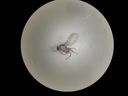
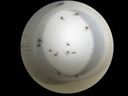
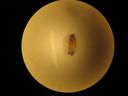
are small flies, up to 1.7 mm in length, with females larger than males. The , , third antennal segment, and scutellum are yellow; the and are black with yellow edges on some abdominal plates. The is distinctive and useful for distinguishing from close relatives. Legs are brown with yellow and . are approximately 0.25 × 0.12 mm, translucent and whitish. Larvae are legless, headless , translucent when young, becoming yellowish-orange in later instars. Pupae are oval, slightly flattened, yellowish-orange to golden brown when adults are near .
Habitat
Found in agricultural areas, vegetable fields, and glasshouses. In its native range, occurs from lowland to mid-elevation areas, typically below 1,200 m in tropical regions. In temperate regions, persists in protected environments (glasshouses) during cold periods. Associated with disturbed and cultivated landscapes.
Distribution
Native to South America (Argentina, Brazil, Chile, Colombia, French Guiana, Peru, Venezuela). Introduced and established in North America (southern USA, Mexico, Hawaii), Central America and Caribbean, Europe (UK, Finland), Asia (China, India, Indonesia, Iran, Israel, Japan, Jordan, Malaysia, Oman, Sri Lanka, Thailand, Turkey, Uzbekistan, Vietnam, Yemen), Africa (Cameroon, Nigeria, Sudan, Zimbabwe), and Oceania (American Samoa, Cook Islands, Federated States of Micronesia, French Polynesia, Guam, New Caledonia, Northern Mariana Islands, Samoa, Vanuatu). In the USA, occurs primarily in southern states; northern are transient, transported in plant material but unable to survive cold winters except in glasshouses.
Seasonality
Multiple per year under favorable conditions. At 25–30°C, larval stage lasts approximately 8 days, pupal stage similar; at 15°C, complete cycle extends to 25 days. Activity year-round in tropical and subtropical regions; in temperate zones, active during warm months with in protected environments.
Diet
Larvae are internal leaf miners, feeding on mesophyll tissue between upper and lower leaf surfaces. feed on plant sap from feeding punctures and possibly nectar.
Host Associations
- Phaseolus - beans
- Solanum lycopersicum - tomato
- Solanum melongena - eggplant
- Capsicum - pepper
- Cucurbita - squash
- Citrullus lanatus - watermelon
- Apium graveolens - celery, less preferred
- Solanum americanum - wild
- Bidens alba - wild
Life Cycle
Females lay inside leaf tissue, creating small puncture holes. Larvae develop through three instars, feeding internally and creating serpentine mines that widen as larvae grow. Third instar larvae cut a slit in the upper leaf surface and drop to the ground to pupate in soil. from pupae follows. time is temperature-dependent: approximately 16 days at 25–30°C, 25 days at 15°C. Females may lay several hundred eggs over a lifespan of about one month.
Behavior
females use feeding punctures for both nutrition and oviposition site preparation. Larvae exhibit endophytic feeding , tunneling between leaf surfaces. occurs in soil, not in leaf mines. The shows rapid cold hardening capacity in pupal stage; RCH effect lasts approximately 4 hours. Adults do not exhibit rapid cold hardening. Competitive interactions with L. huidobrensis are temperature-mediated, with L. sativae excluded from high-altitude by temperature and from lowland habitats by competition with L. huidobrensis where temperatures overlap.
Ecological Role
Herbivore and agricultural pest. Larval leaf mining reduces photosynthetic capacity of plants. Serves as host for multiple including braconid wasps (e.g., Phaedrotoma scabriventris), figitids (e.g., Zaeucoila unicarinata), and eulophids (e.g., Diglyphus isaea). influenced by natural enemies, though chemical use can disrupt .
Human Relevance
Major agricultural pest of vegetable crops worldwide. Causes economic damage through reduced yield and quality of leafy vegetables, beans, cucurbits, and solanaceous crops. Management relies on including , cultivars, and selective . Has developed resistance to multiple insecticide classes. Subject to regulations in many countries.
Similar Taxa
- Liriomyza trifoliiSimilar leaf-mining habit and range; distinguished by coloration and pupal characteristics. L. trifolii has better cold and rapid cold hardening capacity in adults, which L. sativae lacks.
- Liriomyza huidobrensisOverlapping range and distribution; distinguished by temperature preferences. L. huidobrensis is restricted to cooler, high-altitude by upper thermal limit of 28–29°C, while L. sativae occupies warmer lowland areas. Where they co-occur, L. huidobrensis competitively excludes L. sativae from preferred hosts.
Sources and further reading
- BugGuide
- Wikipedia
- GBIF taxonomy match
- iNaturalist taxon
- NCBI Taxonomy
- Catalogue of Life
- Liriomyza miserabilis Lonsdale dorsal | Entomology Research Museum
- Primary Type List | Entomology Research Museum
- Publications | Entomology Research Museum
- Predicting Shifts in the Range of Invasive Insect Species in the Face of Climate Change
- Liriomyza huidobrensis Archives - Entomology Today
- A Case for Preservation: Maintaining Insect Collections in Developing Countries
- Liriomyza sativae . [Distribution map].
- Liriomyza sativae . [Distribution map].
- Liriomyza sativae . [Distribution map].
- Aspectos bioecológicos de duas espécies de parasitoides da mosca minadora Liriomyza sativae Blanchard (Diptera: Agromyzidae)
- Bioecologia e competição de duas espécies de parasitoides neotropicais (Hymenoptera: Braconidae e Eulophidae) de Liriomyza sativae Blanchard, 1938 (Diptera: Agromyzidae)
- Quantitative Genetic Analysis of Feeding and Oviposition Behavior in the Polyphagous Leafminer Liriomyza sativae
- Host Plant-Related Parasitism and Host Feeding Activities of Diglyphus isaea (Hymenoptera: Eulophidae) on Liriomyza huidobrensis, Liriomyza sativae, and Liriomyza trifolii (Diptera: Agromyzidae)
- What Limits the Distribution of Liriomyza huidobrensis and Its Congener Liriomyza sativae in Their Native Niche: When Temperature and Competition Affect Species’ Distribution Range in Guatemala
- Identifying factors determining the altitudinal distribution of the invasive pest leafminersLiriomyza huidobrensisandLiriomyza sativae
- Differential Response of Leafminer Flies Liriomyza trifolii (Burgess) and Liriomyza sativae (Blanchard) to Rapid Cold Hardening
- Biology of the Tomato Leafminer Liriomyza Sativae (Diptera: Agromyzidae)
- Overwintering, Cold Tolerance and Supercooling Capacity Comparison Between Liriomyza Sativae and L. Trifolii, Two Successively Invaded Leafminers in China
- Insecticidal and Sublethal Effects of Artemisia scoparia Essential Oil on Liriomyza sativae.