
Phytomyza ranunculi
(Schrank, 1803)
Ranunculus leaf-mining fly
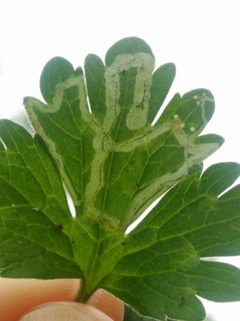
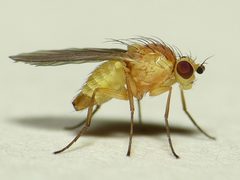
Phytomyza ranunculi is a leaf-mining fly in the Agromyzidae that develops within leaves of Ranunculus plants (buttercups). are approximately 2 mm long and highly variable in coloration, with several named color variants. The larvae are primarily leaf-miners, forming long, conspicuous white mines with arranged in close strings. The is widespread in Europe and occurs in the Palearctic region. Pupae are heavily parasitized, with up to 75% of attacked by .
Pronunciation
How to pronounce Phytomyza ranunculi: /ˌfaɪtoʊˈmaɪzə rəˈnʊŋkjʊlaɪ/
These audio files are automatically generated. While they are not always 100% accurate, they are a good starting point.
Identification
Distinguished from similar leaf-mining flies by the distinctive long, white leaf mines with arranged in close strings on Ranunculus plants. The highly variable coloration (pale to dark forms) requires caution; identification should be confirmed by mine characteristics and host association. The 's with 18-20 bulbs provide a diagnostic feature.
Images
Appearance
flies are approximately 2 mm in length. Coloration is highly variable, with several named variants: a pale form (P. ranunculi var. flava) and dark forms (P. ranunculi var. flavoscutellata and var. islandica). Larvae form long, conspicuous white leaf mines. The is greyish or brown; each bear about 18-20 bulbs.
Habitat
Lowland areas where Ranunculus plants grow, including meadows, pastures, and disturbed . The is associated with agricultural and semi-natural environments supporting buttercup .
Distribution
Widespread throughout Europe; recorded in the Palearctic region including Belgium (Flemish Region, Walloon Region, Brussels-Capital Region) and São Jorge (Azores).
Seasonality
occurs from late March to early April. The is active from fall through summer with overlapping . Larvae overwinter inside mined leaves and pupate in spring.
Diet
Larvae feed on leaf tissue of Ranunculus plants, creating internal leaf mines. feed on plant sap from feeding punctures made by the female's ovipositor.
Host Associations
- Ranunculus acris - primary Meadow buttercup; reared from stem-mines in 2018, representing rare 'organoxeny'
- Ranunculus - primary Buttercup plants in Ranunculaceae; laid on leaves, larvae primarily leaf-miners
Life Cycle
are deposited in leaves of Ranunculus plants. Larvae are primarily leaf-miners, feeding within leaf tissue and creating long, conspicuous white mines. They overwinter as larvae inside mined leaves. occurs in spring within a greyish or brown . is timed to coincide with the appearance of tender new leaves in spring. In 2018, adults were confirmed reared from stem-mines of Ranunculus acris, representing a rare case of 'organoxeny' where the insect occurred on a different plant part than normally found.
Behavior
Female flies use their ovipositor to pierce leaf surfaces and deposit into soft tissue beneath. Larvae mine leaves in a snaking pattern, enlarging the trail as they grow. Before , larvae cut a small window in the leaf surface to enable escape. The exhibits oviposition restraint, avoiding excessive egg deposition in heavily exploited leaves by laying fewer eggs per visit and visiting leaves more sparsely.
Ecological Role
Herbivore and leaf-miner on Ranunculus plants. Serves as for eulophid including Kratochviliana sp. and Chrysocharis pentheus. Up to 75% of may be parasitized, making this an important host in parasitoid .
Human Relevance
Minor agricultural significance as a herbivore of Ranunculus . The 2018 observation of stem-mining on meadow buttercup suggests potential for previously unrecognized damage patterns. No major economic impact documented.
Similar Taxa
- Phytomyza ilicicolaAnother Phytomyza leaf-miner, but restricted to Ilex (holly) rather than Ranunculus; mines differ in context
- Phytomyza gymnostomaAllium leaf-miner with similar mining but restricted to Allium crops (onions, garlic, leeks); distinguished by association and geographic range
More Details
Organoxeny
In 2018, the first confirmed were reared from stem-mines of meadow buttercup (Ranunculus acris), representing a rare example of 'organoxeny'—where a phytophagous insect occurs on a different part of a plant from where it is normally found (leaves vs. stems).
Parasitoid pressure
P. ranunculi pupae are particularly vulnerable to . Studies document up to 75% parasitism rates, with including multiple in the hymenopteran superfamilies Chalcidoidea and Ichneumonoidea, particularly eulophid such as Kratochviliana sp. and Chrysocharis pentheus.
Spatial oviposition patterns
Research demonstrates that females avoid excessive oviposition in leaves by laying fewer per visit and visiting leaves more sparsely, particularly avoiding leaves heavily exploited by mature larvae. This has been modeled mathematically to predict egg distribution patterns.
Sources and further reading
- BugGuide
- Wikipedia
- GBIF taxonomy match
- NCBI Taxonomy
- Catalogue of Life
- The Holly and Ivy - A two part series: This week the holly and the native holly leaf miner, Phytomyza ilicicola — Bug of the Week
- Deck the halls with boughs of holly…and the Native holly leafminer, 'Phytomyza ilicicola', and Holly berry midge, 'Asphondylia ilicicola' — Bug of the Week
- Invasive Fly Targets North American Onions, Leeks, Related Crops
- Archive — Bug of the Week
- Occurrence of a Ranunculus Leaf-Mining Fly, Phytomyza ranunculi and Its Eulophid Parasitoids from Fall to Summer in the Low Land
- Models of the spatial pattern of egg population of Ranunculus leaf mining fly, Phytomyza ranunculi (Diptera: Agromyzidae), in host leaves
- Host‐attacking behavior of a eulophid parasite, Kratochviliana sp., to the leaf mining host, Phytomyza ranunculi (Diptera: Agromyzidae) during its stay on the leaf
- Mortality of Larvae of a Ranunculus Leaf Mining Fly, Phytomyza ranunculi (Diptera : Agromyzidae), due to Parasitization and Host-Feeding by its Europhid Parasite, Chrysocharis pentheus (Hymenoptera : Eulophidae)
- Ecological Studies on the Relationship between the Ranunculus Leaf Mining Fly, Phytomyza ranunculi SCHRANK (Diptera : Agromyzidae) and Its Parasite, Kratochviliana sp. (Hymenoptera : Eulophidae) from the Viewpoint of Spatial Structure I. Analysis of Searching and Attacking Behaviors of the Parasite