
Phytomyza gymnostoma
Loew, 1858
onion leaf miner, allium leafminer
Phytomyza gymnostoma is a leaf-mining fly in the Agromyzidae, commonly known as the onion or allium leafminer. Native to mainland Europe, it has established in England (first detected 2002) and North America (first detected December 2015 in Pennsylvania). The is a significant agricultural pest specializing in Allium crops, including onions, garlic, shallots, and leeks. It is , producing two annually, with active during spring and fall periods.
Pronunciation
How to pronounce Phytomyza gymnostoma: /faɪtoʊˈmaɪzə dʒɪmnəˈstoʊmə/
These audio files are automatically generated. While they are not always 100% accurate, they are a good starting point.
Identification
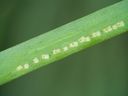
Distinguished from other Phytomyza by its exclusive association with Allium . Identification requires examination of genitalia or molecular methods; field identification relies on host plant and damage . Similar agromyzid leafminers on other host plants (e.g., Phytomyza ilicicola on holly) can be separated by host specificity. The serpentine leaf mines and oviposition punctures on allium foliage are characteristic signs of presence.
Images
Habitat
Agricultural and natural environments supporting Allium . Found in cultivated allium crops (onions, garlic, shallots, leeks) and wild allium . Larval is internal to plant tissue—between leaf layers, within bulbs, or in soil adjacent to plants. are short-lived and associated with plant availability.
Distribution
Native to mainland Europe (Austria, Croatia, Czech Republic, Denmark, France, Germany, Hungary, Italy, Poland, Serbia, Slovakia, Slovenia, Spain, Sweden, Switzerland, Ukraine, Turkey, Turkmenistan). range includes England (since 2002), United States (Pennsylvania, New Jersey, New York since 2015), and Greece (recorded 2007). Climate modeling suggests potential for spread across most of North America except extreme northern and southern regions.
Seasonality
with two per year. periods occur in spring and fall, synchronized with allium growth stages. Larvae undergo summer , a -like resting period during hot months. Winter is spent as pupae. Adult timed to coincide with tender new leaf availability in spring.
Diet
Specialized herbivore feeding exclusively on Allium . puncture leaf tissue with ovipositor to feed on exuded sap. Larvae mine between leaf layers and feed within bulbs, consuming internal plant tissues.
Host Associations
- Allium cepa - onion
- Allium sativum - garlic
- Allium ampeloprasum var. porrum - leek
- Allium ascalonicum - shallot
Life Cycle
Complete with four stages: , larva, pupa, . Eggs deposited through ovipositor punctures into leaf tissue. Larvae hatch and create serpentine mines within leaves, later feeding in bulbs. Larval development includes summer . occurs between leaf layers, in bulbs, or in soil. Adults emerge in spring and fall. Two per year (). stage is pupa.
Behavior
use sharp ovipositor to puncture leaves for both -laying and feeding on sap. Larval mining creates descending galleries within leaves. Summer allows synchronization with plant . Pupae cut escape windows in leaf surface before adult . Short adult lifespan limits detection window.
Ecological Role
Agricultural pest causing stunted growth and wilting in allium crops. No documented native ecological role outside agricultural context; specialized relationship with Allium suggests co-evolution with wild allium in native range.
Human Relevance
Significant economic pest of allium agriculture. Management relies on , timed applications, and removal of plants during off-season. Potential for biocontrol under investigation. Spread facilitated by transport of allium commodities. and monitoring concerns in North American range.
Similar Taxa
- Phytomyza ilicicolaNative holly leafminer with similar leaf-mining and , but restricted to Ilex (holly) rather than Allium; mines are serpentine but on different plant
- Liriomyza spp.Other agromyzid leafminers with similar mining patterns, but generally broader ranges and different preferred hosts; require genitalia examination for definitive separation
More Details
Invasion History
First North American detection in Lancaster County, Pennsylvania, December 2015. Subsequent spread to New Jersey and New York documented by 2018. Natural spread via wild alliums and human-mediated transport through commodities predicted to enable rapid range expansion.
Management Challenges
Concealed lifestyle within plant tissue complicates detection and treatment. Summer creates asynchronous . Short lifespan reduces window for monitoring and intervention.
Sources and further reading
- BugGuide
- Wikipedia
- GBIF taxonomy match
- iNaturalist taxon
- NCBI Taxonomy
- Catalogue of Life
- Invasive Fly Targets North American Onions, Leeks, Related Crops
- The Holly and Ivy - A two part series: This week the holly and the native holly leaf miner, Phytomyza ilicicola — Bug of the Week
- Deck the halls with boughs of holly…and the Native holly leafminer, 'Phytomyza ilicicola', and Holly berry midge, 'Asphondylia ilicicola' — Bug of the Week
- Holly surprise: Native holly leafminer, Phytomyza ilicicola — Bug of the Week
- Holiday miners - Native holly leafminer, Phytomyza ilicicola — Bug of the Week
- Deck the halls with boughs of holly - and maybe some leaves with the native holly leafminer, Phytomyza ilicicola — Bug of the Week
- Phytomyza gymnostoma . [Distribution map].
- First record of Phytomyza gymnostoma Loew (Diptera: Agromyzidae) a leaf mining pest of leeks in Greece