
Psyllaephagus
Ashmead, 1900
Species Guides
2- Psyllaephagus bliteus(Red gum lerp psyllid parasitoid)
- Psyllaephagus pilosus(Bluegum Psyllid Encyrtid Wasp)
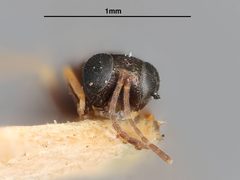
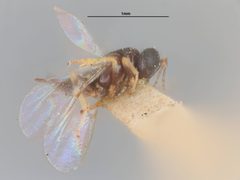
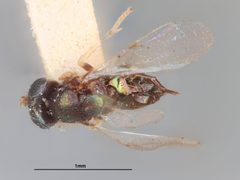
Psyllaephagus is a large of chalcid wasps in the Encyrtidae, containing approximately 245–246 described as of 2019, with greatest diversity in Australia (~100 described species, possibly ~1,000 total). The genus was established by William Harris Ashmead in 1900. Most species are primary of psylloids (Hemiptera: Psylloidea), with some secondary parasitoids. Three Australian species—P. pilosus, P. bliteus, and P. yaseeni—have been successfully deployed as agents against psylloids in California, Europe, Hawaii, and southeast Asia.
Pronunciation
How to pronounce Psyllaephagus: //sɪˌliːəˈfeɪɡəs//
These audio files are automatically generated. While they are not always 100% accurate, they are a good starting point.
Identification
Distinguished from similar Encyrtidae by combination of: punctiform or slightly elongated (shorter than stigmal ), metallic green/blue-green coloration, 11-segmented with 6-segmented funicle, and hidden to exserted ovipositor. Mesopleuron clearly separated from metasoma base by propodeum visible in lateral view. Male antennae with variable funicle structure (whiplike to flattened) differ from females.
Images
Habitat
Associated with psylloid : leaves, twigs, and stems of host plants bearing nymphs. Rearing conducted in laboratory settings using nylon mesh bags containing infested plant material.
Distribution
. Greatest in Australia (~100 described , possibly ~1,000 total). Also abundant in Palaearctic region (~57 species), India (~20), Africa (~30). Documented from China (Ningxia, Shandong, Tianjin, Xinjiang, Guangxi), Russia (Tajikistan, Kazakhstan, Mongolia, Turkmenistan, Uzbekistan), Rica, Hawaii, southeast Asia, California, New York, England, Indonesia, Brazil, Mexico, and European countries.
Seasonality
Activity synchronized with psylloid . Some exhibit facultative in pupal stage, within mummified hosts. Diapause induced by short and low temperature during larval development.
Host Associations
- Acaerus turkestanicus - primary Hemiptera: Psyllidae
- Agonoscena pistaciae - primary common pistachio psylla; major biocontrol target
- Bactericera gobica - primary Hemiptera: Triozidae
- Blastopsylla occidentalis - primary Hemiptera: Aphalaridae; parasitized by P. blastopsyllae
- Caillardia azurea - primary Hemiptera: Aphalaridae
- Caillardia robusta - primary Hemiptera: Aphalaridae
- Ctenarytaina eucalypti - primary controlled by P. pilosus in California and Europe
- Glycaspis brimblecombei - primary controlled by P. bliteus in California, Mexico, Brazil, and elsewhere
- Heteropsylla cubana - primary controlled by P. yaseeni in Hawaii and southeast Asia
- Macrohomotoma sinica - primary Hemiptera: Homotomidae; of P. guangxiensis
- Mastigimas anjosi - primary Hemiptera: Calophyidae; of P. trioziphagus
- Megatrioza hirsuta - primary Hemiptera: Triozidae; of P. phylloplectae
- Pachypsylla celtidismama - primary Hemiptera: Psyllidae; hackberry , parasitized by Psyllaephagus spp.
Life Cycle
develop as larvae within psylloid nymphs, emerging as after at least one month in rearing conditions. occurs as pupa within mummified . Facultative induced by short and low temperature during larval stage; diapause termination temperature-dependent but chilling unnecessary.
Behavior
Females use plant volatiles and honeydew for host location. Infested host plant leaves are most attractive; honeydew stimulates increased searching activity, antennal drumming, and ovipositor probing, serving as directional cue to retain in favorable patches. Host-stage selection and oviposition adapted to psylloid nymphal instars.
Ecological Role
Primary regulating psylloid ; agent of pests. Some act as secondary parasitoids.
Human Relevance
Major agents for pests. P. pilosus introduced to California and Europe for control of Ctenarytaina eucalypti. P. bliteus introduced to California, Mexico, and Brazil for control of Glycaspis brimblecombei, achieving up to 90% natural control in Mexico City. P. yaseeni introduced to Hawaii and southeast Asia for control of Heteropsylla cubana. P. pistaciae is the major biocontrol agent of common pistachio psylla in pistachio . pipientis endosymbiont detected in some .
Similar Taxa
Sources and further reading
- BugGuide
- Wikipedia
- GBIF taxonomy match
- iNaturalist taxon
- NCBI Taxonomy
- Catalogue of Life
- Encyrtid Holdings | Entomology Research Museum
- Publications | Entomology Research Museum
- Bug Eric: Hackberry Psyllids: A Fixture of Fall
- Diapause strategy in the parasitoid Psyllaephagus pistaciae
- A taxonomic study of Psyllaephagus Ashmead (Hymenoptera, Encyrtidae) from China
- Psyllaephagus trioziphagus (Hymenoptera: Encyrtidae), parasitoide de Mastigimas anjosi (Hemiptera: Calophyidae)
- New Eucalyptus (Myrtaceae) species host of Blastopsylla occidentalis (Hemiptera: Aphalaridae) and its parasitism by Psyllaephagus blastopsyllae (Hymenoptera: Encyrtidae) in Indonesia
- Figure 2 from: Wu F, Zhen W, Yang Z, Zu G (2021) A new species of Psyllaephagus (Hymenoptera: Encyrtidae) from China, parasitoid of Macrohomotoma sinica (Hemiptera: Homotomidae) on Ficus concinna. Biodiversity Data Journal 9: e63253. https://doi.org/10.3897/BDJ.9.e63253
- Figure 1 from: Wu F, Zhen W, Yang Z, Zu G (2021) A new species of Psyllaephagus (Hymenoptera: Encyrtidae) from China, parasitoid of Macrohomotoma sinica (Hemiptera: Homotomidae) on Ficus concinna. Biodiversity Data Journal 9: e63253. https://doi.org/10.3897/BDJ.9.e63253
- Wolbachia pipientis: first detection in populations of Glycaspis brimblecombei (Hemiptera: Aphalaridae) and Psyllaephagus bliteus (Hymenoptera: Encyrtidae) in Brazil
- Behavioral responses of the parasitoid Psyllaephagus pistaciae (Hymenoptera: Encyrtidae) to host plant volatiles and honeydew
- Host Specificity Tests Reveals New Host of a Global Biological Control Agent Psyllaephagus bliteus (Hymenoptera: Encyrtidae)
- New record of Psyllaephagus phylloplectae Sushil & Khan (Hymenoptera: Chalcidoidea: Encyrtidae) from Karnataka, with notes on its taxonomy and host, Megatrioza hirsuta (Crawford) (Hemiptera: Triozidae)
- Host-stage selection and oviposition behaviour of Psyllaephagus pistaciae, parasitoid of the common pistachio psylla Agonoscena pistaciae
- Parasitoidismo de Psyllaephagus pilosus Noyes (Hym.: Encyrtidae) Sobre el Psílido del Eucalipto Ctenarytaina eucalypti (Maskell) (Hem.: Psyllidae) en Plantaciones de Eucaliptos en la V Región
- New record of Psyllaephagus phylloplectae Sushil & Khan (Hymenoptera: Chalcidoidea: Encyrtidae) from Karnataka, with notes on its taxonomy and host, Megatrioza hirsuta (Crawford) (Hemiptera: Triozidae)
- De Australia a México el éxito del parasitoide Psyllaephagus bliteus (Hymenoptera Encyrtidae) sobre el psílido del eucalipto.
- A new species of Psyllaephagus (Hymenoptera: Encyrtidae) from China, parasitoid of Macrohomotoma sinica (Hemiptera: Homotomidae) on Ficus concinna
- The complete mitochondrial genome of Psyllaephagus populi (Hymenoptera: Encyrtidae).