
Calophyidae
Genus Guides
1- Calophya(jumping plant lice)
is a of jumping plant lice (psyllids) within the superfamily Psylloidea (Hemiptera). Members of this family are phloem-feeding insects that induce galls on plants, with several studied as agents for weeds. The family contains four recognized : Atmetocraniinae, Calophyinae, Metapsyllinae, and Symphorosinae. Notable include Calophya, which contains multiple species associated with Schinus species (Anacardiaceae).
Pronunciation
How to pronounce Calophyidae: //ˌkæləˈfaɪidae//
These audio files are automatically generated. While they are not always 100% accurate, they are a good starting point.
Identification
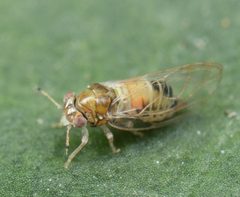
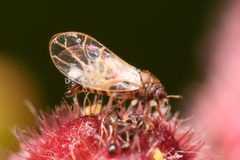
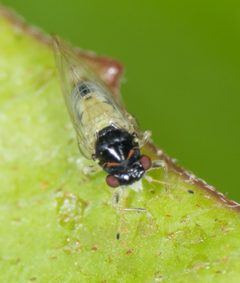
can be distinguished from other by the combination of: forewing with simple, non-branched ; absence of a pterostigma; and genal processes on the that are typically short or absent. Members of the Calophyinae are characterized by the presence of a strongly developed metatibia with an spur. The family is morphologically intermediate between Triozidae and Psyllidae, lacking the strongly developed genal cones of Triozidae and the complex wing venation patterns of Psyllidae.
Images
Habitat
occur in association with their plants, primarily woody shrubs and trees. Documented associations include species in Anacardiaceae (Schinus, Cedrela), with ranging from Mediterranean climate regions to tropical and subtropical forests. The Atlantic Forest biome in Brazil has been documented as habitat for Mastigimas anjosi on Cedrela fissilis.
Distribution
The has a disjunct global distribution. Atmetocraniinae is distributed in Australia and New Zealand. Metapsyllinae occurs in Asia. Calophyinae has representatives in South America (Chile, Brazil), with some introduced to North America (California, Florida) as agents. Native ranges of economically significant species include southern Chile and southeastern Brazil.
Seasonality
Calophya mammifex exhibits a with a period under Mediterranean climate conditions in southern Chile. Observations of Mastigimas anjosi in southeastern Brazil were conducted in May and June, indicating activity during autumn months in that region.
Diet
Phloem-feeding on plant vascular tissues. Nymphs and extract nutrients from plant phloem, with feeding activity inducing gall formation on leaves.
Host Associations
- Schinus terebinthifolia - plantPrimary for multiple Calophya ; Brazilian peppertree, in Florida
- Schinus polygama - plant for Calophya mammifex and Calophya rubra in southern Chile
- Schinus molle - plant for Calophya schini in California
- Cedrela fissilis - plant for Mastigimas anjosi in Brazil
Life Cycle
Calophya mammifex develops a with a period in Mediterranean climate conditions. Nymphs produce white flocculent waxy secretions that form a physical protective barrier on plant tissues. Gall induction occurs through feeding activity that alters morphogenetic and histochemical leaf patterns, resulting in complex structures with specialized nutritive-like tissue and common storage tissue compartments.
Behavior
Ecological Role
Primary consumers as phloem-feeding herbivores. Gall induction creates specialized microhabitats that alter leaf tissue structure and function. Serve as for including Psyllaephagus trioziphagus (Encyrtidae) and Tamarixia (Eulophidae). Some species function as agents of plants, reducing host plant through gall induction and feeding damage.
Human Relevance
Several are under investigation or have been deployed as agents for weeds, particularly Brazilian peppertree (Schinus terebinthifolia) in Florida and California. Calophya latiforceps, Calophya terebinthifolii, and Calophya schini have been evaluated for specificity and potential non-target effects. Mastigimas anjosi is a pest of commercially important timber trees (Cedrela fissilis) in Brazil, requiring -based control.
Similar Taxa
- TriozidaeSimilar body plan and jumping ability; distinguished by presence of well-developed genal cones and different wing venation patterns
- PsyllidaeSimilar and feeding ; distinguished by more complex wing venation with distinct pterostigma and different
- AphalaridaePreviously included now assigned here; distinguished by taxonomic revisions of Cecidopsyllinae and genus-level placements
More Details
Taxonomic instability
Four previously placed in have been reassigned based on recent revisions: Allophorina to Psyllidae (Platycoryphinae), Cecidopsylla to Aphalaridae (Cecidopsyllinae), and multiple genera to the restored Mastigimatidae. Some databases may not reflect these changes as of March 2026.
Biocontrol agent selection criteria
selection for biocontrol emphasizes lack of native in target regions to minimize non-target effects. The absence of native Schinus species in North America has been a key factor in approving Calophya species for introduction against Brazilian peppertree.
Gall structure complexity
Galls induced by Calophya represent complex structures with sufficient anatomical and histochemical alterations to be diagnosed as distinct from simple plant reactions. differentiation patterns differ between congeneric species on the same , indicating structural constraints imposed by host plant organs.
Sources and further reading
- BugGuide
- Wikipedia
- GBIF taxonomy match
- iNaturalist taxon
- NCBI Taxonomy
- Catalogue of Life
- Host induced polyphenism in the psylloid, Calophya californica Schwarz (Hemiptera: Calophyidae)
- Psyllaephagus trioziphagus (Hymenoptera: Encyrtidae), parasitoide de Mastigimas anjosi (Hemiptera: Calophyidae)
- Yellow Brazilian Pepper-tree Leaf Galler (suggested common name) Calophya latiforceps Burckhardt (Insecta: Hemiptera: Calophyidae: Calophyinae)
- Taxonomy ofCalophya(Hemiptera: Calophyidae) Species Associated withSchinus terebinthifolia(Anacardiaceae)
- Host specificity of gall-inducingCalophyaspp. (Hemiptera: Calophyidae): Implications for biological control of Brazilian peppertree
- Factors influencing the morphogenesis of galls induced by Calophya mammifex (Calophyidae) on Schinus polygama (Anacardiaceae) leaves
- Interaction of the jumping plant-louse Mastigimas anjosi (Hemiptera: Calophyidae) nymphs by Polybia platycephala (Hymenoptera: Vespidae) in Cedrela fissilis (Meliaceae) trees
- Host specificity of the psyllidCalophya terebinthifolii(Hemiptera: Calophyidae), a potential biological control agent against Brazilian peppertree in Florida, USA
- Two new species of Tamarixia (Hymenoptera: Eulophidae) from Chile and Australia, established as biological control agents of invasive psyllids (Hemiptera: Calophyidae, Triozidae) in California
- Biology, Host Preferences, and Potential Distribution ofCalophya terebinthifolii(Hemiptera: Calophyidae), a Candidate for Biological Control of Brazilian Peppertree,Schinus terebinthifolia, in Florida
- Native range density, host utilisation and life history ofCalophya latiforceps(Hemiptera: Calophyidae): an herbivore of Brazilian Peppertree (Schinus terebinthifolia)
- Calophya latiforceps, a New Species of Jumping Plant Lice (Hemiptera: Calophyidae) Associated withSchinus terebinthifolius(Anacardiaceae) in Brazil