
Calophya
Löw, 1879
jumping plant lice
Species Guides
7- Calophya californica(lemonade berry psyllid)
- Calophya flavida
- Calophya minuta
- Calophya nigripennis
- Calophya oweni
- Calophya schini(Peppertree Psyllid)
- Calophya triozomima
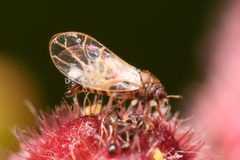
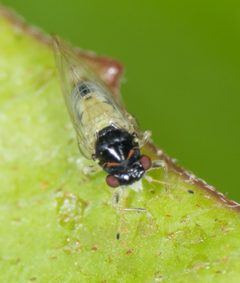
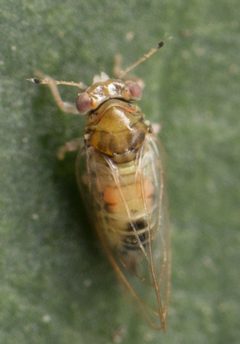
Calophya is the type of the Calophyidae, containing at least 69 described . Members are gall-forming psyllids that feed on phloem and induce galls on plants, primarily in the family Anacardiaceae. Several species have been investigated as agents for plants, particularly Brazilian peppertree (Schinus terebinthifolia). The genus shows high host specificity, with most species completing development only on specific host plants.
Pronunciation
How to pronounce Calophya: //kəˈloʊfiə//
These audio files are automatically generated. While they are not always 100% accurate, they are a good starting point.
Identification
Calophya are distinguished from other by their placement in the Calophyidae. Species-level identification requires examination of morphological characters, particularly of the genitalia and wing venation. Gall on plants can provide diagnostic clues for some species.
Images
Habitat
Associated with plants in the Anacardiaceae, particularly Schinus . Native ranges include Brazil and southern Chile, with some species evaluated for introduction to Florida, USA for purposes.
Distribution
Native distribution includes South America, with records from Brazil and Chile. Some have been evaluated for introduction to North America (Florida, USA) as agents.
Seasonality
Some exhibit with periods in Mediterranean climate zones; seasonal activity is synchronized with plant .
Diet
Phloem-feeding; induces galls on plant tissues.
Host Associations
- Schinus terebinthifolia - primary Brazilian peppertree; supports complete development for multiple Calophya including C. lutea, C. terebinthifolii, and C. latiforceps
- Schinus polygama - for C. rubra and C. mammifex in southern Chile
Life Cycle
to development occurs within galls on plants. Some exhibit with periods in response to seasonal conditions.
Behavior
Induces galls on plant leaves or stems through feeding activity. High host specificity with oviposition and development largely restricted to specific host plants.
Ecological Role
Gall formation damages plant tissues. Several have been evaluated as agents for Brazilian peppertree in Florida.
Human Relevance
Investigated as agents for Brazilian peppertree (Schinus terebinthifolia) in Florida. specificity testing has been conducted to assess safety for non-target release.
Similar Taxa
- Other Psylloidea generaCalophya is distinguished by gall-forming and -level characters of Calophyidae; most other psyllids do not induce galls
More Details
Biological control evaluation
Multiple Calophya (C. lutea, C. terebinthifolii, C. latiforceps) have undergone extensive specificity testing for potential release in Florida. Testing on 97 plant species demonstrated that C. lutea oviposited on nine species and C. terebinthifolii on five species, but complete development with occurred only on Brazilian peppertree.
Gall structure
Galls induced by Calophya exhibit complex anatomical and histochemical alterations, including specialized nutritive-like tissue and storage tissue compartments. Gall varies between species and is influenced by plant organ structure.
Sources and further reading
- BugGuide
- Wikipedia
- GBIF taxonomy match
- iNaturalist taxon
- NCBI Taxonomy
- Catalogue of Life
- Host specificity and non-target longevity of Calophya lutea and Calophya terebinthifolii, two potential biological control agents of Brazilian peppertree in Florida, USA
- Host induced polyphenism in the psylloid, Calophya californica Schwarz (Hemiptera: Calophyidae)
- The Life History and Early Stages of Calophya Nigripennis Riley
- Taxonomy ofCalophya(Hemiptera: Calophyidae) Species Associated withSchinus terebinthifolia(Anacardiaceae)
- Yellow Brazilian Pepper-tree Leaf Galler (suggested common name) Calophya latiforceps Burckhardt (Insecta: Hemiptera: Calophyidae: Calophyinae)
- Host specificity of gall-inducingCalophyaspp. (Hemiptera: Calophyidae): Implications for biological control of Brazilian peppertree
- Host specificity of the psyllidCalophya terebinthifolii(Hemiptera: Calophyidae), a potential biological control agent against Brazilian peppertree in Florida, USA
- Biology, Host Preferences, and Potential Distribution ofCalophya terebinthifolii(Hemiptera: Calophyidae), a Candidate for Biological Control of Brazilian Peppertree,Schinus terebinthifolia, in Florida
- Factors influencing the morphogenesis of galls induced by Calophya mammifex (Calophyidae) on Schinus polygama (Anacardiaceae) leaves
- Native range density, host utilisation and life history ofCalophya latiforceps(Hemiptera: Calophyidae): an herbivore of Brazilian Peppertree (Schinus terebinthifolia)
- Calophya latiforceps, a New Species of Jumping Plant Lice (Hemiptera: Calophyidae) Associated withSchinus terebinthifolius(Anacardiaceae) in Brazil
- Anatomical and phenological implications of the relationship between Schinus polygama (Cav.) (Cabrera) and the galling insect Calophya rubra (Blanchard)