
Calophya schini
Tuthill, 1959
Peppertree Psyllid
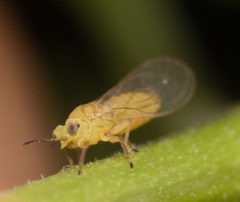
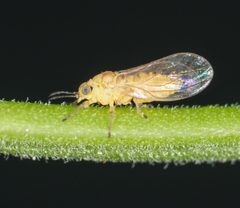
Calophya schini is a small in the Calophyidae, specialized on Schinus molle (Peruvian peppertree). are approximately 2 mm in length with orange to pale yellow or green coloration and hyaline wings. The is to Central America but has been introduced widely through human of its plant, now occurring in the United States, New Zealand, and other regions. Nymphs cause distinctive dimples on leaves and can produce severe leaf malformations when abundant.
Pronunciation
How to pronounce Calophya schini: /kæˈloʊfiə ˈskiːnaɪ/
These audio files are automatically generated. While they are not always 100% accurate, they are a good starting point.
Identification
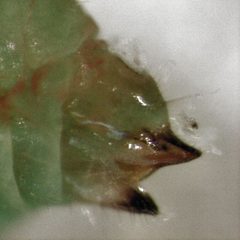
Distinguished from other psyllids by its small size (2 mm), orange to pale yellow or green coloration, and association with Schinus molle. The hyaline wings and folded-wing resting posture are characteristic. Nymphal damage (leaf dimpling) can serve as an indirect indicator of presence. Specific identification may require examination of genitalia or other microscopic features typical of the Calophya.
Images
Habitat
Strictly associated with Schinus molle (Peruvian peppertree), a widely cultivated ornamental tree. Occurs in urban and suburban environments, gardens, and wherever the plant has been introduced. The host plant's distribution determines the 's range expansion.
Distribution
to Central America. Introduced and established in the United States, New Zealand, and other regions where Schinus molle has been distributed as a garden ornamental. GBIF records indicate presence in Argentina, Bolivia, Chile, and additional South American localities.
Diet
Specialized feeder on Schinus molle. and nymphs feed on phloem sap of the plant.
Host Associations
- Schinus molle - obligatePeruvian peppertree; sole known plant. Nymphs cause leaf dimpling and malformations.
Behavior
Nymphs feed gregariously on leaves, producing characteristic dimpled damage. are likely active fliers given the ' of new plant . or activity patterns not documented in available sources.
Ecological Role
Herbivore on Schinus molle. Nymphal feeding can cause significant leaf damage and malformation, potentially affecting plant . May serve as prey for insect and , though specific relationships are undocumented.
Human Relevance
Considered a pest of ornamental Schinus molle due to nymphal damage causing leaf dimpling and malformations. The has been inadvertently distributed worldwide through human of its plant. No documented economic importance beyond ornamental pest status.
Similar Taxa
- Other Calophya speciesSame , likely similar ; distinguished by plant association and geographic range. C. schini is specifically tied to Schinus molle.
- Other psyllids on SchinusPsyllids in Psyllidae or Triozidae may occur on related Anacardiaceae; distinguished by wing venation, body shape, and nymphal .
Sources and further reading
- BugGuide
- Wikipedia
- GBIF taxonomy match
- iNaturalist taxon
- NCBI Taxonomy
- Catalogue of Life
- Bug Eric: Wasp Wednesday: Not Wasp VIII
- Catch a Glimpse of Caterpillars During National Moth Week
- Bug Eric: White Prairie Clover: An Awesome Blossom
- Bug Eric: Remembering National Moth Week 2018
- Bug Eric: October 2018
- 2013 Oklahoma Collecting Trip iReport | Beetles In The Bush