
Tamarixia
Mercet, 1924
Species Guides
1- Tamarixia radiata(Asian citrus psyllid parasitoid)
Tamarixia is a of small in the Eulophidae, primarily known as parasitoids of psyllids (jumping plant lice, superfamily Psylloidea). The genus was established by Mercet in 1924 and contains approximately 50 described distributed worldwide. Most species are ectoparasitoids, though at least one species has been recorded as an endoparasitoid. Several species, particularly T. radiata and T. triozae, are important agents used in programs for citrus and solanaceous crops.
Pronunciation
How to pronounce Tamarixia: /tæməˈrɪksiə/
These audio files are automatically generated. While they are not always 100% accurate, they are a good starting point.
Identification
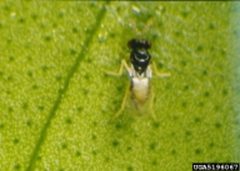
Tamarixia are small chalcidoid wasps typically measuring 1-2 mm in body length. They can be distinguished from other eulophid by their association with and specific wing venation patterns. Species-level identification requires examination of morphological characters including segmentation, body coloration, and genitalic structures. T. radiata, the most extensively studied species, has a distinctive dark body with yellow legs and antennae.
Images
Habitat
Tamarixia are found in agricultural and natural environments where their occur. Specific include citrus orchards (T. radiata), tomato and potato fields (T. triozae), and areas with host plants of various psyllid species. Rearing conditions for programs typically use potted host plants maintained at 25±2°C with 70±10% relative humidity and 14L:10D .
Distribution
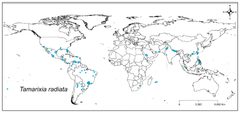
The has a distribution with recorded from North America, South America, Europe, Asia, Africa, and Oceania. T. radiata is native to India and Pakistan and has been introduced to California, Brazil, and Reunion Island for . T. triozae is native to North America. T. poddubnyi has been recorded from Iran, representing an extension to the Middle East.
Diet
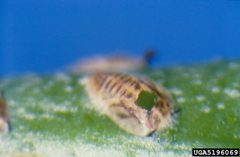
Tamarixia feed on honeydew and obtained through host-feeding . stages develop as on nymphs. T. radiata develops preferably on 3rd to 5th instar nymphs of Diaphorina citri, with adults also feeding on and younger nymphs. T. triozae parasitizes nymphs of Bactericera cockerelli on tomato and other solanaceous crops.
Host Associations
- Diaphorina citri - Asian citrus psyllid, primary of T. radiata
- Bactericera cockerelli - tomato/potato psyllid, of T. triozae
- Trioza eugeniae - of T. dahlsteni
- Trioza neglecta - of T. poddubnyi on Elaeagnus angustifolia
- Bactericera tremblayi - of T. monesus and T. tremblayi
- Murraya paniculata - associated plantorange jasmine, used for rearing D. citri in programs
- Citrus sinensis - associated plantsweet orange, plant in
- Solanum lycopersicum - associated planttomato, plant for B. cockerelli and T. triozae
- Capsicum annuum - associated plantchili pepper, alternative plant for T. triozae studies
Life Cycle
Tamarixia have short times typical of small . T. radiata completes development from to in approximately 9 days under optimal conditions (25°C). Females lay eggs under or on nymphs; larvae develop as ectoparasitoids (most species) or endoparasitoids (at least one species). occurs on or near the . T. radiata is an idiobiont parasitoid, killing the host during development. T. triozae is synovigenic, continuing to produce eggs throughout adult life.
Behavior
Female Tamarixia exhibit -feeding in addition to , consuming host to obtain nutrients for production. A single T. radiata female can eliminate up to 500 nymphs through combined feeding and parasitism over her lifetime. Host deprivation followed by feeding on honey or water can enhance for releases. are susceptible to many used in citrus production, with varying by life stage—adults are most susceptible, pupae most tolerant.
Ecological Role
Tamarixia serve as important agents of pests, particularly those vectoring plant . T. radiata is the primary natural enemy used against Diaphorina citri, of Huanglongbing (), and has achieved rates up to 70% in release areas. The contributes to natural suppression of psyllid in both native and introduced ranges, forming a key component of in citrus and solanaceous cropping systems.
Human Relevance
Several Tamarixia are commercially mass-reared and released for . T. radiata has been released in California since 2011, with over 200,000 released at more than 400 sites by 2014; it is also used in Brazil with six bio-factories producing for release. T. triozae has been imported to New Zealand for potential of Bactericera cockerelli. The has been subject to extensive specificity testing to evaluate environmental safety prior to release. Research focuses on optimizing rearing methods, diet for maintenance, and integration with chemical control.
Similar Taxa
- Diaphorencyrtus aligarhensisAnother of Diaphorina citri in the Encyrtidae; distinguished by different family placement and endoparasitic development
- PsyllaephagusEncyrtid of psyllids; distinguished by -level differences and typically endoparasitic lifestyle
- CirrospilusEulophid that may attack similar ; distinguished by different host associations and morphological characters
More Details
Biological Control Safety
range testing of T. radiata sourced from Pakistan demonstrated high specificity to Diaphorina citri, with minimal risk to non-target . Only Bactericera cockerelli (potato psyllid) showed any at levels below 5%, supporting regulatory approval for release in California.
Insecticide Susceptibility
T. radiata is susceptible to many used in citrus production, including , , and neonicotinoids. The pupal stage shows greatest , while are most vulnerable. Selective insecticide use is recommended to preserve in integrated management programs.
Augmentative Release Strategies
Research on T. triozae indicates that pre-release diet affects efficacy. fed water for one day before release show rapid increase suitable for high pest densities, while honey-fed adults are better for shipment and establishment when pest densities are low.
Sources and further reading
- BugGuide
- Wikipedia
- GBIF taxonomy match
- iNaturalist taxon
- NCBI Taxonomy
- Catalogue of Life
- Publications | Entomology Research Museum
- tamarixia_radiata-feature - Entomology Today
- Tamarixia radiata Archives - Entomology Today
- Wasps Used to Combat Citrus Greening Disease are Unlikely to Threaten Non-target Insects
- Biological Control in Brazil is Used on an Area that is Larger than Belgium
- Quiz Yourself: 2020 Entomology Games Questions
- Tamarixia species (Hymenoptera: Eulophidae), parasitoid of Triozinae (Hemiptera: Triozidae) in Iran with new evidence of Tamarixia poddubnyi (Kostjukov, 1978)
- Life parameters of the synovivenic parasitoid Tamarixia triozea (Hymenoptera. Eulophidae)
- Lethal and Sublethal Effects of Insecticides Used on Citrus, on the Ectoparasitoid Tamarixia radiata
- First record of Tamarixia dahlsteni Zuparko (Hymenoptera, Eulophidae), a parasitoid of Trioza eugeniae Froggatt (Hemiptera, Triozidae) and current status of Tamarixia species in Mexico
- Diets for Tamarixia triozae adults before releasing in augmentative biological control
- Effects of Ladybeetle, Harmonia axyridis, Foraging Trails on Behavior of Tamarixia radiata
- Seletividade de inseticidas recomendados para a produção integrada de citros sobre o parasitoide Tamarixia radiata (Waterston, 1922) (Hymenoptera: Eulophidae)
- Reduced Parasitism of Diaphorina citri (Hemiptera: Liviidae) by Tamarixia Radiata (Hymenoptera: Eulophidae) at Increasing Parasitoid:Host Ratios
- Toxicity of Organosilicone Adjuvants and Selected Pesticides to the Asian Citrus Psyllid (Hemiptera: Psyllidae) and Its Parasitoid Tamarixia radiata (Hymenoptera: Eulophidae)
- Life history and behavior of Tamarixia triozae parasitizing the tomato-potato psyllid, Bactericera cockerelli
- Toxicity of pesticides to Tamarixia radiata, a parasitoid of the Asian citrus psyllid
- Rapid Communication. Tamarixia monesus (Walker) (Hym.: Eulophidae) parasitoid of Bactericera tremblayi (Wagner, 1961) (Hemiptera: Triozidae) in Iran
- Importing <i>Tamarixia triozae</i> into containment in New Zealand
- an Asian citrus psyllid parasitoid Tamarixia radiata (Waterston) (Insecta: Hymenoptera: Eulophidae)
- Otimização da criação de Diaphorina citri Kuwayama, 1908 (Hemiptera: Liviidae) e de Tamarixia radiata (Waterston, 1922) (Hymenoptera: Eulophidae), visando a produção em larga escala do parasitoide e avaliação do seu estab