
Bactericera cockerelli
(Šulc, 1909)
potato psyllid, tomato psyllid, tomato/potato psyllid
Bactericera cockerelli, commonly known as the potato or tomato psyllid, is a phloem-feeding insect native to southern North America. It is a major agricultural pest of solanaceous crops, particularly potatoes and tomatoes, causing direct feeding damage and transmitting the bacterium Candidatus Liberibacter solanacearum, which causes zebra chip in potatoes and psyllid yellows in other . The has expanded its range northward and has been introduced to New Zealand, where it causes significant economic damage to protected and outdoor crops.
Pronunciation
How to pronounce Bactericera cockerelli: //bækˌtɛrɪˈsɪərə kɒkˈɜrɪlaɪ//
These audio files are automatically generated. While they are not always 100% accurate, they are a good starting point.
Identification
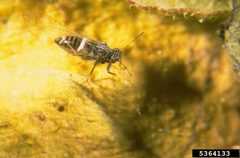
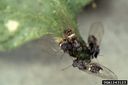
Distinguished from other psyllids by the combination of small size (2 mm), black body with white abdominal markings, and association with solanaceous plants. The clear, rooflike wing posture and jumping are characteristic of psyllids generally. Specific identification may require examination of genitalia or molecular methods. In the Pacific Northwest, monitoring of matrimony vine (Lycium spp.) can serve as an early warning system for potato field .
Images
Habitat
Agricultural fields and non-agricultural areas supporting solanaceous plants. In crop systems, found in potato, tomato, pepper, eggplant, and tobacco fields. Non-crop include wild solanaceous plants such as silverleaf nightshade (Solanum elaeagnifolium) and matrimony vine (Lycium spp.), which serve as and alternative hosts when cultivated crops are unavailable. The requires leaf shade to survive high summer temperatures.
Distribution
Native to southern North America, with range extending from Central America north to the American Pacific Northwest and parts of Manitoba, Canada. Restricted to western North America in its native range. Introduced to New Zealand, where established cause extensive damage. EPPO A1 listed pest for the EPPO region. Potential for establishment in Southern and Central Europe and mild winter areas of Northern Europe based on climate modeling.
Seasonality
Activity patterns vary regionally. In the Pacific Northwest, psyllids colonize matrimony vine in spring, then migrate to potato fields as summer defoliation of vines occurs. Multiple per year in favorable climates. Not heat tolerant; summer survival depends on adequate leaf for shade. occurs on alternative when crop hosts are unavailable.
Diet
Phloem-feeding on Solanaceae. Feeds on sap from phloem tissue of plants. Host range encompasses over 40 of solanaceous plants across 20 , including potato (Solanum tuberosum), tomato (Solanum lycopersicum), pepper (Capsicum annuum), eggplant (Solanum melongena), tobacco (Nicotiana tabacum), tamarillo (Solanum betaceum), silverleaf nightshade (Solanum elaeagnifolium), and matrimony vine (Lycium spp.). Limited breeding hosts recorded on Convolvulaceae including bindweed and sweet potato.
Host Associations
- Solanum tuberosum - primary Potato; major crop causing zebra chip transmission
- Solanum lycopersicum - primary Tomato; equally preferred for settling and oviposition with potato
- Capsicum annuum - Pepper; settled upon but less preferred for oviposition
- Solanum melongena - Eggplant; settled upon but less preferred
- Nicotiana tabacum - Tobacco
- Solanum betaceum - Tamarillo
- Solanum elaeagnifolium - Silverleaf nightshade; common weed in Lower Rio Grande Valley, for Liberibacter
- Lycium spp. - Matrimony vine/Goji berry; and source of spring in Pacific Northwest
- Ipomoea spp. - breeding Bindweed; Convolvulaceae
- Ipomoea batatas - breeding Sweet potato; Convolvulaceae
Life Cycle
with , nymph, and stages. Eggs are laid on leaf undersides, particularly along margins and in upper . Nymphs feed on phloem on leaf undersides. Multiple per year under favorable conditions. occurs as adults on alternative . In Pacific Northwest, spring develop on matrimony vine before migrating to potato fields.
Behavior
Strong jumping response when disturbed. and nymphs feed in phloem tissue. Demonstrates settling and oviposition preferences, with strongest preference for potato and tomato. Uses non- plant 'whistle stops' for water and nutrients during landscape movement when preferred hosts unavailable. Gut content analysis reveals extensive movement between agricultural and non-agricultural . Nymph feeding on potato causes yellows condition, presumed toxin-mediated.
Ecological Role
Agricultural pest and . Primary vector of Candidatus Liberibacter solanacearum, causing zebra chip disease in potatoes and associated diseases in other solanaceous crops. Serves as prey for natural enemies including (Tamarixia triozae) and . Alternative and non-crop maintain between crop seasons and contribute to persistence.
Human Relevance
Major economic pest causing significant yield losses in potato, tomato, and other solanaceous crops. Direct feeding damage includes yellows; indirect damage through transmission of Liberibacter bacteria causing zebra chip , rendering potatoes unmarketable for processing. Estimated losses of $22.5 million in New Zealand (2010-2011) and up to 60% crop loss in northern Mexico. Subject to regulations in EPPO region. Management relies on , with research ongoing into cultivars, , and cultural practices including monitoring of alternative .
Similar Taxa
- Diaphorina citriAsian citrus psyllid; similar size and but associated with citrus (Rutaceae) rather than Solanaceae, and of different Liberibacter
- Cacopsylla pyricolaPear ; similar as phloem-feeding pest of rosaceous crops, distinguished by association and geographic distribution
More Details
Molecular gut content analysis
sequencing of gut contents enables identification of previously fed-upon plants, revealing landscape-level movement patterns between crop and non-crop . This technique demonstrated that B. cockerelli uses diverse non-host plants as 'whistle stops' during movement, with matrimony vine serving as a key in the Pacific Northwest.
Biological control
The Tamarixia triozae has established in New Zealand achieving up to 40% rates, preferring fourth and fifth instar nymphs. Requires sources such as nectar for optimal . Sensitivity to may limit effectiveness in integrated management programs.
Pathogen association
Transmits Candidatus Liberibacter solanacearum haplotypes A and B (non-European, -regulated) causing zebra chip , and associated with haplotypes C, D, E in some regions. Both nymphs and are competent . acquisition can occur within 2-week feeding periods on infected alternative .
Climate change projections
CLIMEX modeling indicates potential range expansion in semi-arid, temperate, and continental climates within native range. Future climate scenarios (2090) suggest significant range reduction with possible altitudinal expansion, though most European and New Zealand regions predicted to remain suitable or become more favorable.
Sources and further reading
- BugGuide
- Wikipedia
- GBIF taxonomy match
- iNaturalist taxon
- NCBI Taxonomy
- Catalogue of Life
- UC Davis Researcher Targeting Zebra Chip: It's Not a Chip You Want | Bug Squad
- Bembicid Holdings | Entomology Research Museum
- Encyrtid Holdings | Entomology Research Museum
- Publications | Entomology Research Museum
- Psyllid Movements Revealed Via Gut Content Analysis
- Wasps Used to Combat Citrus Greening Disease are Unlikely to Threaten Non-target Insects
- Bactericera cockerelli . [Distribution map].
- Bactericera cockerelli (tomato/potato psyllid).
- The potato psyllid, Bactericera cockerelli (Å ulc)
- Bactericera cockerelli Picorna-like Virus and Three New Viruses Found Circulating in Populations of Potato/Tomato Psyllids (Bactericera cockerelli)
- El Análisis de Resistencia a Bactericera cockerelli en Germoplasma de Papa: un enfoque sostenible Analysis of Resistance to Bactericera cockerelli in Potato Germplasm: A Sustainable Approach
- Vibrational communication and evidence for vibrational behavioural manipulation of the tomato potato psyllid, Bactericera cockerelli
- Modelización espacial de ninfas de Bactericera cockerelli Sulc. en tomate de cáscara (Physalis ixocarpa Brot.) por medio de técnicas geoestadísticas//Spatial modeling of Bactericera cockerelli Sulc. nymphs on husk tomato (Physalis ixocarpa Brot.) using of geostatistical techniques
- Table 2: Sequencing analysis of V3 region of 16S rRNA gene and alpha diversity indices calculated for microbial communities associated with Bactericera cockerelli .
- Electrophysiological and behavioral responses of tomato-potato psyllid,Bactericera cockerelli, to olfactory and visual stimuli
- The current and future potential geographical distribution of Bactericera cockerelli: an invasive pest of increasing global importance
- Effect of antibiosis, antixenosis and natural variation of trichomes of wild and commercial tomato species on the development of Bactericera cockerelli
- PM 9/25 (2) Bactericera cockerelli and ‘Candidatus Liberibacter solanacearum’
- PM 9/25 (1) Bactericera cockerelli and ‘Candidatus Liberibacter solanacearum’
- Lasting consequences of psyllid (Bactericera cockerelli L.) infestation on tomato plant gene expression