
Cacopsylla pyricola
(Foerster, 1848)
pear sucker, pear psylla
is a phloem-feeding true in the Psyllidae and a major economic pest of pear trees (Pyrus communis). Native to Europe, it was introduced to the eastern United States in the early 1800s and has since spread to major pear-growing regions including the Pacific Northwest. The exhibits distinct seasonal : summerforms are pale while winterforms are reddish-brown to black. It is a of 'Candidatus Phytoplasma pyri', the causative agent of .
Pronunciation
How to pronounce Cacopsylla pyricola: //ˌkækəˈsɪlə/ /ˌpaɪˈrɪkələ//
These audio files are automatically generated. While they are not always 100% accurate, they are a good starting point.
Identification
Distinguished from other psyllids by association with pear (Pyrus) as , presence of knobbed bristles on nymphal wing buds, and seasonal morphotypic variation. The combination of red-eyed nymphs with wing bud bristles and roof-like wing posture separates it from aphids and other Sternorrhyncha. Molecular identification via can confirm when morphological characters are ambiguous.
Images
Habitat
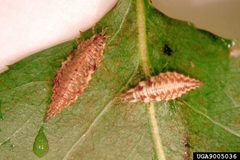
Found in pear orchards and areas with pear trees (Pyrus communis) and quince (Cydonia oblonga). seek shelter on bark or twigs of pear trees, or on adjacent trees and shrubs near orchards. Nymphs occur on undersides of leaves and on buds and shoots of plants.
Distribution
Native to Europe (Austria, Belgium, Bulgaria, Czech Republic, Denmark, France, Germany, Hungary, Italy, Moldova, Netherlands, Norway, Poland, Romania, Russia, Serbia, Spain, Sweden, Switzerland, UK). Introduced to North America: eastern United States (early 1800s), spread to Pacific Northwest by early 1900s. Present in Canada (British Columbia, Nova Scotia, Ontario). Also reported in Asia (China, Georgia, Iran, Israel, Japan, Korea, Lebanon, Syria) and North Africa (Algeria, Morocco, Tunisia).
Seasonality
Multiple per year (up to six in favorable conditions). emerge from in late winter to early spring. laying begins on twigs and expanding shoots, shifting to leaf later in season. Nymphs develop through five instars in weeks. Fall period of winterforms occurs September-November as they seek overwintering sites.
Diet
Phloem sap of pear (Pyrus communis) and quince (Cydonia oblonga). Nymphs feed on buds, flowers, and leaf phloem; feed on phloem of shoots and leaves. Feeding characterized by activities, sustained phloem ingestion, and occasional xylem ingestion as revealed by electrical penetration graph studies.
Host Associations
- Pyrus communis - primary European pear; essential for and development
- Cydonia oblonga - secondary Quince; supports survival but less optimal for
Life Cycle
Hemimetabolous development with five nymphal instars. hatch in 0.3-0.4 days under laboratory conditions (32°C). Total nymphal period approximately 0.7 days under optimal laboratory conditions, though field development is longer and temperature-dependent. have pre-oviposition period of ~0.3 days and oviposition period of ~1.3 days. : 400-650 eggs per female. Adult longevity: males ~62 days, females ~61 days under laboratory conditions. Up to six per year in favorable climates.
Behavior
Nymphs are largely , feeding in place on tissue. are capable of ; winterforms exhibit increased flight activity September-November consistent with to sites. Males are attracted to volatile odors from female-infested or previously infested pear shoots, suggesting for mating. Overwintering adults enter reproductive . Nymphs produce copious honeydew, attracting ants, flies, and bees. Gut content analysis reveals movement between crop and non-crop hosts including hops (Humulus lupulus) in Washington State.
Ecological Role
Herbivore and of plant . Transmits 'Candidatus Phytoplasma pyri', causing disease. Honeydew production supports growth and attracts other insects, potentially altering local composition. Serves as prey for in orchard .
Human Relevance
Major economic pest of pear production in North America and Europe. Feeding damage causes direct yield loss; honeydew production reduces fruit quality and supports ; phytoplasma transmission causes tree decline and death. Management relies on combining monitoring, , and selective . Research subject for development of pear cultivars and alternative management strategies including vibrational disruption.
Similar Taxa
- Cacopsylla bidensAlso associated with pear; distinguished by morphological details of genitalia and wing venation requiring microscopic examination
- Cacopsylla pyrisugaEuropean pear ; overlapping range and distribution; separation requires examination of paramere structure and other genitalic characters
- Psylla pyriFormerly confused with C. pyricola; now recognized as distinct with different preferences and morphological features
More Details
Endosymbiont Associations
Maintains obligate relationships with dual endosymymbionts: 'Candidatus Carsonella ruddii' and 'Candidatus Psyllophila symbiotica'. Carsonella densities remain high during vegetative periods but drop during reproductive ; Psyllophila titers are consistently higher and fluctuate seasonally, possibly related to age.
Resistant Host Cultivars
Certain pear exhibit feeding antixenosis and . 'Bacui-1' and 'Bacui-2' are highly ; 'Karamanlika' and NY10352 are moderately resistant. Resistance mechanisms include reduced feeding stimulation and direct to nymphs.
Movement Ecology
gut content analysis reveals that utilize non-crop 'whistle stop' plants during landscape movement, including hops (Humulus lupulus) in Washington State, with documented travel distances of several kilometers between .
Sources and further reading
- BugGuide
- Wikipedia
- GBIF taxonomy match
- iNaturalist taxon
- NCBI Taxonomy
- Catalogue of Life
- Psyllid Movements Revealed Via Gut Content Analysis
- Cacopsylla pyricola Archives - Entomology Today
- Field Entomologist to Industry Rep: One Entomologist's Unique Journey to Working With Growers
- How One Entomologist Puts Communication and Policy Training Into Action in Pesticide Safety Education
- Boxwood blues II - Boxwood psyllid, Cacopsylla buxi — Bug of the Week
- Bug Eric: Thankful For Small Wonders
- Cacopsylla pyricola . [Distribution map].
- Investigations on Biology and Life Cycle of Pear Psylla, Cacopsylla pyricola Foerster
- Feeding behaviors of Cacopsylla pyricola (Hemiptera: Psyllidae) using electrical penetration graphs (EPGs)
- Changed in Feeding Behavior of Cacopsylla pyricola Foerster(Hemiptera: Psyllidae) and Activities of Several Insecticides
- Effect of Resistant and Susceptible East European Pears on Development and Mortality of the Pear Psylla, Cacopsylla pyricola (Förster)
- Laboratory Study of Mating Behavior as Related to Diapause in Overwintering Cacopsylla pyricola (Homoptera: Psyllidae)
- Seasonal wild dance of dual endosymbionts in the pear psyllid Cacopsylla pyricola (Hemiptera: Psylloidea): Endosymbiont titers tell two different stories
- Tethered flight activity of pear psylla, Cacopsylla pyricola: seasonal, host, and morphotypic effects
- Attraction of male pear psylla, Cacopsylla pyricola, to female‐infested pear shoots
- “CandidatusPhytoplasma pyri” Affects Behavior ofCacopsylla pyricola(Hemiptera: Psyllidae)1