
Bactericera
Puton, 1876
psyllid bugs, jumping plant lice
Species Guides
12- Bactericera antennata(Rudbeckia Triozid)
- Bactericera arbolensis
- Bactericera athenae
- Bactericera californica(California psyllid)
- Bactericera cockerelli(potato psyllid)
- Bactericera dorsalis
- Bactericera lavaterae(Island Mallow Psyllid)
- Bactericera lobata
- Bactericera maculipennis(psyllid)
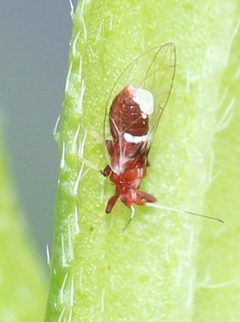
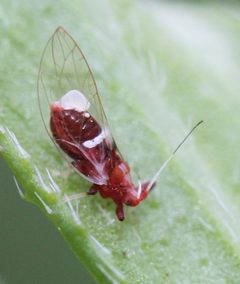
Bactericera is a of ( Triozidae) established by Auguste Puton in 1876. The genus is predominantly distributed in the Palaearctic and Nearctic regions, with 24 recognized in North America north of Mexico. Members are small phloem-feeding insects commonly known as "jumping plant lice." The genus includes economically significant agricultural pests, most notably Bactericera cockerelli (potato/tomato psyllid), which transmits the bacterial 'Candidatus Liberibacter solanacearum' causing zebra chip in potatoes.
Pronunciation
How to pronounce Bactericera: /bækˈtɛrɪˌsɛrə/
These audio files are automatically generated. While they are not always 100% accurate, they are a good starting point.
Images
Distribution
Primarily Palaearctic and Nearctic regions. In North America, 24 are recorded north of Mexico, with documented occurrences in Montana, Wyoming, Colorado, and other western states. The has been introduced to New Zealand.
Human Relevance
The contains significant agricultural pests. Bactericera cockerelli causes major economic damage to potato, tomato, pepper, eggplant, and tobacco crops through feeding damage and transmission of 'Candidatus Liberibacter solanacearum', which causes zebra chip in potatoes. This disease can result in complete crop loss in affected fields and has caused $22.5 million in losses in New Zealand. B. cockerelli is listed as a pest in the EPPO region and has been detected in southern California, where it now occurs annually and has become a chronic problem.
Similar Taxa
- CacopsyllaBoth are in the superfamily Psylloidea, but Cacopsylla belongs to Psyllidae rather than Triozidae. Cacopsylla such as C. pyricola (pear psylla) are also significant agricultural pests that transmit plant , making them ecologically similar to Bactericera cockerelli.
- DiaphorinaDiaphorina citri (Asian citrus psyllid) shares similar pest status and -vectoring with B. cockerelli, but belongs to Liviidae. Both are agricultural pests monitored using similar techniques including gut content analysis to track landscape movements.
Sources and further reading
- BugGuide
- Wikipedia
- iNaturalist taxon
- NCBI Taxonomy
- Catalogue of Life
- UC Davis Researcher Targeting Zebra Chip: It's Not a Chip You Want | Bug Squad
- Looking for Lygus | Bug Squad
- Bactericera cockerelli Archives - Entomology Today
- Bug Eric: It's Always Something....
- Psyllid Movements Revealed Via Gut Content Analysis
- Wasps Used to Combat Citrus Greening Disease are Unlikely to Threaten Non-target Insects
- Bactericera cockerelli . [Distribution map].
- Bactericera cockerelli (tomato/potato psyllid).
- Bactericera cockerelli Picorna-like Virus and Three New Viruses Found Circulating in Populations of Potato/Tomato Psyllids (Bactericera cockerelli)
- The potato psyllid, Bactericera cockerelli (Å ulc)
- Table 2: Number and distribution of antennal sensilla in female and male Bactericera gobica .
- El Análisis de Resistencia a Bactericera cockerelli en Germoplasma de Papa: un enfoque sostenible Analysis of Resistance to Bactericera cockerelli in Potato Germplasm: A Sustainable Approach