
Blastopsylla occidentalis
Taylor, 1985
Eucalyptus Shoot Psyllid
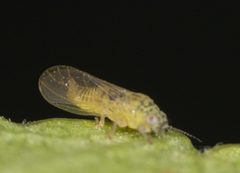
Blastopsylla occidentalis is a native to Australia that has been introduced to multiple continents, becoming a significant pest of Eucalyptus in forestry plantations worldwide. The species forms colonies on shoot tips where and nymphs feed on phloem sap, causing shoot distortion, reduced growth, apical tip death, and general plant weakening. Under field conditions in tropical and subtropical regions, it exhibits polyvoltine with all life stages present year-round. densities fluctuate seasonally, with peaks during dry periods and declines during heavy rainfall.

Pronunciation
How to pronounce Blastopsylla occidentalis: /ˌblæstoʊˈsɪlə ˌɒksɪˈdɛntəlɪs/
These audio files are automatically generated. While they are not always 100% accurate, they are a good starting point.
Images
Habitat
Eucalyptus plantations and natural Eucalyptus forests; colonies concentrate specifically on tips (shoots, buds, and young terminal growth) of plants. Documented in plantations of Eucalyptus urophylla × E. camaldulensis hybrids, E. globulus, E. pellita, and E. viminalis.
Distribution
Native to Australia (New South Wales, Queensland, South Australia, Western Australia). Introduced and established across multiple continents: Africa (Cameroon, Egypt, Kenya, South Africa), Asia (China, Indonesia, Israel, Philippines, Turkey, Yemen), Europe (Italy, Portugal, Spain), North America (Mexico, USA: California, Florida, Hawaii), South America (Argentina, Brazil, Chile, Uruguay), and Oceania (New Zealand). In Brazil, recorded in states including Bahia, Ceará, Espírito Santo, Goiás, Mato Grosso, Minas Gerais, Pará, Paraná, Piauí, Rio Grande do Sul, and São Paulo.
Seasonality
Active year-round in tropical and subtropical regions; peaks during dry season (May–September in Sinop, Mato Grosso, Brazil), with population declines during periods of high rainfall (December–January). No significant correlation with temperature observed in field studies.
Diet
Phloem sap of Eucalyptus ; feeding occurs on buds, bracts, young leaves, and twigs of plants.
Host Associations
- Eucalyptus urophylla × E. camaldulensis - primary hybrid plantation in Brazil
- Eucalyptus globulus - documented in Cameroon
- Eucalyptus pellita - new record from Indonesia, 2023
- Eucalyptus viminalis - first recorded
- Eucalyptus spp. - general
Life Cycle
to egg averages 32 days under field conditions in Cameroon. Eggs laid on buds, bracts, young leaves, and twigs. Embryonic and larval development followed by ; males emerge before females. Under tropical conditions (Sinop, Brazil), all life stages (eggs, immatures, adults) present simultaneously year-round, indicating continuous polyvoltine .
Behavior
and immatures form colonies concentrated on shoot tips. Females select specific sites for -laying on young plant tissue. Mating process lasts approximately 42 minutes. Adults exhibit average longevity of 11 days, with egg-laying beginning 8 days after . show inverse correlation with rainfall, increasing during dry periods and declining during heavy precipitation.
Ecological Role
Forest pest of Eucalyptus in plantation forestry; causes direct damage through phloem feeding leading to shoot distortion, growth reduction, and plant weakening. Serves as for Psyllaephagus blastopsyllae (Hymenoptera: Encyrtidae), which has been recovered in Indonesia as a potential agent.
Human Relevance
Significant economic pest in Eucalyptus plantation forestry, reducing timber productivity and requiring management intervention. Subject of research and development using .
Sources and further reading
- BugGuide
- GBIF taxonomy match
- iNaturalist taxon
- NCBI Taxonomy
- Catalogue of Life
- Bumble Bees: Feeling Impact of Climate Change | Bug Squad
- Probing the Molecular Interactions Between Western Flower Thrips and the Tomato Spotted Wilt Virus | Bug Squad
- Flabellate Grasshopper
- Ticks Can Do More Than 'Tick You Off' | Bug Squad
- Good News for the Western Bumble Bee, Bombus occidentalis
- A sting to kill a cow? Red velvet ant, a.k.a. cow killer, Dasymutilla occidentalis — Bug of the Week
- Blastopsylla occidentalis . [Distribution map].
- New country, Brazilian states and host records of the eucalypt shoot psyllid Blastopsylla occidentalis
- Flutuação populacional de Blastopsylla occidentalis em plantio de eucalipto em Sinop (Mato Grosso)
- Biology of Blastopsylla occidentalis (Hemiptera: Psylloidea: Aphalaridae), a pest of Eucalyptus globulus (Myrtaceae) in Yaounde, Cameroon
- New Eucalyptus (Myrtaceae) species host of Blastopsylla occidentalis (Hemiptera: Aphalaridae) and its parasitism by Psyllaephagus blastopsyllae (Hymenoptera: Encyrtidae) in Indonesia
- First record of Glycaspis brimblecombei (Moore, 1964) and Blastopsylla occidentalis (Taylor, 1985) (Hemiptera, Aphalaridae) in eucalyptus plantations in State of Pará, Brazil