
Blastopsylla
Taylor, 1985
eucalypt shoot psyllid
Species Guides
1- Blastopsylla occidentalis(Eucalyptus Shoot Psyllid)
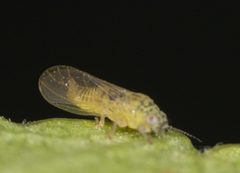
Blastopsylla is a of psyllids in the Aphalaridae. The genus contains at least one economically significant , Blastopsylla occidentalis, native to Australia and introduced to multiple continents including the Americas, Africa, Asia, and Europe. Species in this genus are associated with Eucalyptus species, feeding on plant sap and causing damage to shoot tips.

Pronunciation
How to pronounce Blastopsylla: //blæs.toʊˈsɪl.jə//
These audio files are automatically generated. While they are not always 100% accurate, they are a good starting point.
Images
Habitat
Eucalyptus plantations and natural stands of Eucalyptus . Colonies concentrate on shoot tips of branches.
Distribution
Native to Australia (New South Wales, Queensland, South Australia, Western Australia). Introduced to: Africa (Cameroon, Egypt, Kenya, South Africa, Burundi), Asia (China, Guangdong, Guangxi, Hong Kong, Israel, Turkey, Indonesia, Philippines), Europe (Italy, Portugal, Spain), North America (Mexico, USA: California, Florida, Hawaii), South America (Argentina, Brazil, Chile, Paraguay, Uruguay, Nicaragua), Oceania (New Zealand).
Seasonality
In tropical and subtropical regions, all life stages present year-round. peaks during dry seasons (May-September in Brazil) and declines during periods of high rainfall (December-January).
Diet
Phloem sap from Eucalyptus .
Host Associations
- Eucalyptus urophylla x E. camaldulensis - Hybrid plantation in Brazil
- Eucalyptus pellita - New record from Indonesia
- Eucalyptus viminalis - New record
- Eucalyptus globulus - in Cameroon
Life Cycle
Development includes , (nymphal), and stages. In Blastopsylla occidentalis: eggs laid on buds, bracts, young leaves and twigs; embryonic and nymphal development followed by adult ; from egg to egg averages 32 days; adults live approximately 11 days; females begin oviposition 8 days after emergence; average 38 eggs per female; sex ratio approximately 1:1. Polyvoltine with continuous breeding in suitable climates.
Behavior
and immatures form colonies concentrated on shoot tips. Feeding causes shoot distortion, reduced growth, and apical tip death. Males typically emerge before females. Mating lasts approximately 42 minutes.
Ecological Role
Herbivore and forest pest. Causes significant damage in eucalyptus nurseries and young plantations through sap feeding on shoot tips, leading to plant weakening and growth reduction.
Human Relevance
Major pest of eucalyptus forestry plantations globally. Economic impact through reduced tree growth and timber quality. Subject to monitoring and programs. potential exists through such as Psyllaephagus blastopsyllae.
Similar Taxa
- Glycaspis brimblecombeiAnother introduced pest of eucalyptus; co-occurs in Brazilian plantations and monitored simultaneously using similar trapping methods
More Details
Population dynamics
fluctuations inversely correlated with rainfall; no significant correlation with temperature observed. agent Psyllaephagus blastopsyllae (Hymenoptera: Encyrtidae) recorded parasitizing nymphs in Indonesia.
Sources and further reading
- BugGuide
- GBIF taxonomy match
- iNaturalist taxon
- NCBI Taxonomy
- Catalogue of Life
- Blastopsylla occidentalis . [Distribution map].
- New country, Brazilian states and host records of the eucalypt shoot psyllid Blastopsylla occidentalis
- Flutuação populacional de Blastopsylla occidentalis em plantio de eucalipto em Sinop (Mato Grosso)
- Biology of Blastopsylla occidentalis (Hemiptera: Psylloidea: Aphalaridae), a pest of Eucalyptus globulus (Myrtaceae) in Yaounde, Cameroon
- New Eucalyptus (Myrtaceae) species host of Blastopsylla occidentalis (Hemiptera: Aphalaridae) and its parasitism by Psyllaephagus blastopsyllae (Hymenoptera: Encyrtidae) in Indonesia
- First record of Glycaspis brimblecombei (Moore, 1964) and Blastopsylla occidentalis (Taylor, 1985) (Hemiptera, Aphalaridae) in eucalyptus plantations in State of Pará, Brazil