
Glycaspis brimblecombei
Moore, 1964
Red Gum Lerp Psyllid
Glycaspis brimblecombei, the Red Gum , is an sap-sucking insect native to Australia that has become a significant pest of Eucalyptus plantations worldwide. First described by Moore in 1964, this psyllid has spread to North America, South America, Europe, Africa, and Asia, causing substantial damage to forestry productivity. Nymphs construct protective sugary coverings called lerps while feeding on leaf phloem, and their multivoltine enables rapid growth. The is a major target for efforts using , , and fungi.
Pronunciation
How to pronounce Glycaspis brimblecombei: /ɡlaɪˈkæspɪs ˌbrɪmbəlˈkɒmbaɪ/
These audio files are automatically generated. While they are not always 100% accurate, they are a good starting point.
Identification
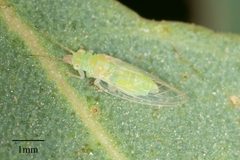
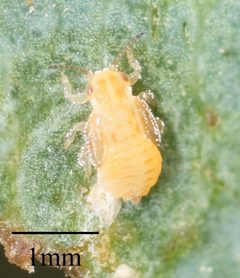
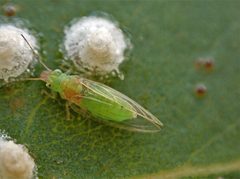
The presence of white, sugary on Eucalyptus leaves is diagnostic for nymphs. may be distinguished from other psyllids by association with lerps and confirmed through microscopic examination or . In regions where multiple Eucalyptus-feeding psyllids occur, molecular identification may be necessary for definitive determination.
Images
Habitat
Eucalyptus plantations and natural stands of Eucalyptus . Found on leaf surfaces where nymphs feed and construct . is influenced by climatic factors, with drier conditions favoring growth and rainfall reducing by washing away protective lerps.
Distribution
Native to Australia (New South Wales, Northern Territory, Queensland, South Australia, Western Australia). Introduced and established in: North America (USA: Arizona, California, Florida, Hawaii; Mexico), South America (Brazil, Argentina, Chile, Colombia, Ecuador, Peru, Venezuela), Europe (France, Italy, Portugal, Spain, Greece, Croatia, Montenegro, Albania, Cyprus, Malta, Turkey), Africa (Algeria, Ethiopia, Kenya, Madagascar, Malawi, Mauritius, Morocco, Reunion, Rwanda, South Africa, Tanzania, Tunisia, Uganda, Zambia, Zimbabwe), Asia (Israel, Syria), and Oceania (New Zealand).
Seasonality
Multivoltine with multiple per year; continuous breeding occurs in suitable climates. Activity patterns vary regionally based on temperature and precipitation.
Diet
Phloem sap feeder specializing on Eucalyptus . Feeds on leaves using .
Host Associations
- Eucalyptus - obligate Multiple Eucalyptus are utilized; specific preferences have been documented in invaded ranges
Life Cycle
Multivoltine with , nymphal instars, and stages. Nymphs construct protective while feeding. Developmental rates and times vary with temperature and plant quality.
Behavior
Nymphs remain beneath their while feeding. are mobile and disperse to new plants. Heavy can cause leaf discoloration, premature leaf drop, and reduced tree vigor.
Ecological Role
Herbivore that can reach pest densities in plantations. Serves as prey for diverse natural enemy including , predatory insects, and fungi. Honeydew and production may support other .
Human Relevance
Major economic pest of Eucalyptus forestry, threatening wood production and pulp industries. Management relies on including agents such as the Psyllaephagus bliteus, , ladybird beetles, and fungi (Cordyceps spp., bassiana, Metarhizium anisopliae). Nymph-produced are technically edible though difficult to harvest.
Similar Taxa
- Blastopsylla occidentalisAnother Eucalyptus-feeding (Aphalaridae) that co-occurs in Brazilian plantations and other regions; both are monitored simultaneously in pest management programs
- Other Glycaspis speciesCongeneric Australian psyllids that may require molecular methods for definitive separation from G. brimblecombei
More Details
Endosymbionts
pipientis has been detected in field of G. brimblecombei in Brazil, with potential implications for and interactions.
Biological Control
The encyrtid Psyllaephagus bliteus is the primary agent deployed against this pest. including lacewings (Chrysoperla externa, Ceraeochrysa cubana) and lady beetles (especially Olla v-nigrum) contribute to natural suppression. fungi Cordyceps javanica and C. fumosorosea show to nymphs in laboratory studies.
Sources and further reading
- BugGuide
- GBIF taxonomy match
- iNaturalist taxon
- NCBI Taxonomy
- Catalogue of Life
- Insect FAQs | Entomology Research Museum
- glycaspis-copy.jpg | Entomology Research Museum
- Glycaspis brimblecombei . [Distribution map].
- Glycaspis brimblecombei . [Distribution map].
- Glycaspis brimblecombei . [Distribution map].
- Predation by Coccinellidae on Glycaspis brimblecombei (Hemiptera: Aphalaridae) eggs
- GLYCASPIS BRIMBLECOMBEI (HEMIPTERA: APHALARIDAE) IN EUCALYPTUS FOREST PLANTATIONS: A REVIEW
- Patterns of host preference of the invasiveGlycaspis brimblecombeiMoore (Hemiptera: Psyllidae)
- Intraguild interactions between generalist predators and an introduced parasitoid of Glycaspis brimblecombei (Homoptera: Psylloidea)
- Wolbachia pipientis: first detection in populations of Glycaspis brimblecombei (Hemiptera: Aphalaridae) and Psyllaephagus bliteus (Hymenoptera: Encyrtidae) in Brazil
- Isolation and molecular characterization of Cordyceps sp. from Bemisia tabaci (Hemiptera: Aleyrodidae) and pathogenic to Glycaspis brimblecombei (Hemiptera: Aphalaridae)
- Potential of lacewings (Neuroptera: Chrysopidae) as predators of the red gum lerp psyllid Glycaspis brimblecombei (Hemiptera: Aphalaridae) in Eucalyptus
- First record of Glycaspis brimblecombei (Moore, 1964) and Blastopsylla occidentalis (Taylor, 1985) (Hemiptera, Aphalaridae) in eucalyptus plantations in State of Pará, Brazil
- First DNA barcoding of a new alien species Glycaspis brimblecombei Moore, 1964 (Hemiptera: Aphalaridae) in Croatia with a distribution note