
Glycaspis
Taylor, 1960
Species Guides
1- Glycaspis brimblecombei(Red Gum Lerp Psyllid)
Glycaspis is a of plant-parasitic psyllids in the Aphalaridae. in this genus are strongly associated with Eucalyptus plants. The genus includes at least two described species: Glycaspis brimblecombei (red gum lerp psyllid), a significant pest of eucalyptus plantations worldwide, and Glycaspis granulata. Many Glycaspis species exhibit high host specificity, often restricted to single Eucalyptus species or closely related host groups. The genus is native to Australia, where it shows patterns of short-range linked to host plant distribution.
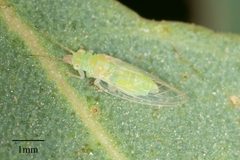
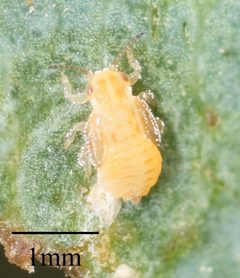
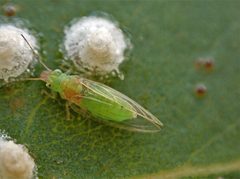
Pronunciation
How to pronounce Glycaspis: //ˌɡlaɪˈkæspɪs//
These audio files are automatically generated. While they are not always 100% accurate, they are a good starting point.
Identification
Glycaspis are psyllids that can be distinguished from related by their association with —protective sugary coverings produced by nymphs. are small hemipterans with typical . Species-level identification often requires advanced techniques due to the presence of complexes. Glycaspis brimblecombei specifically produces distinctive conical lerps on eucalyptus leaves. Separation from other psyllid genera such as Acizzia relies on morphological characters and association patterns.
Images
Habitat
Native to Australia, where occupy diverse eucalyptus-dominated . In invaded regions, Glycaspis brimblecombei occurs in eucalyptus plantations and urban plantings of Eucalyptus species. is influenced by climatic factors, with drought conditions favoring growth and rainfall reducing by removing protective nymphal .
Distribution
Native to Australia (New South Wales, Northern Territory, Queensland, South Australia, Western Australia). Glycaspis brimblecombei has been introduced and established across multiple continents: North America (USA: Arizona, California, Florida, Hawaii; Mexico), South America (Brazil, Chile, Colombia, Ecuador, Peru, Venezuela, Argentina), Europe (France, Spain, Portugal, Italy, Greece, Albania, Croatia, Cyprus, Malta, Montenegro, Turkey), Africa (Algeria, Ethiopia, Kenya, Madagascar, Malawi, Mauritius, Morocco, Reunion, Rwanda, South Africa, Tanzania, Tunisia, Uganda, Zambia, Zimbabwe), Asia (Israel, Syria, Turkey), and Oceania (New Zealand).
Diet
Phloem-feeding on Eucalyptus . Glycaspis brimblecombei feeds on several Eucalyptus species including E. camaldulensis and related . Nymphs and both feed on plant sap.
Host Associations
- Eucalyptus - Primary ; most Glycaspis show high host specificity to single or closely related Eucalyptus species
- Eucalyptus camaldulensis - Key for Glycaspis brimblecombei
Life Cycle
Multivoltine, with multiple per year. Development includes , nymphal (with ), and stages. Nymphs produce protective sugary lerps that cover their bodies during development. The specific duration of life stages varies with environmental conditions.
Behavior
Nymphs remain under protective while feeding. are mobile and disperse to find new plants. Heavy can cause leaf damage, honeydew secretion, and growth on host plants.
Ecological Role
Herbivore and plant on eucalypts. Serves as prey for various natural enemies including (Psyllaephagus bliteus), predatory lacewings (Chrysoperla externa, Ceraeochrysa cubana), coccinellid beetles (Olla v-nigrum, Jaguarita conjugata), and fungi ( bassiana, Metarhizium anisopliae, Cordyceps ). Some Glycaspis species may contribute to short-range patterns in Australian fauna.
Human Relevance
Glycaspis brimblecombei is a major economic pest in eucalyptus forestry, particularly in Brazil and other regions where eucalyptus plantations are important. It reduces tree growth and wood production; similar pests can reduce yields by up to 20%. Management relies on combining , monitoring, and selection of plant material. The sugary produced by nymphs are technically edible but difficult to harvest. No direct medical or agricultural significance for other Glycaspis .
Similar Taxa
More Details
Endosymbionts
pipientis has been detected in field of Glycaspis brimblecombei and its Psyllaephagus bliteus in Brazil, with potential implications for and .
Sibling Species
The contains cryptic complexes; Glycaspis propensa and G. dulcieana were the first formally recognized sibling species, reared from different eucalypt groups (box vs. ironbark).
Taxonomic History
placement has varied between Psyllidae and Aphalaridae in literature; currently accepted as Aphalaridae. Three previously synonymized (G. mirabilis, G. vellerosa, G. convallaria) were reinstated as valid.
Sources and further reading
- BugGuide
- Wikipedia
- GBIF taxonomy match
- iNaturalist taxon
- NCBI Taxonomy
- Catalogue of Life
- glycaspis-copy.jpg | Entomology Research Museum
- Insect FAQs | Entomology Research Museum
- Glycaspis brimblecombei . [Distribution map].
- Glycaspis brimblecombei . [Distribution map].
- Glycaspis brimblecombei . [Distribution map].
- Predation by Coccinellidae on Glycaspis brimblecombei (Hemiptera: Aphalaridae) eggs
- FURTHER INFORMATION ON GLYCASPIS SPECIES (HOMOPTERA: PSYLLIDAE) ASSOCIATED WITH EUCALYPTUS CAMALDULENSIS, AND ON OTHER GLYCASPIS SPECIES
- GLYCASPIS BRIMBLECOMBEI (HEMIPTERA: APHALARIDAE) IN EUCALYPTUS FOREST PLANTATIONS: A REVIEW
- Patterns of host preference of the invasiveGlycaspis brimblecombeiMoore (Hemiptera: Psyllidae)
- Intraguild interactions between generalist predators and an introduced parasitoid of Glycaspis brimblecombei (Homoptera: Psylloidea)
- Wolbachia pipientis: first detection in populations of Glycaspis brimblecombei (Hemiptera: Aphalaridae) and Psyllaephagus bliteus (Hymenoptera: Encyrtidae) in Brazil
- The biology and occurrence of Glycaspis baileyi Moore in New South Wales.
- Short-range endemism and Australian Psylloidea (Insecta : Hemiptera) in the genera Glycaspis and Acizzia (Psyllidae)
- A NEW SPECIES OF GLYCASPIS (HOMOPTERA: PSYLLIDAE) AND ADDITIONAL INFORMATION ON HOST ASSOCIATIONS
- Isolation and molecular characterization of Cordyceps sp. from Bemisia tabaci (Hemiptera: Aleyrodidae) and pathogenic to Glycaspis brimblecombei (Hemiptera: Aphalaridae)
- Potential of lacewings (Neuroptera: Chrysopidae) as predators of the red gum lerp psyllid Glycaspis brimblecombei (Hemiptera: Aphalaridae) in Eucalyptus
- A SIBLING NEW SPECIES OF GLYCASPIS TAYLOR (HOMOPTERA: PSYLLIDAE) AND REINSTATEMENT OF THREE SYNONYMS