
Acizzia
Heslop-Harrison, 1961
Species Guides
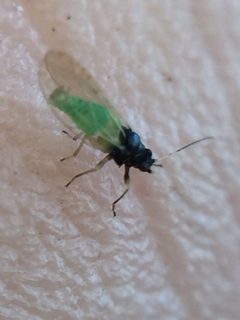
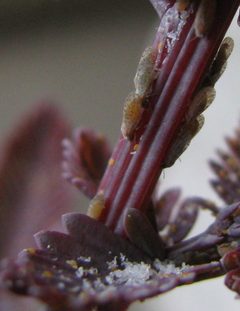
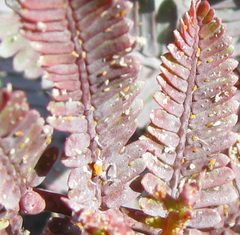
4Acizzia is a of psyllids in the Acizziinae, established by George Heslop-Harrison in 1961. are primarily associated with leguminous , particularly Acacia and Albizia species in Australia, though some have expanded to Solanaceae and Loranthaceae. Many species exhibit high host specificity, with some being monophagous or oligophagous. Several species have become outside their native ranges following the global horticultural trade of their host plants.
Pronunciation
How to pronounce Acizzia: /əˈsɪziə/
These audio files are automatically generated. While they are not always 100% accurate, they are a good starting point.
Images
Habitat
Associated with woody plants, primarily Acacia and Albizia in Australia. Some species occupy cultivated and wild Solanaceae, including eggplant, tobacco bush, and native Solanum species. Three species have been described from Australian mistletoe (Loranthaceae: Amyema spp.). typically occur on adaxial leaf surfaces for feeding and mating, while and nymphs develop on abaxial leaf surfaces.
Distribution
Worldwide distribution; native to Australia with highest diversity there. Established in Asia, Europe, North America, New Zealand, and La Réunion through plant introduction. Specific records include: United States (Florida), New Zealand, Southeast Asia (Brunei, Cambodia, India, Laos, Malaysia, Singapore, Thailand), Europe (Croatia, France, Corsica, Hungary, Italy, Slovenia, Spain, Switzerland, United Kingdom), and East Asia (China, Japan, Korea, Taiwan).
Diet
Phloem-feeding; predominantly ingests from phloem sieve elements. Also performs xylem ingestion and salivation. Accesses plant fluids from mesophyll, xylem, and phloem tissues. Feeding varies between plants, with enhanced phloem ingestion on susceptible hosts and reduced ingestion on hosts.
Host Associations
- Acacia baileyana - Acizzia acaciaebaileyanae
- Acacia melanoxylon - Acizzia uncatoides
- Acacia auriculiformis - Acizzia convector
- Acacia mangium - Acizzia convector
- Acacia veronica - Acizzia hughesae, Acizzia veski; vulnerable with restricted distribution in Western Australia
- Albizia julibrissin - Acizzia jamatonica
- Albizia lebbeck - Acizzia indica; serious pest on seedlings and saplings in India
- Dodonaea viscosa - Acizzia dodonaeae
- Solanum melongena - Acizzia solanicola; eggplant
- Solanum mauritianum - Acizzia solanicola; wild tobacco bush, first New Zealand record 2012
- Solanum petrophilum - Acizzia solanicola; putative ancestral wild in Australia
- Solanum nummularium - Acizzia yeni; Australian money-leaf nightshade
- Solanum lasiophyllum - Acizzia credoensis; flannel bush, Australian
- Brugmansia sp. - Acizzia solanicola; Angel's trumpet
- Physalis peruviana - Acizzia solanicola; cape gooseberry
- Amyema spp. - Acizzia loranthacae, A. amyemae, A. pendulae; Australian mistletoe, new record for
- Grevillea sp. 'Stirling Range' - Acizzia mccarthy; undescribed species under conservation action
- Pultenaea glabra - Acizzia keithi; vulnerable with restricted distribution in eastern Australia, new host record
Life Cycle
, nymphal, and stages. Duration varies with plant quality. On susceptible Albizia lebbeck seed sources, egg stage lasts approximately 1.9 days, nymphal stage 9.8 days, and adult survival exceeds 13 days. On , development takes longer (egg ~3.9 days, nymphal ~17 days) with shorter adult lifespan (~8 days). Nymphs develop on abaxial leaf surfaces where eggs are laid.
Behavior
prefer adaxial leaf surfaces for feeding and mating. Probing includes six distinct waveforms: non-probing, , xylem feeding, first phloem contact, phloem salivation, and phloem ingestion. Shows discrimination, with enhanced feeding on susceptible hosts and reduced phloem ingestion on hosts characterized by shorter ingestion periods, higher return to pathway phase, and more salivation events. Can coexist with other on shared hosts.
Ecological Role
Herbivore; potential of phloem-restricted plant . are strongly -limited— numbers correlate with leaf nitrogen availability and host plant quality. On pruned Acacia karroo with high-quality regenerative foliage, reach levels, while populations remain low on normal trees. Several at risk of coextinction with their threatened host plants.
Human Relevance
Occasional economic pest on plantation and commercial crops. Acizzia solanicola damages eggplant in commercial crops and gardens. Acizzia indica is a serious pest on Albizia lebbeck seedlings and saplings in India. Some species have become outside native ranges following global trade in ornamental Acacia and Albizia species. Concern regarding potential to Candidatus Liberibacter solanacearum on solanaceous crops. Subject of efforts (e.g., Acizzia uncatoides in La Réunion using Harmonia conformis).
More Details
Conservation status of host-specific species
Multiple Acizzia are considered rare and at risk of coextinction due to extreme specificity combined with restricted host plant distributions. Acizzia hughesae, A. mccarthy, A. veski, A. keithi, and A. yeni have been recorded only from single localities on vulnerable or threatened hosts. Two species (A. hughesae and A. mccarthy) were classified as threatened by the Western Australian State Government. Bush Blitz surveys have proven effective for discovering these rare species and identifying native hosts of economically important psyllids.
Short-range endemism
A large proportion of Acizzia are specific to single -plant species in the Acacia, qualifying them as short-range endemics when host plant distribution is restricted. However, this pattern is complicated by geographic variation in host use and possible local use of multiple host species. Short-range appears to be an important factor in diversification on Australian wattles.
Invasive potential
Several have established outside Australia through horticultural trade: Acizzia convector in Southeast Asia since at least the 1980s and recently in Florida (2014 onwards); Acizzia jamatonica in Europe and the United States; Acizzia solanicola in New Zealand (first recorded 2012). The wide distribution of Acacia auriculiformis and A. mangium in tropical Africa and South America suggests potential for further range expansion.
Sources and further reading
- BugGuide
- Wikipedia
- GBIF taxonomy match
- iNaturalist taxon
- NCBI Taxonomy
- Catalogue of Life
- Acizzia jamatonica . [Distribution map].
- Acizzia jamatonica (Kuwayama) (Hemiptera: Sternorrhyncha: Psyllidae): U.S. Distribution of a Recently Detected Asian Psyllid
- Acizzia solanicola (Hemiptera: Psyllidae) probing behaviour on two Solanum spp. and implications for possible pathogen spread
- New species of Acizzia (Hemiptera: Psyllidae) from an Australian endemic Solanum (Solanaceae)
- A new host and additional localities for the rare psyllid Acizzia keithi Taylor and Moir (Hemiptera: Psyllidae)
- Functional asymmetry & Climatic Isolation: Integrating Risk Assessment for the Classical Biological Control of Acizzia uncatoides in La Réunion
- Potential economic pests of solanaceous crops: a new species of Solanum-feeding psyllid from Australia and first record from New Zealand of Acizzia solanicola (Hemiptera: Psyllidae)
- Short-range endemism and Australian Psylloidea (Insecta : Hemiptera) in the genera Glycaspis and Acizzia (Psyllidae)
- Acizzia errabunda sp. nov. and Ctenarytaina insularis sp. nov.: Descriptions of two new species of psyllids (Hemiptera: Psylloidea) discovered on exotic host plants in New Zealand
- A new Australian species of invasive psyllid, Acizzia convector Burckhardt & Taylor, sp. nov. (Psylloidea: Psyllidae) associated with Acacia auriculiformis and A. mangium (Fabaceae)
- In threat of co-extinction: two new species of Acizzia Heslop-Harrison (Hemiptera: Psyllidae) from vulnerable species of Acacia and Pultenaea
- The influence of the host plant on the population dynamics of Acizzia russellae (Homoptera: Psyllidae)
- New species of Acizzia Heslop‐Harrison (Hemiptera: Psyllidae) from Australian mistletoe (Loranthaceae)
- Host plant (Albizia lebbeck) influence on the biological parameters of Psyllid Acizzia indica Heslop-Harrison (Homoptera : Psyllidae)
- Further evidence of the coextinction threat for jumping plant-lice: three new Acizzia (Psyllidae) and Trioza (Triozidae) from Western Australia