
Ceraeochrysa cubana
(Hagen, 1861)
green lacewing
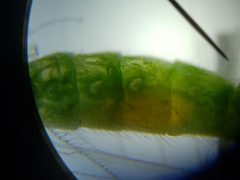
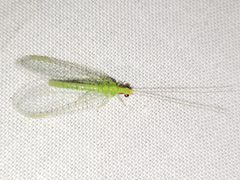
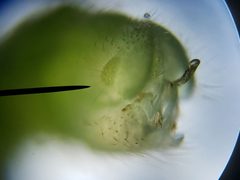
Ceraeochrysa cubana is a green lacewing widely distributed across the Americas, from the Caribbean and Middle America through South America. Larvae are voracious important for of agricultural pests. The species exhibits high genetic diversity in agroecosystems and shows associative learning capabilities in stages.
Pronunciation
How to pronounce Ceraeochrysa cubana: //sɛˈreɪ.oʊˌkɹaɪ.sə kjuˈbɑːnə//
These audio files are automatically generated. While they are not always 100% accurate, they are a good starting point.
Images
Habitat
Agroecosystems in Southeast Brazil, including coffee, corn, and soybean crops. Found in agricultural environments more broadly across its range.
Distribution
Widely distributed across the Americas: Caribbean, Middle America, North America, and South America. Specific records from Brazil including Acre, Amazonas, Bahia, Ceará, Distrito Federal, Espírito Santo, Mato Grosso, Mato Grosso do Sul, Pará, Paraíba, Pernambuco, Rio de Janeiro, Rio Grande do Norte, Rondônia, Roraima, and São Paulo.
Diet
and larvae of Spodoptera frugiperda; eggs of Anagasta kuehniella as alternative prey. feed on plant-provided food and honeydew.
Host Associations
- Spodoptera frugiperda - prey and larvae consumed; third instar larvae show highest consumption and shortest search and handling times on neonate larvae
- Anagasta kuehniella - alternative prey used as food source in laboratory rearing
Life Cycle
Development from larva to takes 25.5 days when fed Anagasta kuehniella , 25.9 days on Spodoptera frugiperda eggs, 35.7 days on S. frugiperda larvae, and 34.6 days on combined eggs and larvae of S. frugiperda. Shorter development period when fed eggs versus larvae.
Behavior
stages exhibit associative learning: larvae exposed to methyl salicylate associated with food are attracted to this volatile and use it to locate food patches, while those exposed to the volatile during food deprivation are repelled. Third instar larvae show greater consumption and reduced search and handling times on prey compared to .
Ecological Role
of agricultural pest and early instar larvae, particularly Spodoptera frugiperda. Contributes to mortality of early life stages of crop pests with potential importance for . High among suggests effective in agroecosystems.
Human Relevance
Used for of agricultural pests. Important for programs. Subject of survival and behavioral avoidance studies.
Similar Taxa
- Ceraeochrysa claveriCongeneric with similar ; both are green lacewings used in and exhibit trash-carrying larval . C. claveri has been documented using mealybug wax in packets, while this specific behavior is not yet documented for C. cubana.
- Ceraeochrysa cinctaCongeneric found in similar agroecosystems of Southeast Brazil; both show high genetic diversity and lack strong structure in agricultural environments.
- Chrysoperla externaSympatric green lacewing also used in ; both species have been studied for survival and behavioral avoidance responses.
More Details
Genetic diversity
in Southeast Brazil show high genetic diversity with no strong genetic structure, indicating broad sharing of genetic diversity among crops and localities. This pattern suggests high , potentially driven by natural or anthropogenic exchange of seedlings among crops.
Associative learning
First documented case of associative learning in lacewings, where larvae can learn to associate volatiles with food presence or absence and subsequently use this information during foraging.
Sources and further reading
- BugGuide
- GBIF taxonomy match
- iNaturalist taxon
- NCBI Taxonomy
- Catalogue of Life
- Ceraeochrysa claveri larva - Entomology Today
- Ceraeochrysa claveri larva - Entomology Today
- Ceraeochrysa claveri Archives - Entomology Today
- Ceraeochrysa claveri larva and coconut mealybug - Entomology Today
- Ceraeochrysa claveri lacewing adult - Entomology Today
- Trash Bug Versus Mealybug: Unique Insect Interaction Filmed for First Time
- Genetic Variability of Ceraeochrysa cincta, Ceraeochrysa claveri, and Ceraeochrysa cubana (Neuroptera: Chrysopidae) Populations in Agroecosystems of Southeast Brazil
- Associative learning in immature lacewings (Ceraeochrysa cubana)
- Biological aspects and predation behavior of Ceraeochrysa cubana against Spodoptera frugiperda
- Insecticide survival and behavioral avoidance in the lacewings Chrysoperla externa and Ceraeochrysa cubana