
Ceraeochrysa
Adams, 1982
trash-carrier lacewings, green lacewings
Species Guides
6- Ceraeochrysa cincta
- Ceraeochrysa claveri(trash bug (larval stage))
- Ceraeochrysa cubana(green lacewing)
- Ceraeochrysa lineaticornis(Stripe-horned Green Lacewing)
- Ceraeochrysa smithi(Smith's Green Lacewing)
- Ceraeochrysa valida
Ceraeochrysa is a of green lacewings in the Chrysopidae, established by Adams in 1982 based on distinct genitalia structure. It is the second largest genus in Chrysopidae with 61 distributed from southeastern Canada to Argentina, with highest diversity in the Neotropics. Larvae are known as 'trash carriers' that construct packets of debris for camouflage, including insect wax, lichen, and plant material. The genus contains important agents that prey on , aphids, mites, , and lepidopteran .
Pronunciation
How to pronounce Ceraeochrysa: /ˌsɛri.oʊˈkrɪsə/
These audio files are automatically generated. While they are not always 100% accurate, they are a good starting point.
Identification
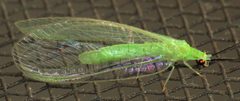
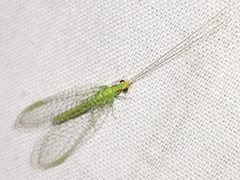
Many have red or brown marks on the pronotum and one or two stripes on the scape. Distinguished from the related Chrysopa by differences in genitalia structure, particularly the male genitalia. Some species possess swollen and darkened branches of the cubital in the wing.
Images
Habitat
Occurs in agroecosystems, agricultural crops, and natural vegetation across the Americas. Found on plants infested with honeydew-producing insects such as , aphids, and scale insects.
Distribution
Widespread in the Americas from southeastern Canada to Argentina. Greatest biodiversity in the Neotropics, particularly Brazil and Rica. Fifteen recorded in Mexico.
Diet
Larvae are voracious . Documented prey includes (Nipaecoccus nipae, ), aphids, mites, , and and larvae of lepidopterans including Spodoptera frugiperda and Ephestia kuehniella. feed on plant-provided food and honeydew.
Life Cycle
Complete with , larva, pupa, and stages. Larval development duration varies with prey type: approximately 25–26 days when fed lepidopteran eggs, 34–36 days when fed larvae or mixed diets. Larval survival rates range from 82–100% depending on food source. Cocoon construction incorporates collected debris from the larval packet.
Behavior
Larvae construct packets of debris ('trash carrying') using to scoop and place materials onto hooked hairs on the back; packet materials include lichen, plant trichomes, wood fragments, prey remains, spider silk, and insect wax. Ceraeochrysa claveri has been observed actively placing live mealybug nymphs onto its dorsal packet, potentially facilitating mealybug via . Larvae demonstrate associative learning: immatures can learn to associate volatile cues such as methyl salicylate with food presence or absence, and use these learned associations during foraging. When encountering mealybug (defensive fluid from ), larvae exhibit distressed reactions and wipe mouthparts on substrate. Third instar larvae show greater consumption and reduced search/manipulation time on mobile prey ( larvae) compared to prey ().
Ecological Role
Human Relevance
Widely used and studied for of agricultural pests. Multiple (C. cincta, C. claveri, C. cubana, C. everes) evaluated for control of , fall armyworm, and other crop pests. Demonstrated compatibility with Bacillus thuringiensis , supporting strategies. Susceptibility to some and biopesticides (, pyriproxyfen) documented, requiring careful management in combined control programs.
Similar Taxa
- ChrysopaDifferentiated by genitalia structure; Ceraeochrysa established based on distinct male genital . Chrysopa larvae also carry trash but Ceraeochrysa shows more specialized use of insect wax.
- ChrysoperlaBoth are green lacewing used in ; Chrysoperla externa has been compared directly with Ceraeochrysa cubana in susceptibility studies. Chrysoperla lacks the pronounced trash-carrying and pronotal markings characteristic of many Ceraeochrysa .
Sources and further reading
- BugGuide
- Wikipedia
- iNaturalist taxon
- NCBI Taxonomy
- Catalogue of Life
- Ceraeochrysa claveri larva - Entomology Today
- Ceraeochrysa claveri larva - Entomology Today
- Ceraeochrysa claveri Archives - Entomology Today
- Ceraeochrysa claveri larva and coconut mealybug - Entomology Today
- Ceraeochrysa claveri lacewing adult - Entomology Today
- Trash Bug Versus Mealybug: Unique Insect Interaction Filmed for First Time
- Genetic Variability of Ceraeochrysa cincta, Ceraeochrysa claveri, and Ceraeochrysa cubana (Neuroptera: Chrysopidae) Populations in Agroecosystems of Southeast Brazil
- Associative learning in immature lacewings (Ceraeochrysa cubana)
- Biological aspects and predation behavior of Ceraeochrysa cubana against Spodoptera frugiperda
- BIOLOGICAL ASPECTS OF Ceraeochrysa everes (NEUROPTERA: CHRYSOPIDAE) FED ON PINK HIBISCUS MEALYBUG
- A new species of Ceraeochrysa Adams (Neuroptera, Chrysopidae), with a key to the species from Mexico
- Insecticide survival and behavioral avoidance in the lacewings Chrysoperla externa and Ceraeochrysa cubana
- Selectivity of Bacillus thuringiensis (Bacillales: Bacillaceae) to the polyphagous predator Ceraeochrysa claveri (Navás, 1911) (Neuroptera: Chrysopidae)
- Effects of Prey on Survival, Development, and Reproduction of Trash-Carrying Chrysopids (Neuroptera:Ceraeochrysa)
- Intake of Pyriproxyfen Through Contaminated Food by the Predator Ceraeochrysa claveri Navás, 1911 (Neuroptera: Chrysopidae): Evaluation of Long-Term Effects on Testes via Transcriptome Analysis.
- Azadirachtin-Based Biopesticide Affects Fitness and Ovarian Development of the Natural Enemy Ceraeochrysa claveri (Neuroptera: Chrysopidae).