
Homotomidae
fig psyllids, mulberry psyllids
Genus Guides
2- Homotoma(fig psylla)
- Macrohomotoma
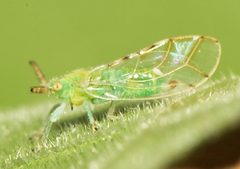
is a of small phloem-feeding insects in the superfamily Psylloidea, commonly known as fig or mulberry psyllids. Members feed almost exclusively on Moraceae, primarily the Ficus, with rare exceptions such as Triozamia on Antiaris toxicaria. The family contains approximately 70 described across three : Dynopsyllinae, Macrohomotominae, and Homotominae. Several species are economically significant pests of ornamental and cultivated figs, including the Macrohomotoma gladiata, which has spread from Asia to Europe, North Africa, and North America.
Pronunciation
How to pronounce Homotomidae: /hoʊ.moʊˈtɒm.ɪˌdiː/
These audio files are automatically generated. While they are not always 100% accurate, they are a good starting point.
Identification
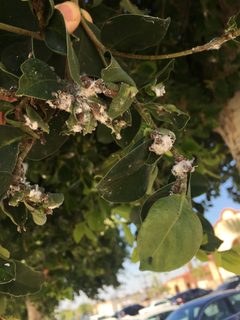
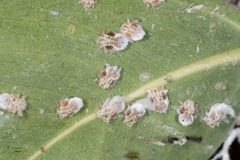
are distinguished from other Psylloidea by their strong association with Moraceae plants, particularly Ficus. Members of the Homotoma are commonly called fig psyllids and are associated with Ficus carica. Macrohomotoma are recognized by their damage : rolled leaf tips, dense white woolly waxy secretions, and honeydew deposits on Ficus microcarpa. The was historically recognized as distinct but was subsumed as Homotominae within Carsidaridae in 2021; this taxonomic change affects identification keys and literature.
Images
Habitat
Primarily associated with Moraceae plants in diverse settings: natural forests, agricultural fig orchards, and urban ornamental plantings. Ficus microcarpa in urban zones and parks; Ficus carica in cultivated orchards. Some occupy mountain regions, as with Moriphila furva collected in northeastern South Korean mountains on Morus australis.
Distribution
Global distribution centered on native ranges of Ficus and Morus: Asia (East Asia, Southeast Asia, South Asia), Mediterranean region, Africa (Cameroon, Afrotropical region for Phytolyma), and introduced in Europe (Greece, Italy, Spain, Portugal, Montenegro, Serbia), North Africa (Morocco, Tunisia), and North America (USA, California).
Seasonality
Macrohomotoma gladiata exhibits or partial trivoltine with in May, August, and October-January; young nymphs present year-round except August-September; development slows in autumn and winter. occurs as young nymphs (first and second instars) protected under stipules. Homotoma ficus phenology in Serbia not detailed in available sources.
Diet
Phloem-feeding on plant sap, targeting young and developing tissues. specificity is extreme: almost exclusively Moraceae Ficus, with the sole documented exception being Triozamia on Antiaris toxicaria (also Moraceae).
Host Associations
- Ficus microcarpa - primary Ornamental tree; main for Macrohomotoma gladiata
- Ficus carica - primary Cultivated fig; for Homotoma ficus and H. indica
- Ficus benjamina - Recorded for Macrohomotoma gladiata
- Ficus benghalensis - Recorded for Macrohomotoma gladiata
- Ficus concinna - for Macrohomotoma sinica in China
- Morus australis - likely Collection site for Moriphila furva in Korea
- Morus mesozygia - for Phytolyma tchuentei in Cameroon
- Antiaris toxicaria - Only non-Ficus recorded; for Triozamia
Life Cycle
with , five nymphal instars, and stages. Macrohomotoma gladiata: eggs laid under stipules; first and second instar nymphs overwinter without further development; middle-aged and late instars in spring and summer; adults rarely observed. or partial third possible. Homotoma : eggs, larvae, and adults documented but detailed not available from sources.
Behavior
Nymphs produce dense white woolly waxy secretions covering twigs and rolled leaf tips. Honeydew leads to sooty mould growth and blackened twigs, causing twig dieback. Young nymphs shelter under stipules, particularly during . are strong jumpers characteristic of Psylloidea but are recorded in very low numbers in some .
Ecological Role
Herbivores specializing on Moraceae phloem; some are significant pests causing direct damage through feeding and indirect damage via sooty mould. Support (Psyllaephagus species, Encyrtidae) and predatory (Anthocoris nemoralis, Anthocoridae). Honeydew production may support other sugar-feeding insects in urban .
Human Relevance
Several are economically damaging pests of ornamental and cultivated figs. Macrohomotoma gladiata is in the Mediterranean Basin, Europe, and North America, causing serious damage to Ficus microcarpa in urban plantings through leaf rolling, waxy secretions, and honeydew. Homotoma ficus causes economic damage on cultivated figs in certain years. Management interest in using (Psyllaephagus) and (Anthocoris).
Similar Taxa
- Carsidaridae was subsumed as Homotominae within Carsidaridae in 2021; historically treated as separate
- TriozidaeBoth are Psylloidea with some Ficus-associated ; distinguished by range breadth and morphological characters
- PsyllidaeAnother Psylloidea ; distinguished by extreme specialization on Moraceae and waxy secretion production
More Details
Taxonomic Status
was subsumed to Homotominae within Carsidaridae in 2021. Literature prior to this date treats Homotomidae as a distinct family. This affects retrieval and interpretation of older sources.
Systematic Classification
Three recognized: Dynopsyllinae ( Diceraopsylla, Dynopsylla, Austrodynopsylla, Triozamia, Afrodynopsylla), Macrohomotominae (genera Mycopsylla, Macrohomotoma, Pseudoeriopsylla, Moriphila), and Homotominae (genera Homotoma, Synoza). Total approximately 70 described .
Sources and further reading
- BugGuide
- Wikipedia
- GBIF taxonomy match
- Catalogue of Life
- MACROHOMOTOMA GLADIATA (HEMIPTERA HOMOTOMIDAE) SEASONAL POPULATION FLUCTUATION AND ITS NATURAL ENEMIES ON FICUS MICROCARPA IN GREECE
- The first finding of the fig psylla Homotoma ficus L. (Hemiptera, Psylloidea, Homotomidae) in Serbia
- Phytolyma tchuentei sp.n. (Hemiptera: Homotomidae), a new species of psyllid associated with Morus mesozygia (Moraceae) from Cameroon
- A new species of Psyllaephagus (Hymenoptera: Encyrtidae) from China, parasitoid of Macrohomotoma sinica (Hemiptera: Homotomidae) on Ficus concinna
- First report, occurrence, biology, ecology and control of fig psylla Homotoma indica (Hemiptera: Homotomidae) from Kolhapur region, India
- Moriphila furva gen. and sp. nov. (Hemiptera: Psylloidea: Homotomidae), a new jumping plant-louse from Korea associated with Morus australis (Moraceae)
- First record of Macrohomotoma gladiata Kuwayama, 1908 (Hemiptera: Psylloidea: Homotomidae), a pest of ornamental Ficus microcarpa L. f., in Morocco
- The psyllid Macrohomotoma gladiata Kuwayama, 1908 (Hemiptera: Psylloidea: Homotomidae): a Ficus pest recently introduced in the EPPO region
- Figure 1 from: Wu F, Zhen W, Yang Z, Zu G (2021) A new species of Psyllaephagus (Hymenoptera: Encyrtidae) from China, parasitoid of Macrohomotoma sinica (Hemiptera: Homotomidae) on Ficus concinna. Biodiversity Data Journal 9: e63253. https://doi.org/10.3897/BDJ.9.e63253
- Figure 2 from: Wu F, Zhen W, Yang Z, Zu G (2021) A new species of Psyllaephagus (Hymenoptera: Encyrtidae) from China, parasitoid of Macrohomotoma sinica (Hemiptera: Homotomidae) on Ficus concinna. Biodiversity Data Journal 9: e63253. https://doi.org/10.3897/BDJ.9.e63253