
Torymus
Dalman, 1820
Species Guides
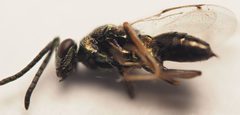
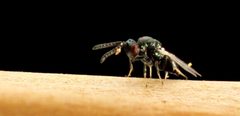
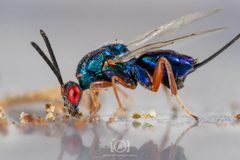
15Torymus is a of chalcid wasps in the Torymidae, established by Dalman in 1820. The genus contains over 400 worldwide. Most species are ectoparasitoids of gall-forming insects, particularly gall wasps (Cynipidae) and gall midges (Cecidomyiidae). Several species have been studied for their role in of agricultural pests.
Pronunciation
How to pronounce Torymus: //ˈtɔːrɪməs//
These audio files are automatically generated. While they are not always 100% accurate, they are a good starting point.
Images
Habitat
Associated with galls on various plants including oaks, chestnuts, hackberries, and sedges. have been documented in chestnut orchards, oak woodlands, and wetlands with Carex lasiocarpa.
Distribution
Worldwide distribution with over 400 . Documented occurrences include North America (British Columbia, California), Europe (England, southern Finland, Balearic Islands), and Asia (China, Japan).
Host Associations
- Dryocosmus kuriphilus (chestnut gall wasp) - Torymus (Syntomaspis) sinensis and T. beneficus are
- Paratephritis fukaii - T. itoi parasitizes this tephritid fly on Farfugium japonicum in Japan
- Pachypsylla spp. (hackberry psyllids) - Torymus spp. parasitize nymphs in hackberry nipple galls
- Andricus quercuscalifornicus (oak apple gall wasp) - T. californicus associated with smaller, late-season galls
- Planetella spp. (gall midges) - T. ventralis known from this association, though not confirmed in Finnish sampling
Behavior
Oviposition in some includes and , rest and preening, searching, -feeding, and stinging. Sting behavior is separated into long time stings (paralyzing host larva, oviposition, and construction of feeding-tube) and short time stings. Torymus (Syntomaspis) sinensis performs 4.5 long time stings per hour, while T. beneficus performs 2.3 long time stings per hour.
Ecological Role
Ectoparasitoid of gall-forming insects. Acts as a natural agent, regulating of gall wasps, gall midges, and psyllids. Contributes to the complex of organisms associated with galls.
Human Relevance
Some are studied for of agricultural pests, particularly the chestnut gall wasp Dryocosmus kuriphilus. Generally harmless to humans; no stinging or biting documented.
Similar Taxa
- Psyllaephagus spp. (Encyrtidae)Also parasitize nymphs in galls; distinguished by -level characters and presumably different gall preferences
- Baryscapus gigas (Eulophidae)Another common of oak apple galls; distinguished by affiliation and gall size/ associations (B. gigas more abundant in late-season galls with constant attack rates)
More Details
Taxonomic note
The subgenus Syntomaspis is used for some including T. sinensis and T. beneficus. Some species have maculated (spotted) forewings, including T. maculatus and T. maculosus.
Research context
Torymus show differential utilization of galls based on size and . T. californicus is associated with smaller, late-developing oak apple galls, suggesting partitioning among species.
Sources and further reading
- BugGuide
- Wikipedia
- GBIF taxonomy match
- iNaturalist taxon
- NCBI Taxonomy
- Catalogue of Life
- A Lot of Gall | Bug Squad
- Bug Eric: Hackberry Psyllids: A Fixture of Fall
- <i>Torymus ventralis</i> (Fonscolombe) and <i>Torymus maculatus</i> sp. n. from Finland, and <i>Torymus maculosus</i> sp. n. from Corfu, Greece (Hymenoptera: Chalcidoidea: Torymidae)
- A redescription of Torymus sapporoensis Ashmead and description of a new species of Torymus Dalman (Hymenoptera: Torymidae) parasitizing Paratephritis fukaii (Diptera: Tephritidae) in Japan
- Oviposition behaviour of two parasitoids of Dryocosmus kuriphilus Yasumatsu(Hymenoptera: Cynipidae), Torymus(Syntomaspis) sinensis Kamijo and Torymus(Syntomaspis) beneficus Yasumatsu et Kamijo(Hymenoptera: Torymidae), in a chestnut orchard.