
Torymidae
Walker, 1833
Subfamily Guides
5is a of chalcidoid wasps containing over 960 in approximately 70 worldwide. Members are typically small with metallic coloration, enlarged hind legs, and females often possess long ovipositors. The family exhibits diverse : many species are of gall-forming insects, while others are phytophagous, feeding on seeds or usurping galls formed by other insects. Torymidae is distinguished from other Chalcidoidea by the visibility of , a rare trait in this superfamily.
Pronunciation
How to pronounce Torymidae: //tɔˈrɪmɪˌdeɪ//
These audio files are automatically generated. While they are not always 100% accurate, they are a good starting point.
Identification
can be distinguished from other Chalcidoidea by the externally visible —most chalcidoid have reduced or concealed cerci. The combination of metallic coloration, enlarged hind legs, and long ovipositors in females further aids recognition. Within the family, differ in : Megastigminae are primarily phytophagous seed-feeders with particularly long ovipositors, while Toryminae and Monodontomerinae are predominantly of gall-formers or other insects. Molecular has revealed that Torymidae as traditionally circumscribed is not monophyletic; Megastigminae has been elevated to family rank (Megastigmidae) in recent revisions.
Images
Appearance
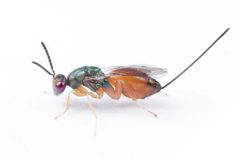
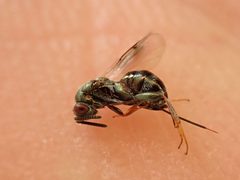
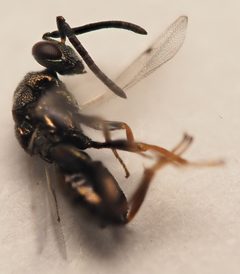
Small , typically 2–10 mm in length, often with striking metallic green, blue, or coloration. Hind are characteristically enlarged and toothed in many . Females generally possess long, conspicuous ovipositors that may exceed body length. are usually 13-segmented. Wings are reduced in venation typical of Chalcidoidea. The are visible externally, a diagnostic feature distinguishing from most other chalcidoid .
Habitat
Diverse including forests, woodlands, grasslands, and agricultural areas. Associated with plants that support gall-forming insects or produce seeds utilized by phytophagous . Many species are found in bark beetle galleries, pine cones, or plant galls. Specific microhabitats vary by : species occur wherever their hosts (gall midges, tephritid flies, cynipid , bark beetles) are present, while phytophagous species are tied to seed-bearing structures of host plants.
Distribution
Worldwide distribution with representation on all continents except Antarctica. Highest diversity in temperate and tropical regions. Well-represented in North America, Europe, Asia, Africa, and Australia. Specific distribution patterns vary by and ; some genera such as Megastigmus have broad distributions while others are more restricted.
Seasonality
Activity patterns vary by and climate. In temperate regions, typically emerge in spring and summer coinciding with availability. Gall-associated species show phenological synchronization with gall formation and development. Some species exhibit extended periods with potential for within galls. Multiple per year are common in warmer climates.
Host Associations
- Cecidomyiidae (gall midges) - Primary for many Torymus and Torymoides
- Cynipidae (gall wasps) - for numerous
- Tephritidae (fruit flies) - Torymus itoi parasitizes Paratephritis fukaii
- Scolytinae (bark beetles) - Roptrocerus xylophagum parasitizes Ips grandicollis
- Mantodea (mantids) - Some parasitize
- Pinaceae seeds - phytophagousMegastigmus feed on conifer seeds
- Various plant galls - or phytophagousSome usurp galls formed by other insects
Life Cycle
Development is holometabolous with complete . varies substantially: develop within or on insects (larvae or pupae of gall-formers, bark beetles, or other hosts), while phytophagous species develop within seeds or plant galls. Thermal requirements have been quantified for some species: Roptrocerus xylophagum requires 158 (males) or 179 degree-days (females) above 13.8°C threshold. Many species exhibit arrhenotokous (unfertilized produce males). size is often dependent on host size or quality. Some species show cycles with in pupal or prepupal stages.
Behavior
Females use their long ovipositors to access concealed within plant tissue, seeds, or galls. females typically paralyze hosts before oviposition. Some can parasitize multiple hosts per day (up to 11 recorded for Roptrocerus xylophagum). Courtship varies among species and has been studied in Monodontomerus. Phytophagous species deposit directly into developing seeds or gall tissue. of some species visit colonies or extrafloral for feeding.
Ecological Role
function as important natural enemies of various insect herbivores, particularly gall-forming insects and bark beetles, contributing to of these groups. Phytophagous serve as seed in forest . Some species are significant as agents against agricultural and forest pests. The occupies diverse trophic positions including primary , facultative hyperparasitoids, and phytophages, contributing to complex dynamics in terrestrial ecosystems.
Human Relevance
Several have been evaluated or deployed as agents: Roptrocerus xylophagum was introduced to Australia for control of Ips grandicollis; various species have been studied for control of glassy-winged sharpshooter and other agricultural pests. Phytophagous Megastigmus species can be significant pests of conifer seed production in forestry. Some species cause nuisance issues when associated with hackberry psyllids on ornamental trees. The is taxonomically important for understanding chalcidoid and evolution.
Similar Taxa
- ChalcididaeAlso have enlarged hind , but differ in wing venation, antennal structure, and lack visible ; primarily of Lepidoptera and Diptera
- EupelmidaeSome formerly placed in ; share metallic coloration but differ in mesosomal structure and larval
- PteromalidaeSimilar size and general form, but lack visible and enlarged hind ; diverse lifestyles
- MegastigmidaeFormerly Megastigminae of ; elevated to rank based on phylogenetic analysis; distinguished by elongated ovipositor and seed-feeding
More Details
Taxonomic instability
The classification of has undergone substantial revision. A 2018 phylogenetic analysis found that Torymidae as traditionally circumscribed was not monophyletic, leading to elevation of Megastigminae to rank (Megastigmidae). Several historically placed in Torymidae (Idarninae, Sycophaginae, Epichrysomallinae, Ormyrinae) had been transferred to other families prior to this revision.
Subfamily composition
Current classifications recognize up to six : Megastigminae (now Megastigmidae), Monodontomerinae, Toryminae, Podagrioninae, Erimerinae (=Microdontomerinae), and Thaumatoryminae, though the exact number varies among authorities.
Host range diversity
The exhibits exceptional diversity in associations, ranging from of gall midges, tephritid flies, bark beetles, and to on conifer seeds and exploitation of galls formed by unrelated insects.
Sources and further reading
- BugGuide
- Wikipedia
- GBIF taxonomy match
- iNaturalist taxon
- NCBI Taxonomy
- Catalogue of Life
- Publications | Entomology Research Museum
- A Lot of Gall | Bug Squad
- Bug Eric: Hackberry Psyllids: A Fixture of Fall
- Bug Eric: Wasp Wednesday: Pseudomalus auratus
- A chalcidid jewel beetle parasitoid wasp | Beetles In The Bush
- The biology ofRoptrocerus xylophagorum [Hym.: Torymidae], with a note on its taxonomic status
- Comparative Courtship Behavior and Karyology in Monodontomerus (Hymenoptera: Torymidae)
- New species of Pteromalidae and Torymidae (Hymenoptera: Chalcidoidea) from California, with taxonomic notes
- Host Seed Size and Adult Size, Emergence, and Morphology of Megastigmus aculeatus nigroflavus (Hymenoptera: Torymidae)
- Chalcidoid parasitoids (Hymenoptera: Torymidae and Eupelmidae) of mantids (Mantodea) oothecae in Iran
- Two torymid species (Hymenoptera: Chalcidoidea, Torymidae) developing on Artemisia gall midges (Diptera: Cecidomyiidae)
- Nomenclatural changes in Neotropical Eulophidae, Eupelmidae and Torymidae (Hymenoptera: Chalcidoidea) relating to parasitoids of Cecidoses eremita (Lepidoptera: Cecidosidae)
- A NEW SPECIES OF MEGASTIGMUS FROM MEXICO (CHALCIDOIDEA: TORYMIDAE, MEGASTIGMINAE)
- A new Arthula Cameron (Ichneumonidae, Cryptinae) parasitoid of Ropalidia plebeiana Richards (Vespidae) and host of Amoturoides breviscapus Girault (Torymidae) (Hymenoptera)
- A redescription of Torymus sapporoensis Ashmead and description of a new species of Torymus Dalman (Hymenoptera: Torymidae) parasitizing Paratephritis fukaii (Diptera: Tephritidae) in Japan
- Preliminary studies on the efficacy and establishment ofRoptrocerus xylophagorum [Hym.: Torymidae], a parasitoid ofIps grandicollis [Col.: Scolytidae], in Australia