
Ips grandicollis
Wood & Bright, 1992
eastern five-spined engraver, eastern five-spined ips, southern pine engraver, fivespined engraver
Ips grandicollis is a bark beetle in the Curculionidae, commonly known as the eastern five-spined engraver or southern pine engraver. The is native to North America and has been introduced to Australia. It primarily colonizes Pinus species, attacking weakened, stressed, or recently felled trees rather than healthy standing timber. Males initiate gallery construction and produce to attract multiple females. The species has reached economic importance in some regions, including Jamaican pine plantations, where it can kill trees when aggregate on living .
Pronunciation
How to pronounce Ips grandicollis: /ˈɪps ˈɡrændɪˌkɒlɪs/
These audio files are automatically generated. While they are not always 100% accurate, they are a good starting point.
Identification
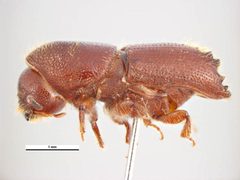
Distinguished from other Ips by five spines arranged in two rows on the declivity ( slope) of the . Ips avulsus has four spines; Ips calligraphus has six spines. The species is small, with typically 3-5 mm in length. The elytral declivity is concave with the spine rows flanking a central depression. Identification requires examination of the posterior elytra; similar species in the Dendroctonus lack the spine rows characteristic of Ips.
Images
Habitat
Pine forests and plantations. Colonizes freshly cut logs, slash, and weakened or stressed standing trees. In Jamaica, thrives mainly on freshly cut logs and weakened trees, with recent expansion to economic pest status in plantations. Successful attack on live trees is enhanced by mass of dispersing .
Distribution
Native to North America: Canada (Manitoba, Ontario, Quebec), United States (widespread in eastern and central states from Maine to Florida, west to Minnesota, Nebraska, and Texas), Mexico, Central America and Caribbean (Bahamas, Cuba, Dominican Republic, Guatemala, Honduras, Jamaica, Nicaragua). Introduced to Australia (New South Wales, Queensland, South Australia, Victoria, Western Australia).
Diet
Phloem of Pinus . Feeds on inner bark tissues of trees.
Host Associations
- Pinus caribaea - attacked in Jamaica
- Pinus elliottii - attacked in North America
- Pinus radiata - attacked in Australia and New Zealand plantings
- Pinus spp. - five Pinus attacked in Jamaica, four newly recorded for these scolytids on the island
Life Cycle
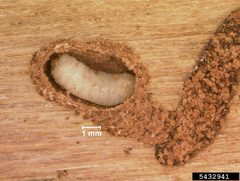
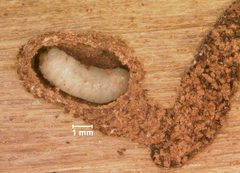
disperse to locate suitable material. Males initiate galleries and release . Females construct galleries branching from the central chamber. Eggs hatch into legless larvae that tunnel through phloem, creating characteristic engraver patterns. Some adults may re-emerge after oviposition to disperse to new food sources. muscles degenerate during oviposition and regenerate to allow subsequent flights. Mean eggs per gallery: 19.29 ± 3.04. Sex ratio at : approximately 50% female.
Behavior
Males are the primary finders and initiators of . Upon locating suitable host material, males bore into bark and produce ipsenol and other to aggregate conspecifics, including multiple females. Beetles respond to host volatiles including α-pinene. During host selection, beetles may reject trees with active resin exudation; continued boring and pheromone production occurs only in hosts where resin defenses are overcome or absent. Mass enhances attack success on living trees. losses are substantial: minimum 44% of lost during dispersal, with male losses (77.3%) higher than female losses (35.4%).
Ecological Role
Secondary colonizer of stressed, damaged, or recently killed pines. Contributes to nutrient cycling by accelerating decomposition of woody material. In natural forests, thins weakened trees. Can shift to primary pest status when aggregate on living trees, particularly in plantations or during drought stress. Associated with blue-staining fungi including Ophiostoma ips, which are vectored to trees. Serves as host for phoretic mites and parasitic .
Human Relevance
Economic pest in pine plantations, particularly in the southeastern United States, Jamaica, and Australia. Damage occurs when beetles colonize stressed or damaged trees, and subsequent mass attacks can kill apparently healthy trees. Can infest cut Christmas trees and stored logs. Management includes rapid utilization or treatment of felled timber, maintaining tree vigor, and monitoring for conditions. -based monitoring and mass trapping are used for management.
Similar Taxa
- Ips avulsusFour spines on elytral declivity versus five in I. grandicollis; smaller size; different blend
- Ips calligraphusSix spines on elytral declivity versus five in I. grandicollis; larger size; different gallery patterns
- Ips piniFive spines but different arrangement and body proportions; different chemistry (ipsdienol primary)
- Dendroctonus frontalisLacks spine rows on declivity entirely; different with distinct gallery architecture and
More Details
Pheromone chemistry
Produces ipsenol as primary ; also produces and responds to cis-verbenol and ipsdienol. Detects monoterpene α-pinene and interspecific compounds including frontalin and verbenone from Dendroctonus .
Associated organisms
Phoretic mites including Dendrolaelaps quadrisetus and Histiogaster arborsignis attach to dispersing and detach within trees. Mites feed on fungal including Ophiostoma ips. Parasitic Contortylenchus grandicolli coordinates its with the .
Flight muscle plasticity
Exhibits reversible muscle degeneration during reproductive phase, with enabling subsequent . This physiological allows resource tracking across ephemeral patches.
Sources and further reading
- BugGuide
- Wikipedia
- GBIF taxonomy match
- iNaturalist taxon
- NCBI Taxonomy
- Catalogue of Life
- Congrats to Antoine Abrieux, Innovator Fellow Award | Bug Squad
- Beetle Mania to Descend on the Bohart | Bug Squad
- Unhappy Christmas tree - Fivespined engraver, Ips grandicollis — Bug of the Week
- A thrips is a thrips… | Beetles In The Bush
- Insect-resistant Maize Could Increase Yields and Decrease Pesticide Use in Mexico
- How Systematic Entomology Will Thrive in the Age of Artificial Intelligence
- Ips grandicollis . [Distribution map].
- THE BIOLOGY OF IPS CALLIGRAPHUS AND IPS GRANDICOLLIS (COLEOPTERA: SCOLYTIDAE) IN JAMAICA
- Antennal olfactory responsiveness of three sympatricIps species [Ips avulsus (Eichhoff),Ips calligraphus (Germar),Ips grandicollis (Eichhoff)], to intra- and interspecific behavioral chemicals
- Behaviour of the bark beetle, Ips grandicollis , during host selection
- THE POPULATION DYNAMICS OF IPS GRANDICOLLIS (EICHHOFF) (COLEOPTERA: SCOLYTIDAE) IN JAMAICA
- Response of the beetle, Ips grandicollis, to combinations of host and insect produced attractants
- Co-Ordination of the Life-Cycle of Contortylenchus Grandicolli (Nematoda: Allantonematidae) With That of Its Host Ips Grandicollis (Scolytidae)
- Parasitic and phoretic nematodes associated with Ips grandicollis (Coleoptera: Scolytidae) in New South Wales, Australia
- Aggregation behaviour of the beetle Ips grandicollis in response to insect-produced attractants
- Aggregation behaviour of the beetle Ips grandicollis in response to host-produced attractants
- Population Dynamics ofIps piniandIps grandicollisin Red Pine Plantations in Wisconsin: Within- and Between-Year Associations with Predators, Competitors, and Habitat Quality
- Behaviours of phoretic mites (Acari) associated with Ips pini and Ips grandicollis (Coleoptera: Curculionidae) during host‐tree colonization
- Role of Ipsdienol, Ipsenol, and <I>cis</I>-Verbenol in Chemical Ecology of <I>Ips avulsus</I>, <I>Ips calligraphus</I>, and <I>Ips grandicollis</I> (Coleoptera: Curculionidae: Scolytinae)
- RESPONSE OF IPS GRANDICOLLIS (EICHHOFF) ADULTS (COLEOPTERA;SCOLYTIDAE) TO SITES IN BARK INITIATED BY OTHERS OF THE SAME SPECIES
- Influence of cell viability of freshly felled Pinuselliottii on the subcortical community associated with Ipsgrandicollis (Coleoptera: Scolytidae)