
Ips avulsus
(Eichhoff, 1868)
Small Southern Pine Engraver
Ips avulsus, the small southern pine engraver, is a bark beetle in the Curculionidae. It colonizes pine , primarily attacking the lower bole of stressed or damaged trees. The uses a blend of ipsdienol and lanierone for , with responses to influenced by context and spatial arrangement. It cohabits trees with other Ips species and Dendroctonus frontalis, showing differential attack height partitioning.
Pronunciation
How to pronounce Ips avulsus: /ɪps əˈvʊlsəs/
These audio files are automatically generated. While they are not always 100% accurate, they are a good starting point.
Identification
Distinguished from sympatric Ips by attack height preferences (lower bole, 0.3-2.0 m), blend composition (ipsdienol and lanierone), and differential response to enantiomeric ratios of ipsdienol. Ips calligraphus uses ipsdienol with cis-verbenol and trans-verbenol; Ips grandicollis uses ipsenol. Attack failure rate is notably higher than cohabiting species (45.5%).
Images
Appearance
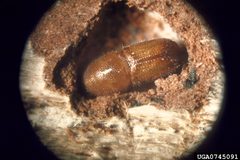
Small bark beetle with typical scolytine . possess paired spines on the declivity, characteristic of the Ips. Specific spine count and arrangement distinguish it from .
Habitat
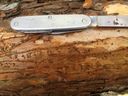
Bark and phloem of pine trees, specifically the lower bole region (0.3-2.0 m height). Found in loblolly pine plantations and pine forests where trees experience stress or damage.
Distribution
North America and Caribbean. Documented from southern United States pine forests, including North Carolina, South Carolina, and Florida.
Diet
Phloem tissue of pine trees. and larvae feed on inner bark.
Host Associations
- Pinus taeda - primary Loblolly pine; most abundant in studied
- Pinus - Pine generally
Behavior
Males initiate attacks on trees and excavate chambers. Females enter male-initiated galleries for mating; polygamous system with multiple females joining single male galleries. Shows context-dependent responses to components, with attraction to ipsdienol modified by presence of ipsenol, lanierone, and spatial separation of sources. Host monoterpene α-pinene increases attraction when released 4 m from pheromone source but reduces catches when collocated.
Ecological Role
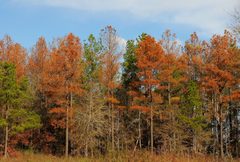
Primary colonizer of stressed and damaged pine trees. Contributes to tree mortality in association with other bark beetles. Attacks trees with lowest oleoresin flow and highest crown damage ratings among cohabiting . Induces resin response in trees; attacked trees exude approximately three times more resin than control trees.
Human Relevance
Forest pest contributing to pine tree mortality, particularly during drought or stress conditions. Subject of chemical research for -based monitoring and management. Cedar oil products have been tested for preventing .
Similar Taxa
- Ips calligraphusSympatric with overlapping range; distinguished by blend (includes cis-verbenol and trans-verbenol), attack height (upper bole), and preference for less stressed trees
- Ips grandicollisSympatric ; distinguished by composition (ipsenol rather than ipsdienol/lanierone) and different attack patterns
- Dendroctonus frontalisCohabiting bark beetle with mid-bole attack height; distinguished by different chemistry and reproductive
More Details
Chemical ecology
blend of ipsdienol and lanierone; enantiospecific response to ipsdienol depends on context including co-baits ipsenol and lanierone. Responses shaped by interspecific interactions and absence of conspecifics or related .
Attack dynamics
Highest proportion of unsuccessful attacks (45.5%) and lowest gallery among cohabiting Dendroctonus frontalis, Ips avulsus, and I. calligraphus. Preferentially attacks most suppressed and damaged trees with lowest oleoresin flow.
Sources and further reading
- BugGuide
- Wikipedia
- GBIF taxonomy match
- iNaturalist taxon
- NCBI Taxonomy
- Catalogue of Life
- Congrats to Antoine Abrieux, Innovator Fellow Award | Bug Squad
- Beetle Mania to Descend on the Bohart | Bug Squad
- Unhappy Christmas tree - Fivespined engraver, Ips grandicollis — Bug of the Week
- A thrips is a thrips… | Beetles In The Bush
- Insect-resistant Maize Could Increase Yields and Decrease Pesticide Use in Mexico
- How Systematic Entomology Will Thrive in the Age of Artificial Intelligence
- Feeding and Reproductive Behavior of Ips Avulsus
- Antennal olfactory responsiveness of three sympatricIps species [Ips avulsus (Eichhoff),Ips calligraphus (Germar),Ips grandicollis (Eichhoff)], to intra- and interspecific behavioral chemicals
- Host Colonization by Cohabiting Dendroctonus frontalis, Ips avulsus, and I. calligraphus (Coleoptera: Scolytidae)1
- Synergistic effect of a pheromone and a kairomone on host selection and colonisation by Ips avulsus
- Enantiospecific response of Ips avulsus (Coleoptera: Curculionidae: Scolytinae) to ipsdienol depends on semiochemical context
- Effectiveness of Cedar Oil Products for Preventing Host Use by Ips avulsus (Eichhoff) (Coleoptera: Curculionidae) in a Modified Small-Bolt Assay
- Role of Ipsdienol, Ipsenol, and <I>cis</I>-Verbenol in Chemical Ecology of <I>Ips avulsus</I>, <I>Ips calligraphus</I>, and <I>Ips grandicollis</I> (Coleoptera: Curculionidae: Scolytinae)
- Host odour alpha-pinene increases or reduces response of Ips avulsus (Coleoptera: Curculionidae: Scolytinae) to its aggregation pheromone, depending on separation of release points
- Tree resin flow dynamics during an experimentally induced attack by Ips avulsus, I. calligraphus, and I. grandicollis
- No Evidence of Responding Individuals Constraining the Evolution of the Pheromone Signal in the Pine Engraver Ips avulsus.