
Dendroctonus frontalis
Zimmermann, 1868
southern pine beetle, SPB
Dendroctonus frontalis, the southern pine , is a bark beetle native to pine forests of the southern United States, Mexico, and Central America. It is the most economically destructive forest pest in the southern U.S., causing over $900 million in damage from 1960-1990 and over $1 billion during a 1998-2002 . The beetle is eruptive, with remaining and difficult to detect for long periods, then rapidly increasing to outbreak levels when silvicultural conditions favor overstocked, even-aged pine stands. and larvae feed on phloem, typically killing trees. The has recently expanded its range to the northeastern United States, where it is considered .
Pronunciation
How to pronounce Dendroctonus frontalis: //dɛnˈdɹɒktənəs fɹɒnˈtaɪlɪs//
These audio files are automatically generated. While they are not always 100% accurate, they are a good starting point.
Identification
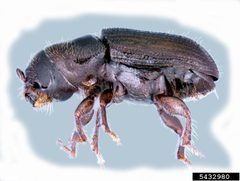
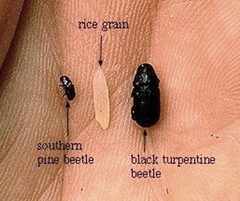
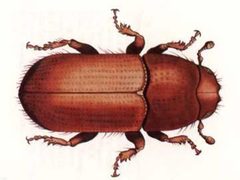
measure approximately 3 mm, about the size of a grain of rice. The is reddish brown to black. The is short-legged. Males have a notched front of the ; females possess a wide elevated transverse ridge. The hind is round in both sexes.
Images
Habitat
Pine forests, particularly overstocked, even-aged, large pine stands. In natural conditions, the is rare and rarely causes . Silvicultural practices that create dense, uniform pine stands promote outbreak conditions.
Distribution
Native to the southern United States, Mexico, and Central America. In the U.S., documented in Alabama, Arizona, Arkansas, California, Delaware, Florida, Georgia, Kentucky, Louisiana, Maryland, Mississippi, North Carolina, Oklahoma, Pennsylvania, South Carolina, Tennessee, Texas, Virginia, and West Virginia. Recently expanded to the northeastern United States, where it is considered . Also present in Central America: Belize, El Salvador, Guatemala, Honduras, and Nicaragua.
Diet
Phloem of pine trees.
Life Cycle
are deposited in created by females within the phloem of trees. Larvae feed on phloem, creating galleries as they develop. Development to adulthood takes approximately 30 days in summer. emerge from trees after completing development.
Behavior
Females initiate attacks on trees, selecting pines that are stressed or damaged. Females release the frontalin, which attracts both males and females to the tree. This mass attack overwhelms host defenses and leads to tree . The exhibits eruptive , with long periods of low punctuated by rapid increases.
Ecological Role
Major disturbance agent in pine forest . Drives forest dynamics through extensive tree mortality, creating gaps and altering stand structure. Interactions with associated organisms include phoretic mites and fungal . The blue-stain fungus Ophiostoma minus and the mycangial fungus Ceratocystiopsis sp. are associated with the and contribute to tree death.
Human Relevance
The most economically important forest insect in the southern U.S. timber industry. Caused estimated losses of $900 million from 1960-1990 and over $1 billion from a 1998-2002 in the southern Appalachians. Management relies on silvicultural practices including thinning and rapid detection and removal of . The Southern Pine Prevention Program, established in 2003, has facilitated proper management of over one million acres of pine lands through congressional funding appropriation.
Similar Taxa
- Dendroctonus terebransBlack turpentine ; colonizes the lower few feet of the trunk while D. frontalis congregates higher up. D. frontalis responds to chemical signals from D. terebrans, including frontalin and exo-brevicomin, which may facilitate location.
- Dendroctonus brevicomisWestern pine ; shares common components including frontalin, endo-brevicomin, trans-verbenol, verbenone, and myrtenol. D. frontalis responds positively to exo-brevicomin, an pheromone produced by D. brevicomis, even outside their zone of sympatry.
- Dendroctonus mesoamericanus with which D. frontalis shares chemical and associations; both discriminate odors from and heterospecific .
Sources and further reading
- BugGuide
- Wikipedia
- GBIF taxonomy match
- iNaturalist taxon
- NCBI Taxonomy
- Catalogue of Life
- The Day That The Beetles Invaded the Bohart | Bug Squad
- Encyrtid Holdings | Entomology Research Museum
- Southern Pine Beetle: How a Fellow Species May Help in Host Location
- Managing Southern Pine Beetle Infestations in a Changing Forest Environment
- Communication is Power: Here's How Entomologists Can Use It
- Eastern Larch Beetle Outbreak Keeps Going When Winter's Not So Cold
- Dendroctonus frontalis Zimmermann. [Distribution map].
- Dendroctonus frontalis . [Distribution map].
- Southern Pine Beetle Dendroctonus frontalis (Coleoptera: Curculionidae: Scolytinae)
- TARSONEMID MITE ASSOCIATES OF DENDROCTONUS FRONTALIS (COLEOPTERA: SCOLYTIDAE): IMPLICATIONS FOR THE HISTORICAL BIOGEOGRAPHY OF D. FRONTALIS
- TOXICITY OF HOST MONOTERPENES TO DENDROCTONUS FRONTALIS AND IPS CALLIGRAPHUS (COLEOPTERA: SCOLYTIDAE)
- Electrophysiological and Behavioral Responses of Dendroctonus frontalis (Coleoptera: Curculionidae) to Volatiles Isolated from Conspecifics
- Discrimination of Odors Associated With Conspecific and Heterospecific Frass by Sibling Species Dendroctonus frontalis (Coleoptera: Curculionidae: Scolytinae) and Dendroctonus mesoamericanus (Coleoptera: Curculionidae: Scolytinae)
- Attraction of the Southern Pine Beetle, Dendroctonus frontalis, to Pheromone Components of the Western Pine Beetle, Dendroctonus brevicomis (Coleoptera: Curculionidae: Scolytinae), in an Allopatric Zone