
Dendroctonus terebrans
(Olivier, 1800)
Black Turpentine Beetle
Dendroctonus terebrans, the black turpentine , is the largest bark beetle in the southeastern United States. It attacks pine trees near the base of the trunk and in stumps, typically targeting stressed or freshly cut trees. Unlike the more destructive southern pine beetle (D. frontalis), it rarely kills healthy trees outright but can contribute to tree mortality through sustained feeding damage and by vectoring blue-stain fungi. The produces and responds to complex , including frontalin and brevicomin, which facilitate mass attack and may mediate interactions with other bark beetle species.
Pronunciation
How to pronounce Dendroctonus terebrans: //dɛnˈdrɒktənəs ˈtɛrəbrænz//
These audio files are automatically generated. While they are not always 100% accurate, they are a good starting point.
Identification
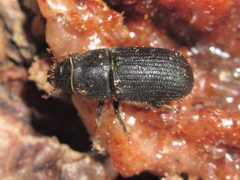
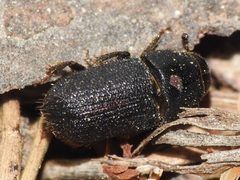
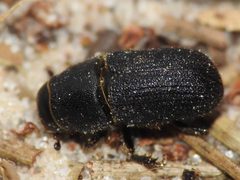
Distinguished from other Dendroctonus by its larger size (5–8 mm vs. 2–4 mm for most ), attack location on the lower bole and stumps rather than upper trunk, and less destructive impact on trees. The gallery pattern—initially horizontal then turning vertically downward, often extending below ground level—differs from the more complex patterns of D. frontalis. Pitch tubes at the base of the trunk are pinkish from resin mixed with wood dust. Distinguished from D. valens (red turpentine ) by geographic range; the two species overlap very little, with D. terebrans primarily in the eastern coastal plain and D. valens more widespread inland.
Images
Habitat
Pine forests, particularly in the coastal plain. Attacks living pine trees near the base of the trunk (lower few feet) and freshly cut pine stumps. Strongly attracted to volatile chemicals from freshly cut pine stumps and stressed trees. Often found in association with trees simultaneously attacked by Ips spp. (engraver beetles) and Dendroctonus frontalis.
Distribution
Native to eastern United States. Range extends from New Hampshire south through the coastal plain to Florida, and westward to Texas and Missouri. Attacks both native pines and pine .
Seasonality
In Florida, breeding occurs year-round with up to three overlapping . Activity peaks vary by region but generally coincide with warmer months when and are optimal.
Diet
and larvae feed on phloem tissue of pine trees (Pinus spp.). Larvae tunnel through surface layers of sapwood, creating galleries packed with .
Host Associations
- Pinus spp. - Both native and pine ; specifically noted for loblolly pine (P. taeda)
- Leptographium terebrantis - Blue-stain fungus vectored by the ; weak that contributes to tree mortality in combination with beetle damage
- Leptographium serpens - Additional blue-stain fungus associate
Life Cycle
Females initiate attacks by tunneling into bark, overcoming resin defenses to create pinkish pitch tubes at entry sites. After successful entry, females excavate galleries—initially horizontal, then vertically downward, often below ground level—for approximately two weeks. Males join females, and females lay about 100 along one side of the gallery. Eggs hatch in 10–14 days. Larvae fan out and feed side by side through sapwood surface layers, creating -packed galleries. Upon completing development, larvae tunnel individually to create chambers. emerge, disperse, and seek new . In Florida, three overlapping occur annually with year-round breeding.
Behavior
Exhibits mass attack facilitated by . Females are pioneering attackers that release frontalin and trans-verbenol to attract males and additional females. Males produce endo-brevicomin, exo-brevicomin, and myrtenol. The responds synergistically to resin monoterpenes (α-pinene, β-pinene) combined with pheromones. Produces that attract the southern pine (D. frontalis), potentially acting as a source for this more destructive . Can blue-stain fungi to host trees, contributing to tree mortality beyond direct feeding damage.
Ecological Role
Primary bark beetle of pine forests that contributes to tree mortality and forest disturbance dynamics. Acts as a pioneer that may facilitate attack by more aggressive bark beetles through signaling. blue-stain fungi (Leptographium spp.) that further compromise tree health. Provides and food resources for including the introduced European Rhizophagus grandis, which is attracted to larval and has been investigated for .
Human Relevance
Economic pest of pine forestry, though less destructive than D. frontalis. Damage is concentrated in the lower bole and stumps, reducing timber value. Management typically focuses on removing stressed trees and fresh stumps that attract beetles. using Rhizophagus grandis was investigated with releases in Louisiana in 1988. -based monitoring and management approaches have been developed. Firewood from infested trees can spread the pest to new areas.
Similar Taxa
- Dendroctonus frontalisShares and geographic range; distinguished by smaller size, upper trunk attack location, more destructive mass attacks, and more complex gallery patterns. D. terebrans produces that attract D. frontalis, potentially facilitating its attacks.
- Dendroctonus valensSimilar size and (red turpentine ); distinguished by more widespread distribution in eastern North America with minimal range overlap, and reddish coloration. Gallery patterns are similar.
- Dendroctonus rhizophagusMexican bark beetle with similar gallery patterns on pine; distinguished by geographic restriction to Mexico and different chemistry.
- Ips spp.Engraver beetles often found attacking same trees; distinguished by smaller size, different gallery patterns (Y- or H-shaped), and attack of upper trunk and branches rather than base.
More Details
Semiochemical Ecology
D. terebrans has one of the most thoroughly documented systems among bark beetles. Females produce frontalin (primary pheromone) and trans-verbenol from α-pinene; males produce endo-brevicomin, exo-brevicomin, and myrtenol. The exhibits strong electrophysiological and behavioral responses to D. frontalis pheromones, suggesting complex interspecific chemical communication that may mediate host-sharing and facilitation.
Biological Control Investigations
The European predatory Rhizophagus grandis, normally a of the great spruce bark beetle (Dendroctonus micans), was found to be attracted to from D. terebrans larvae. An experimental release of R. grandis from Belgium occurred in Louisiana in 1988 to evaluate potential for , though operational programs were not established.
Sources and further reading
- BugGuide
- Wikipedia
- GBIF taxonomy match
- iNaturalist taxon
- NCBI Taxonomy
- Catalogue of Life
- The Day That The Beetles Invaded the Bohart | Bug Squad
- Publications | Entomology Research Museum
- Southern Pine Beetle: How a Fellow Species May Help in Host Location
- Managing Southern Pine Beetle Infestations in a Changing Forest Environment
- Eastern Larch Beetle Outbreak Keeps Going When Winter's Not So Cold
- Pheromone Treatment Puts Up the "No Vacancy" Sign for Douglas-Fir Beetles
- Pathogenicity of Blue-Stain Fungi Associated with Dendroctonus terebrans
- Leptographium terebrantis sp. nov. associated with dendroctonus terebrans in loblolly pine
- Kairomonal‐pheromonal system in the black turpentine beetle, Dendroctonus terebrans (Ol.)1
- Antennal olfactory responses of black turpentine beetle,Dendroctonus terebrans (Olivier), to bark beetle pheromones and host terpenes
- Potential for a minor pine bark beetle pest, Dendroctonus terebrans (Coleoptera: Curculionidae: Scolytinae), to mediate host location by a major pine killer, Dendroctonus frontalis
- Correction to: Electrophysiological and behavioral responses Dendroctonus frontalis and D. terebrans (Coleoptera: Curculionidae) to resin odors of host pines (Pinus spp.)
- Electrophysiological and behavioral responses Dendroctonus frontalis and D. terebrans (Coleoptera: Curculionidae) to resin odors of host pines (Pinus spp.)