
Dendroctonus valens
LeConte, 1859
Red Turpentine Beetle
Dendroctonus valens is a bark beetle native to North and Central America, ranging from Canada to Honduras. In its native range, it primarily colonizes stumps of freshly cut trees and stressed or damaged conifers, causing minimal economic damage. Following its accidental introduction to China in the mid-1990s, likely via wood packaging material, it has become a highly destructive pest. In China, it attacks healthy as well as stressed pine trees, particularly Pinus tabuliformis, and has killed over six million trees. The exhibits complex mating involving acoustic signals and chemical , and maintains symbiotic relationships with fungi and bacteria that assist in nutrition and detoxification of plant defenses.
Pronunciation
How to pronounce Dendroctonus valens: /dɛnˈdrɒk.tə.nəs ˈveɪ.lɛnz/
These audio files are automatically generated. While they are not always 100% accurate, they are a good starting point.
Identification
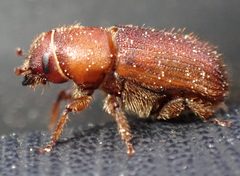
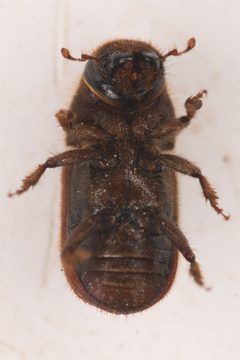
Distinguished from other Dendroctonus by its larger size (6–10 mm, making it among the largest North American bark beetles), dark reddish-brown coloration, and preference for the lower trunk and root collar of trees. Distinguished from the related black turpentine (Dendroctonus terebrans) by geographic range—D. terebrans occurs in eastern North America while D. valens is western and more broadly distributed. In China, confirmed identification requires examination of gallery patterns and morphological features, as multiple bark beetles may be present. Antennal club shape and distribution differ from D. rhizophagus: D. valens lacks the clustered long sensilla basiconica in the third sensory band present in D. rhizophagus.
Images
Appearance
are 6–10 mm long, approximately twice as long as wide. Newly emerged adults are tan, darkening to dark reddish-brown within days. The body is cylindrical with a typical bark beetle form. are cylindrical with rounded ends, white, opaque, shiny, and about 1 mm long. Larvae are white, legless with brown and brown abdominal tips; fully grown larvae reach 10–12 mm and develop lateral rows of pale brown . Pupae are white and exarate, with free and legs not enclosed in a cocoon.
Habitat
In native range: coniferous forests, particularly pine, spruce, and fir; colonizes stumps of freshly felled trees, recently dead trees, and stressed or fire-damaged standing trees. In China: plantations and natural stands of Pinus tabuliformis and Pinus armandii, primarily at elevations of 600–2,000 m. Forest structure influences invasion success: higher forest coverage within 250 m reduces into disturbed areas, while forest isolation promotes spread following disturbance events.
Distribution
Native: North America from Canada (Alberta, British Columbia, Manitoba, New Brunswick, Newfoundland, Northwest Territories, Nova Scotia, Ontario, Quebec, Saskatchewan) through the United States (widespread including western, central, and eastern states) to Mexico, Guatemala, and Honduras. Introduced: China (Shanxi, Hebei, Henan, Shaanxi, Nei Mongol, Liaoning provinces), where first detected in Shanxi Province in 1999. Has potential to spread further across Eurasia given suitable availability.
Seasonality
In northern native range: active May–October with single per year; larvae may take more than one year to mature and overwinter in roots. In southern native range: potentially active year-round with multiple overlapping generations. In China: overwinter in pupal chambers, emerge in fall, and disperse mid-April to mid-May; peak activity late May through early June. Flight period spans approximately 20 days with peak on day 21 post-.
Diet
Phloem and cambium tissue of coniferous trees. In North America: primarily attacks white fir (Abies concolor), various spruce (Picea) , and pine (Pinus) species. In China: primarily Manchurian red pine (Pinus tabuliformis), occasionally Chinese white pine (Pinus armandii).
Host Associations
- Pinus tabuliformis - primary Main in China; extensive mortality documented
- Pinus armandii - secondary Occasionally attacked in China
- Abies concolor - Native North American range
- Picea spp. - Various spruce in native range
- Pinus spp. - Various pine throughout native range
Life Cycle
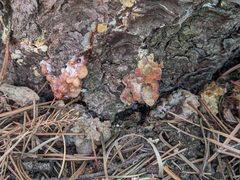
Females initiate gallery construction in phloem, excavating vertical galleries and laying in small clusters along one side. Eggs incubate while enlarge galleries. Larvae hatch and construct large communal galleries in phloem and cambium, filling them with . Development takes two months or more; rate is temperature-dependent. Larvae have five instars with capsule widths of 0.64, 0.83, 1.16, 1.45, and 1.99 mm, following with ratio of increase of 1.33. occurs in individual within the communal chamber or in short side galleries. In China: egg duration ~10 days, larval duration ~84 days, pupal duration ~10 days. Adults emerge, darken to reddish-brown over approximately 10 days, then disperse.
Behavior
Exhibits monogamous mating system. Females construct entrance galleries and emit for long-distance male attraction and acoustic signals (stridulation) for short-range attraction. Males prefer larger females, assessed via tunnel dimensions and acoustic signal intensity; louder chirps correlate with larger body size and higher . Males remain in gallery post-mating, blocking the entrance to ensure monogamy. Both sexes produce "agreement sounds" during courtship, forming acoustic duets. Uses mass attack strategy in China: initial aggregation pheromones attract conspecifics to overcome tree defenses, then anti-aggregation pheromones prevent overexploitation. Attracted to including (+)-α-pinene, (−)-β-pinene, and (+)-3-carene; repelled by non-host volatiles including 1-octen-3-ol, (Z)-3-hexen-1-ol, and (E)-2-hexen-1-ol.
Ecological Role
In native range: acts as decomposer of dead and dying conifer wood, contributing to nutrient cycling; generally considered a secondary pest that exploits stressed . In China: primary pest causing extensive tree mortality, altering forest composition and structure. Associated with ophiostomatalean fungi (32 documented, including Ceratocystiopsis, Leptographium, Ophiostoma) that may contribute to tree decline; fungal association involves external potentially mediated by phoretic mites. Maintains gut microbial including nitrogen-fixing bacteria (Raoultella terrigena) and uricolytic bacteria (Pseudomonas, Serratia, Rahnella) that compensate for nitrogen-limited phloem diet and assist in detoxification of host monoterpenes. Yeast symbionts (Candida nitratophila, Ogataea spp.) transform precursors and assimilate complex .
Human Relevance
In native range: minor forestry pest of limited economic concern; occasionally present in salvage operations. In China: major forest pest causing severe ecological and economic damage—over six million Pinus tabuliformis killed across more than 500,000 hectares. Subject to programs using the predatory Rhizophagus grandis, which has been shown to attack D. valens in laboratory and field studies and is being mass-reared for release. Lindgren funnel traps baited with used for monitoring, though placement requires care as traps may attract beetles to susceptible areas. Research subject for understanding bark beetle invasion , chemical , and microbial .
Similar Taxa
- Dendroctonus terebransBlack turpentine is morphologically similar and occupies similar (lower trunk ), but restricted to eastern North America; distinguished by geographic separation and subtle morphological differences in antennal arrangement
- Dendroctonus rhizophagus with similar size and coloration; distinguished by antennal club shape and distribution—D. rhizophagus has clustered long sensilla basiconica in third sensory band absent in D. valens
- Dendroctonus frontalisSouthern pine beetle is smaller (2–4 mm), more aggressive tree-killer in native range, colonizes upper trunk rather than base, and produces different blend including exo-brevicomin
More Details
Invasion History in China
Introduced accidentally in mid-1990s, likely via wood packaging material from western North America. First detected Shanxi Province 1999; subsequently spread to Hebei, Henan, Shaanxi, Nei Mongol, and Liaoning. success attributed to: availability of naive without coevolved defenses, warm winters reducing mortality, low winter rainfall stressing trees, and association with ophiostomatalean fungi that may enhance .
Microbial Symbiosis
(approximately 6) maintains optimal conditions for bacterial production; deviations reduce verbenone production. Gut bacteria including Pseudomonas and Serratia degrade >50% of α-pinene within 24 hours , enabling detoxification of defenses. Yeast concentrate nitrogen and transform verbenol to verbenone, a key anti- pheromone.
Acoustic Communication
Females emit chirps at 689.1 Hz lasting 23.1 ms when exposed to frontalin; males respond with similar chirps. Sound production via stridulation serves multiple functions: mate attraction, courtship duets, , and territorial defense. Acoustic signals function at short range while operate at long range, creating a multimodal communication system.
Sources and further reading
- BugGuide
- Wikipedia
- GBIF taxonomy match
- iNaturalist taxon
- NCBI Taxonomy
- Catalogue of Life
- The Day That The Beetles Invaded the Bohart | Bug Squad
- Meet the 'Extreme Insects' Aug. 19 at Bohart Museum of Entomology Open House | Bug Squad
- UC Davis Seminars: Two USDA Forest Entomologists to Zero in on Bark Beetles | Bug Squad
- Southern Pine Beetle: How a Fellow Species May Help in Host Location
- Managing Southern Pine Beetle Infestations in a Changing Forest Environment
- Eastern Larch Beetle Outbreak Keeps Going When Winter's Not So Cold
- Dendroctonus valens . [Distribution map].
- Electrophysiological and behavioral responses of Dendroctonus valens to non-host volatiles Réponses électrophysiologiques et comportementales de Dendroctonus valens à des composés volatils non-hôtes
- Nitrogen-Fixing and Uricolytic Bacteria Associated with the Gut of Dendroctonus rhizophagus and Dendroctonus valens (Curculionidae: Scolytinae)
- Preliminary Study on Mechanism of Cold Stress on Dendroctonus valens Larvae
- Ophiostomatalean Fungi (Ascomycota, Ophiostomatales) Associated with Dendroctonus valens in Liaoning, China
- Effects of Forest Structure On Dendroctonus Valens Damage Under Natural and Human Disturbances
- Effects of simulated gut pH environment on gut bacterial pheromone production of Dendroctonus valens (LeConte)
- Field Response of Dendroctonus valens (Coleoptera: Scolytidae) and a Major Predator, Temnochila chlorodia (Coleoptera: Trogositidae), to Host Kairomones and a Dendroctonus spp. Pheromone Component1
- The Effects of Landscape Structure and Stand-Scale Factors on Dendroctonus Valens Damage Under Disturbance Conditions in North China
- Comparative Study of the Antennae of Dendroctonus rhizophagus and Dendroctonus valens (Curculionidae: Scolytinae): Sensilla Types, Distribution and Club Shape
- Pine Defensive Monoterpene α-Pinene Influences the Feeding Behavior of Dendroctonus valens and Its Gut Bacterial Community Structure
- Instar Numbers, Development, Flight Period, and Fecundity of Dendroctonus valens (Coleoptera: Curculionidae: Scolytinae) in China
- Microbiome and metabolome dynamics in phloem and rhizosphere of Pinus tabuliformis against Dendroctonus valens infestation
- Yeast Diversity Associated with Invasive Dendroctonus valens Killing Pinus tabuliformis in China Using Culturing and Molecular Methods
- Electrophysiological and Behavioral Responses ofDendroctonus valens(Coleoptera: Curculionidae: Scolytinae) to Four Bark Beetle Pheromones