
Toryminae
Walker, 1833
Genus Guides
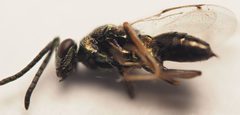
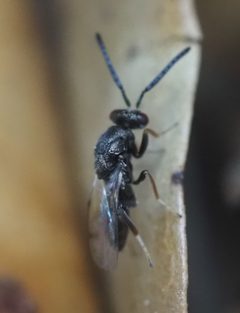
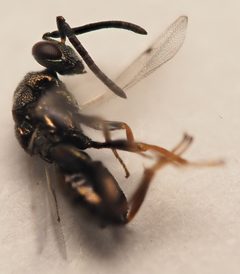
3Toryminae is a of chalcid wasps in the Torymidae. Members are primarily , with documented associations including gall wasps (Cynipidae) and . The subfamily includes the tribe Microdontomerini, which contains such as Microdontomerus iridis, an ectoparasitoid of praying mantid . European species have been studied for larval and phylogenetic relationships.
Pronunciation
How to pronounce Toryminae: //ˈtɔːrɪˌmaɪniː//
These audio files are automatically generated. While they are not always 100% accurate, they are a good starting point.
Images
Habitat
Varied; includes galls formed by gall wasps on plants, and riparian where occur. Specific habitat associations depend on host requirements.
Distribution
Europe, Mediterranean region including Greece, Spain, and Turkey. Distribution patterns reflect availability rather than -wide geographic constraints.
Host Associations
- Cynipidae (gall wasps) - European develop as within galls
- Mantodea (praying mantids) - Specifically ; documented for Microdontomerus iridis on Iris oratoria and Ameles sp.
Life Cycle
Terminal-instar larvae develop within structures. For gall-associated , development occurs inside galls. For -associated species, larvae develop as ectoparasitoids on within , with occurring on or removed from host eggs.
Behavior
Ectoparasitoid lifestyle documented for some ; larvae feed externally on while remaining within protective host structures.
Ecological Role
of other insects, contributing to of gall wasps and potentially .
Similar Taxa
- Torymidae other subfamiliesToryminae distinguished by specific associations and larval ; other may have different host ranges or larval development modes
More Details
Taxonomic note
Microdontomerus iridis was transferred from Torymus to Microdontomerus as a new combination, with the first description of the male and designation of a neotype, based on material from the Mediterranean region.
Sources and further reading
- BugGuide
- iNaturalist taxon
- NCBI Taxonomy
- Catalogue of Life
- Systematics, biology and distribution of Microdontomerus iridis (Picard, 1930), comb. n. (Hymenoptera, Torymidae, Toryminae, Microdontomerini), a parasitoid of Mantodea oothecae
- Comparative morphology, biology and phylogeny of terminal-instar larvae of the European species of Toryminae (Hym., Chalcidoidea, Torymidae) parasitoids of gall wasps (Hym. Cynipidae)
- Figures 20–25 from: Janšta P, Delvare G, Krogmann L, Schütte K, Peters RS (2016) Systematics, biology and distribution of Microdontomerus iridis (Picard, 1930), comb. n. (Hymenoptera, Torymidae, Toryminae, Microdontomerini), a parasitoid of Mantodea oothecae. Journal of Hymenoptera Research 48: 1-18. https://doi.org/10.3897/JHR.48.7470
- Figures 11–19 from: Janšta P, Delvare G, Krogmann L, Schütte K, Peters RS (2016) Systematics, biology and distribution of Microdontomerus iridis (Picard, 1930), comb. n. (Hymenoptera, Torymidae, Toryminae, Microdontomerini), a parasitoid of Mantodea oothecae. Journal of Hymenoptera Research 48: 1-18. https://doi.org/10.3897/JHR.48.7470
- Figures 1–4 from: Janšta P, Delvare G, Krogmann L, Schütte K, Peters RS (2016) Systematics, biology and distribution of Microdontomerus iridis (Picard, 1930), comb. n. (Hymenoptera, Torymidae, Toryminae, Microdontomerini), a parasitoid of Mantodea oothecae. Journal of Hymenoptera Research 48: 1-18. https://doi.org/10.3897/JHR.48.7470
- Supplementary material 1 from: Janšta P, Delvare G, Krogmann L, Schütte K, Peters RS (2016) Systematics, biology and distribution of Microdontomerus iridis (Picard, 1930), comb. n. (Hymenoptera, Torymidae, Toryminae, Microdontomerini), a parasitoid of Mantodea oothecae. Journal of Hymenoptera Research 48: 1-18. https://doi.org/10.3897/JHR.48.7470
- Figures 5–10 from: Janšta P, Delvare G, Krogmann L, Schütte K, Peters RS (2016) Systematics, biology and distribution of Microdontomerus iridis (Picard, 1930), comb. n. (Hymenoptera, Torymidae, Toryminae, Microdontomerini), a parasitoid of Mantodea oothecae. Journal of Hymenoptera Research 48: 1-18. https://doi.org/10.3897/JHR.48.7470