Iris oratoria
Linnaeus, 1758
Mediterranean mantis, iris mantis
Iris oratoria, commonly called the Mediterranean mantis, is a medium-sized praying mantis native to Europe, North Africa, and parts of Asia. The species has been introduced to the southwestern United States, where it was first recorded in southern California in the 1930s and continues to expand its range. reach approximately 6.5 cm in length and are distinguished by violet-brown eyespots on the hindwings that are displayed during threat responses. The species exhibits facultative and delayed from as adaptations that may contribute to its success.
Pronunciation
How to pronounce Iris oratoria: //ˈaɪ.ɹɪs ɒˈɹæ.tiːə//
These audio files are automatically generated. While they are not always 100% accurate, they are a good starting point.
Identification
Distinguished from sympatric Mantis religiosa by the red-orange spot on the side of the fourth abdominal segment and by shorter . Distinguished from Tenodera sinensis by more slender body form. Distinguished from Stagmomantis by the large violet-brown eyespots on the hindwings, visible when wings are spread; Stagmomantis species lack such prominent eyespots. Females with short wings may resemble some Stagmomantis species but are separable if hindwings are visible.
Images
Appearance
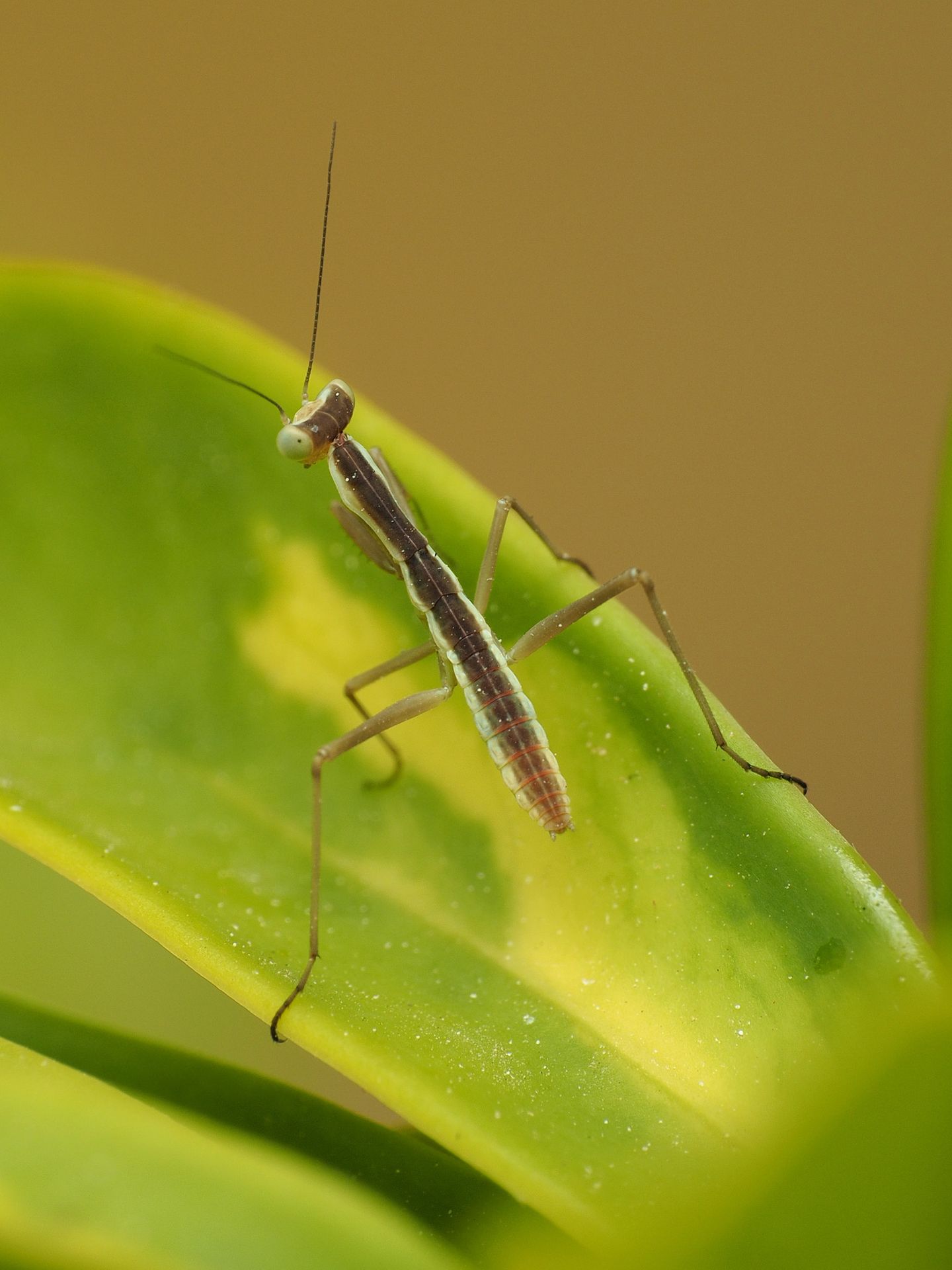
grow to approximately 6.5 cm (2.6 in) in length. Nymphs are very pale, maturing to grass green. The body is slender, similar in proportions to Mantis religiosa. Females have wings shorter than the . The hindwings bear two large, startling violet-brown eyespots that are concealed at rest and revealed when wings are unfolded. The side of the fourth abdominal segment (second to last) has a distinctive red-orange spot. are shorter than those of Mantis religiosa.
Habitat
Found in open, sunny including grasslands, meadows, agricultural fields, gardens, and disturbed areas. In the southwestern United States, occurs in urban and suburban environments as well as natural areas. Often associated with herbaceous vegetation where it can perch and ambush prey.
Distribution
Native to southern Europe (including Mediterranean islands), North Africa (Morocco to Egypt), and western and central Asia (Turkey to India). Introduced and established in the southwestern United States: Arizona, California, Nevada, and Texas. First recorded in southern California in the 1930s; range continues to expand.
Seasonality
In California, hatching occurs later in the season than Stagmomantis limbata; persist longer into the year, extending activity into late season. Nymphs may emerge from in a second season, one year after the was produced, creating overlapping .
Diet
of arthropods. Consumes a lesser proportion of Orthopteran insects compared to Stagmomantis limbata, and fewer long-bodied insects. Prey includes , flies, butterflies, bees, , caterpillars, and other soft-bodied insects. Prey size limited by predator body size and foreleg length.
Life Cycle
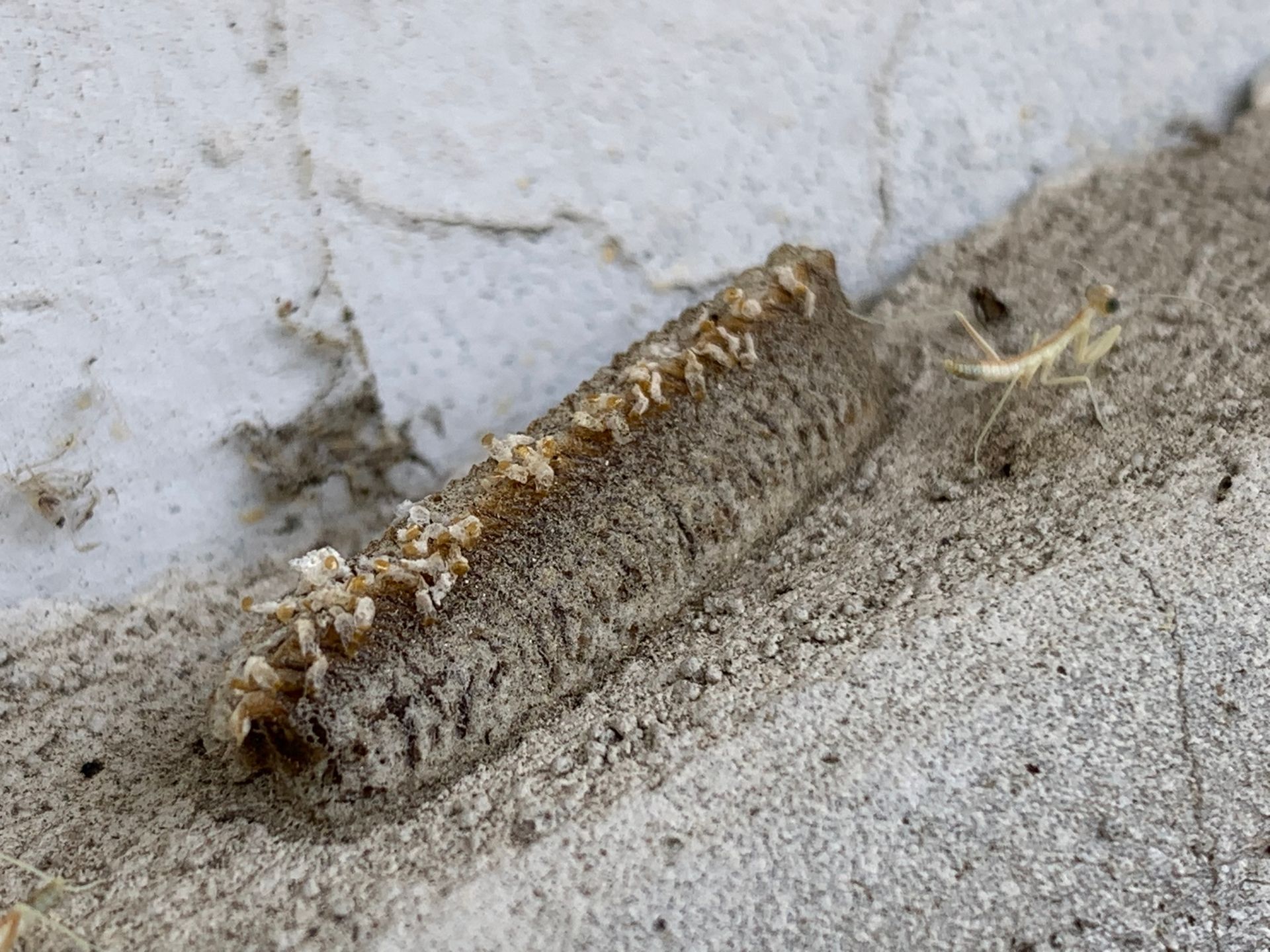
stage contained within . Nymphs undergo through multiple instars. Nymphs are pale, gradually darkening to grass green with maturity. Unique delayed : some nymphs may emerge from oothecae in the second season after production, when siblings from the same ootheca are already reproductive . Adults are short-lived; females produce oothecae.
Behavior
Ambush that waits motionless on vegetation to capture passing prey. Exhibits pronounced deimatic display when threatened: turns to aggressor, arches back, curls upward (dorsiflexion), raises and waves forelimbs, spreads wings to expose violet-brown eyespots, and stridulates by scraping hindwings against tegmina. Sexual occurs in approximately 25% of male-female encounters. Males exhibit risk-reduction during approach, preferring non-frontal mount attempts and approaching more quickly from rear positions. Capable of facultative when males are scarce.
Ecological Role
that contributes to . In invaded range, may compete with native such as Stagmomantis limbata through dietary overlap and temporal partitioning; its later-season persistence may reduce competitive pressure. Serves as prey for larger predators including birds, bats, and spiders.
Human Relevance
Introduced to the United States, where it is now established in the Southwest. Occasionally kept in captivity by insect enthusiasts. Subject of scientific study regarding , reproductive adaptations, and -prey interactions. Not considered a pest ; provides of other insects in gardens and agricultural settings.
Similar Taxa
- Mantis religiosaOverlaps in range and general size; distinguished by red-orange abdominal spot and shorter in I. oratoria, and by violet-brown hindwing eyespots not present in M. religiosa
- Tenodera sinensisSimilar size but more robust body; I. oratoria is more slender with distinctive hindwing eyespots
- Stagmomantis limbataNative California with similar female wing length; distinguished by absence of large violet-brown hindwing eyespots and earlier seasonal activity
- Stagmomantis carolinaEastern North American ; I. oratoria has displaced it in some areas through competitive exclusion and reproductive advantages
More Details
Invasive success mechanisms
Two reproductive traits may facilitate range expansion: facultative allows without males, and delayed nymph from enables persistence through unfavorable conditions and reduces .
Research significance
Frequently used as a model organism in studies of sexual , male mating under risk, and deimatic display evolution.
Sources and further reading
- BugGuide
- Wikipedia
- GBIF taxonomy match
- iNaturalist taxon
- NCBI Taxonomy
- Catalogue of Life
- Magical Mantis Moments | Bug Squad
- Meet 'Mantis Master Keeper' Andrew Pfeifer | Bug Squad
- UC Davis Doctoral Student Iris Quayle to Study Darkling Beetles in Africa | Bug Squad
- Congrats to UC Davis Scientists Iris Bright and Megan Ma: Selected for NSF REPS Program | Bug Squad
- Clover Research Published on St. Pat's Day: Luck o' the Irish? | Bug Squad
- Complexities Behind Ecosystem Services | Bug Squad
- THE RISK OF CANNIBALISM AND MALE MATING BEHAVIOR IN THE MEDITERRANEAN PRAYING MANTID, IRIS ORATORIA