
Tenodera sinensis
Saussure, 1871
Chinese mantis, Chinese praying mantis
Species Guides
1- Tenodera sinensis sinensis(Chinese praying mantis)
Tenodera sinensis is a large praying mantis native to China and Japan, accidentally introduced to North America in 1896 near Philadelphia, Pennsylvania. It has become widely established across the eastern and central United States and parts of the Pacific Northwest. This is among the largest mantids in North America and is known for its voracious predatory , including documented consumption of pests such as the brown marmorated stink bug and spotted lanternfly. Females are flightless or poor fliers, while males are capable of sustained . The species overwinters as in a hardened foam case called an .

Pronunciation
How to pronounce Tenodera sinensis: /tɛˈnoʊdərə sɪˈnɛnsɪs/
These audio files are automatically generated. While they are not always 100% accurate, they are a good starting point.
Identification
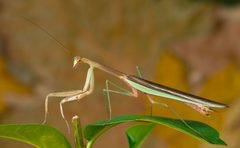
Tenodera sinensis is one of the largest in North America, with reaching up to 100 mm in body length. It can be distinguished from the native Carolina mantis (Stagmomantis carolina) by its substantially larger size and from the European mantis (Mantis religiosa) by the absence of the diagnostic black-and-white bullseye marking on the inner foreleg. Coloration ranges from green to brown, with individuals capable of changing color after molting. The is brown, Styrofoam-like, and typically deposited on upright vegetation. Males possess fully developed wings and fly at night; females have reduced wings and are effectively flightless.
Images
Habitat
Disturbed and weedy areas, often associated with man-made structures. Frequently found on flowering plants such as goldenrod in late summer, where they hunt . Also occupies gardens, meadows, agricultural fields, and woodland edges.
Distribution
Native to China, Japan, and nearby Asian islands. Introduced and established in North America: eastern United States (east of the Mississippi River), northward into Canada, and westward to the Pacific Northwest including Washington, Oregon, and California. Distribution records include Vermont and the conterminous 48 United States.
Seasonality
typically appear in September. Breeding season involves male . () deposited in autumn overwinter, with nymphs hatching in spring when temperatures warm and small insect prey become available. In temperate regions, the can complete its in approximately four months, though individuals may live six months to a year.
Diet
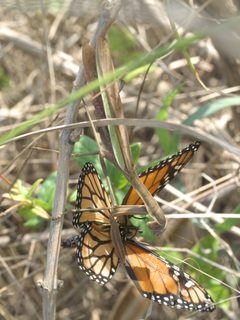
consuming a wide variety of arthropods including , flies, grasshoppers, caterpillars, butterflies, bees, , and spiders. Documented to prey on including brown marmorated stink bugs (Halyomorpha halys) and spotted lanternflies (Lycorma delicatula). Large females have been observed to capture and consume scorpions. Has been observed drinking water when deprived, and facultative omnivory has been demonstrated in captivity with consumption of banana.
Life Cycle
Overwinters as within a protective containing 100 or more embryos. Oothecae deposited on upright vegetation such as twigs or stems in autumn. Nymphs hatch in spring and undergo through multiple instars. mature in late summer, with males beginning approximately one week after reaching maturity. Females deposit one or more oothecae before winter.
Behavior
Sit-and-wait that employs active pursuit when starved and ambush tactics when sated. Hunting is modulated by internal physiological state: starved individuals exhibit stereotyped, prey-motivated sequences including increased prey monitoring, turns to track prey, translations to close distance, and strike attempts toward distant prey (≥15 cm). Sated individuals show more variable behavior, restricting attention to close-proximity prey (~5 cm) with reduced locomotor pursuit. Insulin injection can induce behavioral shift from active pursuit to ambush . Males fly at night and possess a single auditory organ between the second and third pair of legs adapted for bat echolocation detection. Females are flightless or capable only of short . can occur during courtship and mating, particularly when females are nutritionally stressed.
Ecological Role
Apex in many ; contributes to of agricultural and nuisance pests. Preys upon including brown marmorated stink bugs and spotted lanternflies, potentially mitigating their ecological and economic impacts. Serves as prey for vertebrate predators including bats (males employ auditory evasion). may be parasitized by .
Human Relevance
Widely kept in captivity by entomology enthusiasts and educators; popular for behavioral research due to its size and hardiness. Occasionally sold for garden pest control, though effectiveness is variable. sometimes accidentally transported on nursery stock or Christmas trees, leading to indoor hatching events. Not endangered or protected; legal to collect and keep.
Similar Taxa
- Mantis religiosaEuropean mantis shares introduced range in North America but distinguished by black-and-white bullseye marking on inner foreleg and smaller maximum size.
- Stagmomantis carolinaNative Carolina mantis is substantially smaller (typically half the size or less), with more limited distribution in eastern and central North America.
- Stagmomantis limbataNative to western North America; females employ signaling for mate attraction similar to T. sinensis but differs in and geographic range.
Sources and further reading
- BugGuide
- GBIF taxonomy match
- iNaturalist taxon
- NCBI Taxonomy
- Catalogue of Life
- Meet 'Mantis Master Keeper' Andrew Pfeifer | Bug Squad
- Decorations on the Christmas tree: Egg cases of the European mantis, Mantis religiosa, Chinese mantis, Tenodera sinensis, and Carolina mantis, Stagmomantis carolina — Bug of the Week
- Surviving winter, Part III: Egg cases of the Praying mantis, Mantis religiosa, Chinese mantis, Tenodera sinensis, and Carolina mantis, Stagmomantis carolina — Bug of the Week
- Decorations on the Christmas tree: Egg cases of the European mantis, Mantis religiosa, Chinese mantis, Tenodera sinensis, and Carolina mantis, Stagmomantis carolina — Bug of the Week
- From the Bug of the Week Mailbag: Non-native mantids, the European mantis, Mantis religiosa, and Chinese mantis, Tenodera sinensis, enjoying North American cuisine — Bug of the Week
- Death of a stink bug, Part 1: A curious reunion between the Brown Marmorated Stink Bug, Haylomorpha halys, and the Chinese Praying Mantis, Tenodera sinensis — Bug of the Week
- Internal state effects on behavioral shifts in freely behaving praying mantises (Tenodera sinensis)
- Courtship and mating behaviour of the Chinese praying mantis, Tenodera aridifolia sinensis
- A long-read draft assembly of the Chinese mantis (Mantodea: Mantidae: Tenodera sinensis ) genome reveals patterns of ion channel gain and loss across Arthropoda
- Prey capture in the praying mantis Tenodera aridifolia sinensis: coordination of the capture sequence and strike movements
- Non-Predatory Ingestive Behaviors of the Praying Mantids Tenodera aridifolia sinensis (Sauss.) and Sphodromantis lineola (Burr.)
- Microsatellite markers for the praying mantid Tenodera sinensis (Mantodea, Mantidae) and the demonstration of multiple paternity
- Predatory behavior changes with satiety or increased insulin levels in the praying mantis (Tenodera sinensis)
- Examinations of Female Pheromone use in Two Praying Mantids,Stagmomantis limbataandTenodera Aridifolia Sinensis(Mantodea: Mantidae)
- The Role of Central Complex Neurons in Prey Detection and Tracking in the Freely Moving Praying Mantis (Tenodera sinensis)
- Life History, Environment, and Deme Extinction in the Chinese Mantid <I>Tenodera aridifolia sinensis</I> (Mantodea: Mantidae)
- A long-read draft assembly of the Chinese mantis (Mantodea: Mantidae: Tenodera sinensis ) genome reveals patterns of ion channel gain and loss across Arthropoda