
Mantidae
mantids, mantid mantises
Subfamily Guides
4- Amelinae
- Mantinae(mantids)
- Stagmomantis(Carolina mantis)
- Vatinae(Unicorn Mantises)
is the largest in the order Mantodea, historically encompassing all mantises before modern classifications split the group into multiple families. Most are tropical or subtropical in distribution. The family contains ten recognized including Choeradodinae, Hierodulinae, Mantinae, and Stagmomantinae. The term "" technically refers only to members of this family, though it is commonly used more broadly for any mantis.
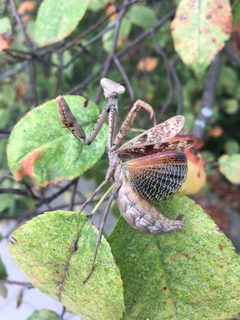
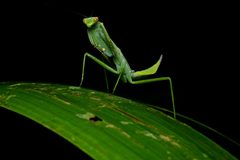
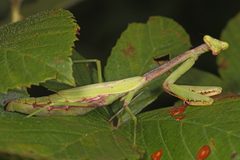
Pronunciation
How to pronounce Mantidae: //ˈmæn.tɪˌdiː//
These audio files are automatically generated. While they are not always 100% accurate, they are a good starting point.
Identification
is distinguished from other mantodean by morphological features including the structure of the prothorax and forelegs, though specific diagnostic characters vary by . Members of subfamily Choeradodinae possess expanded, leaf-like pronotal extensions. Stagmomantinae typically show sexually dimorphic features. The family historically encompassed all mantises, and modern classifications require careful examination of male genitalia and other structural features to separate from elevated families such as Iridopterygidae, Sibyllidae, and Thespidae.
Images
Habitat
Most occupy tropical and subtropical environments. Specific associations vary by and genus: Choeradodinae occur in forested habitats of the Americas and Asia; Hierodulinae range across Africa, Asia, and Australia in diverse terrestrial habitats; Stagmomantinae are restricted to the Americas; Tenoderinae occur in Africa, Asia, and North America. Some members, such as those in the genus Litaneutria, occupy arid grassland and desert habitats and have adopted (ground-running) predatory strategies.
Distribution
Widespread across all major biogeographic regions except Antarctica. distributions are geographically structured: Choeradodinae in the Americas and Asia; Deromantinae in Africa; Hierodulinae in Africa, Asia, and Australia; Mantinae in Africa, Eurasia, and North America; Mellierinae in Australia; Stagmomantinae in the Americas; Tenoderinae in Africa, Asia, and North America; Vatinae in South America.
Diet
All members are predatory, feeding on live prey. Specific prey preferences vary by and .
Life Cycle
Development includes (encased in ), nymph, and stages. is common, with females typically larger than males. Some exhibit brachyptery (short-winged condition), particularly in females. In at least one (Hondurantemna), males and females employ different camouflage strategies: males retain stick-like brown coloration, while females transform to leaf-mimicking green coloration with expanded, rounded forewings.
Behavior
Most are ambush , waiting motionless for prey. Some lineages, including ground-dwelling such as Litaneutria and Yersiniops, have evolved hunting strategies involving active pursuit of prey. These cursorial species are capable of rapid movement, hopping over obstacles and darting through vegetation.
Ecological Role
of other arthropods. Some have been introduced outside native ranges for , though the efficacy and ecological impacts of such introductions vary.
Human Relevance
The European mantis (Mantis religiosa), a member of this , was introduced to North America in the late 19th century, reportedly for pest control. Some have expanded their ranges through human-mediated transport, such as Hierodula tenuidentata, which has established in parts of Europe including the Balkan Peninsula. Mantids are commonly used in educational contexts and are popular in insect photography and citizen science observations.
Similar Taxa
- IridopterygidaeElevated from ; differs in morphological features of the forewing venation and prothoracic structure
- SibyllidaeElevated from ; differs in body form and foreleg spination
- ThespidaeElevated from ; contains formerly classified in Mantidae
- TarachodidaeElevated from ; differs in genitalia and body proportions
- ToxoderidaeElevated from ; contains specialized bark-mimicking
Misconceptions
The term "" is frequently used to refer to any mantis, but technically applies only to members of the . The term "mantis" properly refers to the Mantis, though it is widely used for any mantodean. Historically, Mantidae was the only recognized family in Mantodea, leading to confusion in older literature where all mantises were treated as mantids.
More Details
Taxonomic instability
The classification of Mantodea has undergone substantial revision. Recent treatments have elevated several former to rank, while other classifications have reduced subfamily numbers without elevating them. The 2019 revision recognized ten subfamilies within Mantidae: Choeradodinae, Deromantinae, Hierodulinae, Mantinae, Mellierinae, Omomantinae, Orthoderinae, Stagmomantinae, Tenoderinae, and Vatinae.
Phylogenetic context
belongs to the order Mantodea, which is placed within Dictyoptera alongside Blattodea (cockroaches and termites). Mantids are considered derived with morphological specializations for , including forelegs and an elongated prothorax.
Sources and further reading
- BugGuide
- Wikipedia
- GBIF taxonomy match
- iNaturalist taxon
- NCBI Taxonomy
- Catalogue of Life
- Litaneutria minor – agile ground mantid | Beetles In The Bush
- Male & female mantises differ in camouflage | Blog
- Hierodula tenuidentata Saussure, 1869 (Mantodea: mantidae) has settled down in Bosnia and Herzegovina Prvi nalaz bogomoljke Hierodula tenuidentata Saussure, 1869 (Mantodea: Mantidae) u Bosni i Hercegovini
- A synoptic review of the genus Stagmomantis (Mantodea: Mantidae)
- New northernmost records of the shield mantis Choeradodis rhombicollis (Latreille, 1833) (Mantidae: Choeradodinae) in Mexico
- Taxonomic revision of Stagmatoptera Burmeister, 1838 (Mantodea: Mantidae, Stagmatopterinae)
- Notes on the reproductive biology of Parastagmatoptera tessellata Saussure & Zehntner (Dictyoptera, Mantidae)
- On the identity and taxonomic status of the enigmatic mantid Thespoides bolivari Chopard, 1916 (Mantodea: Mantidae, Angelinae)
- Ampliación de la distribución de Antemna Rapax Stal 1877 (Mantodea: Mantidae) en Panamá, Costa Rica y Nicaragua Expansion of the distribution of Antemna Rapax Stal 1877 (Mantodea: Mantidae) in Panama, Costa Rica and Nicaragua
- Review of the genus Hierodula Burmeister (Mantodea: Mantidae) in Iran.