
Litaneutria
Saussure, 1892
American Ground Mantises
Species Guides
8- Litaneutria chaparrali
- Litaneutria elongata
- Litaneutria emarginata
- Litaneutria minor(Agile Ground Mantis)
- Litaneutria obscura(obscure ground mantis)
- Litaneutria ocularis(Obscure Ground Mantis)
- Litaneutria pacifica(Pacific Ground Mantis)
- Litaneutria skinneri(Skinner's Ground Mantis)
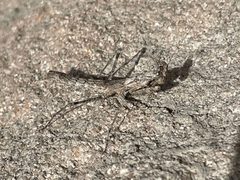
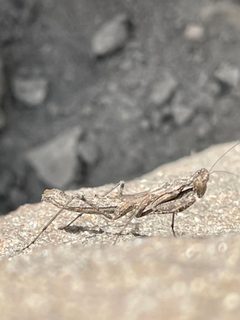
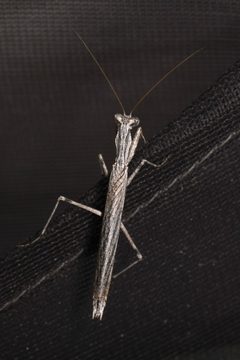
Litaneutria is a of ground mantises in the Amelidae, comprising approximately eleven distributed across North America. These small, mantids are distinguished by their exclusively terrestrial lifestyle, cryptic brown or gray coloration, and rounded . Unlike the ambush strategy typical of most mantids, Litaneutria species actively pursue prey on the ground. The genus includes the only native species in Canada (L. minor).
Pronunciation
How to pronounce Litaneutria: /ˌlɪtəˈnjuːtrɪə/
These audio files are automatically generated. While they are not always 100% accurate, they are a good starting point.
Identification
Members of Litaneutria can be distinguished from the other North American ground mantis Yersiniops by their rounded —Yersiniops has pointed tops to the eyes giving a 'horned' appearance. Litaneutria also tend toward brown coloration rather than the gray typical of Yersiniops. are small (typically under 40 mm), with females brachypterous and males usually possessing small wings with a spot at the forewing base. The pronotum is relatively smooth in males.
Images
Habitat
Desert and grassland across western North America. Specific records include shortgrass prairie in northwestern Nebraska and arid regions of the southwestern United States. These mantids occupy open, xeric environments with sparse vegetation where ground-running is advantageous.
Distribution
North America, with distributed across the western United States, Great Plains, southwestern Canada, and desert southwest. L. minor occurs broadly throughout the Great Plains and western U.S. into southwestern Canada; L. obscura is restricted to the desert southwest.
Diet
; preys on small arthropods. Specific prey items have not been documented in the available sources.
Behavior
that actively runs down prey rather than employing ambush tactics. Individuals hop over rocks and dart swiftly through sparse vegetation when pursuing prey or evading predators. This ground-running strategy represents a derived to open, dry with limited non-herbaceous vegetation.
Similar Taxa
- YersiniopsOther North American ground mantis ; distinguished by pointed 'horned' , gray coloration, and different pronotum structure
More Details
Taxonomic note
The was revised by Anderson (2021), which described multiple new and clarified species boundaries. Previous literature (e.g., BugGuide) listed additional U.S. species including L. borealis, but these were synonymized under L. minor by Hebard in 1935.
Evolutionary context
The ground-running strategy has evolved independently at least three times in mantids, always associated with transitions from woodlands to grassland in arid regions.