
Litaneutria minor
Scudder, 1872
Agile Ground Mantis, Minor Ground Mantid, Lesser Ground Mantid
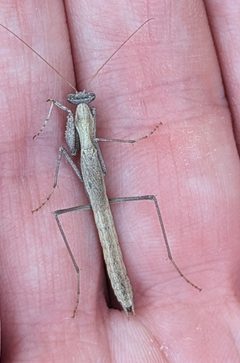
Litaneutria minor is a small ground-dwelling native to arid and semi-arid regions of North America. Unlike typical ambush-hunting mantids, it pursues prey actively across open ground. reach approximately 30 mm in length. Females are brachypterous (short-winged or wingless); males possess small wings but do not fly. The is notable for high rates of sexual during mating and is the only native mantid species in Canada.
Pronunciation
How to pronounce Litaneutria minor: //ˌlaɪtəˈnjuːtriə ˈmaɪnər//
These audio files are automatically generated. While they are not always 100% accurate, they are a good starting point.
Identification
Distinguished from other mantids by its ground-dwelling habit and (running) hunting rather than ambush posture. Separated from the Litaneutria obscura (restricted to desert southwest) by broader Great Plains distribution. Distinguished from Yersiniops (the other U.S. ground ) by rounded rather than pointed (horned) tops, and typically browner rather than greyer coloration. Fore lacks groove present in other mantid ; four spines on outer margin of fore femur.
Images
Appearance
measure approximately 30 mm in length. Body coloration is dark grey to dark tan, providing cryptic camouflage against ground substrates. are long and filamentous. Fore has four spines on the outer margin and lacks the groove typical of other mantids. Males possess eight abdominal segments and a brown spot near the base of the forewings. Females have six abdominal segments, a rough-textured pronotum, and are wingless or possess only wing pads. Most males are also brachypterous (short-winged).
Habitat
Open ground in dry and semi-arid regions, including shortgrass prairie, desert grasslands, and open scrub. Occupies areas with sparse vegetation where running pursuit of prey is feasible. Found at ground level or within a few centimeters above ground on small shrubs.
Distribution
North America: Great Plains and western United States from eastern Washington and southwestern Canada (southern Okanagan Valley, British Columbia—Canada's only native ) south through Colorado, Arizona, and Texas into Mexico.
Seasonality
Active from early spring through late summer. reach sexual maturity in late summer. Females lay in late summer and early fall. overwinter; nymphs emerge the following early spring. Adults die in fall.
Diet
. Prey includes , flies, grasshoppers, katydids, and crickets. Young nymphs feed mainly on small flies, transitioning to larger prey as they grow.
Life Cycle
stage overwinters in laid on twigs and branches. Ootheca measures 5–10 mm and contains 10–20 eggs. Nymphs emerge in early spring. Females undergo seven ; males undergo six molts. Terminal molt occurs mid to late summer for both sexes. live from late summer through fall.
Behavior
that actively runs down prey rather than employing typical ambush strategy. Hunts on open ground during sunny days, occasionally on low vegetation. Extremely aggressive: defends against predators by extending forearms and standing tall to appear larger. occurs among nymphs. Males locate females by following trails; approach slowly to avoid being mistaken for prey. Sexual cannibalism during mating occurs at unusually high frequency (nearly all females consume male's ).
Ecological Role
in arid and semi-arid grassland and desert . Controls of various insects including grasshoppers, crickets, and flies.
Human Relevance
Subject of entomological study due to unusual hunting strategy and extreme sexual . Potential interest for in appropriate , though not widely utilized. Occasionally encountered by collectors and naturalists in prairie and desert regions.
Similar Taxa
- Litaneutria obscuraCongeneric ground restricted to desert southwest; L. minor occurs more broadly in Great Plains and western U.S.
- Yersiniops speciesOther U.S. ground ; distinguished by pointed (horned) tops versus rounded eyes in Litaneutria, and typically greyer coloration.
- Typical arboreal mantids (Mantidae, etc.)Distinguished by ground-dwelling habit, running pursuit of prey, reduced or absent wings in females, and fore lacking typical groove.
More Details
Auditory adaptations
Unlike flying mantids that possess specialized ears detecting bat echolocation (60–120 kHz), L. minor has reduced hearing sensitivity (30–50 kHz), correlating with its flightless condition and lack of bat pressure.
Taxonomic note
Formerly placed in Mantidae; now classified in family Amelidae. Some sources list additional U.S. in Litaneutria, but these were synonymized under L. minor by Hebard in 1935.