
Mantis religiosa
(Linnaeus, 1758)
European mantis, praying mantis
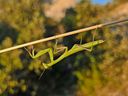
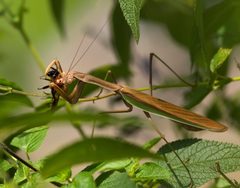
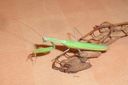
Mantis religiosa, the European mantis, is a large hemimetabolic insect native to Europe that has established widespread in North America since its introduction in 1899. It is distinguished by a diagnostic black spot with white center on the inner surface of each foreleg. The exhibits remarkable color , appearing in shades of green, brown, and bluish-green. Females deposit brown, Styrofoam-like () containing over 100 that overwinter and hatch in spring. Sexual occurs, with females sometimes consuming males during or after mating.
Pronunciation
How to pronounce Mantis religiosa: /ˈmantɪs rɪˈliːɡɪoʊsə/
These audio files are automatically generated. While they are not always 100% accurate, they are a good starting point.
Identification
Distinguished from other North American mantids by the black and white 'target' or 'bullseye' marking on the inner surface of the foreleg . This spot is absent in native Stagmomantis and the introduced Chinese mantis (Tenodera sinensis). European mantis is generally smaller than Tenodera sinensis. Carolina mantis (Stagmomantis carolina) is smaller, gray or brown, and lacks the foreleg spot.
Images
Appearance
Large hemimetabolic insect with elongated body and two pairs of wings. Coloration varies from green to brown to bluish-green within . Forelegs modified as appendages held in distinctive 'praying' posture at rest. Diagnostic black spot with white center (bullseye marking) on inner surface of each foreleg near body joint. Females larger and heavier than males; females often too large for wings to enable take-off. Males more slender and agile with functional capability.
Habitat
Found in gardens, meadows, agricultural fields, and open landscapes with herbaceous vegetation. Requires upright vegetation for hunting perches and deposition. Occupies diverse climates from temperate forests to deserts in its native range.
Distribution
Native to Europe, Asia, and Africa. Introduced to North America: first detected 1899 in New York State, now widespread east of the Mississippi River, northward into Canada, and established in Washington, Oregon, and California. Range expanding in British Columbia. Has achieved Holarctic distribution.
Seasonality
most visible in late summer and autumn when larger size makes them easier to spot. in overwinter; nymphs emerge in spring when temperatures warm and prey become available. Activity ceases with onset of cold weather.
Diet
consuming insects and other arthropods. Prey includes grasshoppers, caterpillars, crickets, fruit flies, milkweed bugs, and spiders. Has been observed feeding on fence lizards. Does not prey on large hairy caterpillars such as gypsy moth larvae.
Life Cycle
Hemimetabolous development without pupal stage. Female deposits one or more on upright vegetation (branches, stems) in autumn. Each ootheca contains 100+ that overwinter. Nymphs hatch in spring and progress through multiple instars, growing larger throughout summer. present in late summer and autumn. Sexual documented: females may consume males during or after mating.
Behavior
Sit-and-wait ambush relying on camouflage and rapid foreleg strike to capture prey. Males exhibit cautious approach toward females to avoid , using 'stop-and-go' tactics and approaching from behind while monitoring female movements. Males may display rocking behavior to mimic leaves. Males adjust copulation duration in response to perceived sperm competition risk. Possesses auditory organ (ear) on that detects ultrasonic bat echolocation; responds to bat detection by diving to ground. for mate-seeking exposes individuals to bat .
Ecological Role
contributing to . In North America, occupies different from native mantids by hunting at lower foliage levels and on ground, potentially competing with native . Documented predator of pests including brown marmorated stink bug and spotted lanternfly. May contribute to decline of native Litaneutria species and California mantis (Stagmomantis wheeleri) through competition.
Human Relevance
Introduced to North America as potential biocontrol agent; released in British Columbia 1937-1938 to combat grasshoppers. Now common in gardens and agricultural landscapes. Occasionally brought indoors on Christmas trees when deposited on evergreen branches; indoor warmth may cause premature hatching. Popular in captivity for behavioral observation. Protected in Poland (strict protection, Red Book status EN).
Similar Taxa
- Tenodera sinensis (Chinese mantis)Larger size, lacks diagnostic black-and-white foreleg spot, different structure. Both introduced to North America but Chinese mantis native to East Asia.
- Stagmomantis carolina (Carolina mantis)Native to North America, smaller size, gray or brown coloration, lacks foreleg spot. Range southeastern and central United States.
- Stagmomantis limbata (Arizona/bordered mantid)Native to western North America, lacks foreleg spot, different wing .
More Details
Sensory adaptations
Possesses a single ear (auditory organ) on the midline of the capable of detecting ultrasonic frequencies emitted by hunting bats. This enables evasive diving during .
Sperm competition
Males exhibit behavioral plasticity in response to perceived sperm competition risk, extending copulation duration when male-biased sex ratios indicate higher competition. Male condition affects both survival probability and copulation duration.
Introduction history
First North American record 1899 in New York State, likely arriving as stowaway in nursery stock from Europe. Subsequent intentional releases for biocontrol occurred, notably in British Columbia 1937-1938 for management.
Sources and further reading
- BugGuide
- GBIF taxonomy match
- iNaturalist taxon
- NCBI Taxonomy
- Catalogue of Life
- Meet a Male Mantis in a Patch of Blanket Flowers | Bug Squad
- Magical Mantis Moments | Bug Squad
- From the Bug of the Week Mailbag: Non-native mantids, the European mantis, Mantis religiosa, and Chinese mantis, Tenodera sinensis, enjoying North American cuisine — Bug of the Week
- Old World mantis with New World tastes: European Mantis, Mantis religiosa — Bug of the Week
- Surviving winter, Part III: Egg cases of the Praying mantis, Mantis religiosa, Chinese mantis, Tenodera sinensis, and Carolina mantis, Stagmomantis carolina — Bug of the Week
- Decorations on the Christmas tree: Egg cases of the European mantis, Mantis religiosa, Chinese mantis, Tenodera sinensis, and Carolina mantis, Stagmomantis carolina — Bug of the Week
- European mantis Mantis religiosa (Linnaeus, 1758) in Poland: identification and handling
- AN EXPERIMENTAL ANALYSIS OF THE SEXUAL BEHAVIOR OF THE PRAYING MANTIS (MANTIS RELIGIOSA L.)
- Males Respond to the Risk of Sperm Competition in the Sexually Cannibalistic Praying Mantis,Mantis religiosa
- Distribution of Mantis religiosa (L.) and its changes in Poland