
Stagmomantis limbata
Hahn, 1835
bordered mantis, Arizona mantis, bosque mantis, New Mexico praying mantis
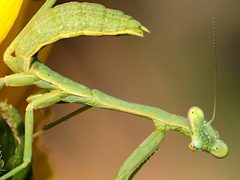
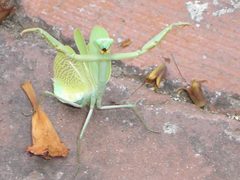
Stagmomantis limbata is one of the largest native mantids in North America, reaching approximately 3 inches in length. It exhibits pronounced : females are flightless, robust, and typically plain green or gray with a dark spot on the tegmina, while males are slender, long-winged, and capable of . The is notable for female-emitted that attract males, with production linked to female nutritional status and receptivity. Sexual occurs, particularly when females are food-limited.
Pronunciation
How to pronounce Stagmomantis limbata: /stæɡmoʊˈmæntɪs lɪmˈbɑːtə/
These audio files are automatically generated. While they are not always 100% accurate, they are a good starting point.
Identification
Distinguished from Stagmomantis carolina by less protruding and facial plate proportions. Separated from introduced Tenodera sinensis (Chinese mantis) and Mantis religiosa (European mantis) by native range and, in males, by wing pattern and body proportions. Females identifiable by wide with exposed segments and dark tegmina spot. Males often found at lights at night; females never fly.
Images
Habitat
Variable, including open semi-arid areas with tall forbs, shrubs, or trees; more abundant in lusher riparian and wooded areas along streamsides, roadsides, canyons, and within towns. Often associated with flowering plants in late summer where prey is abundant.
Distribution
Native to southwestern North America. Range extends from Texas to Southern California, north into Colorado and Utah, and south into Mexico.
Seasonality
activity peaks in late summer; mating activity concentrated in September based on two years of field data. Males fly to lights during breeding season.
Diet
of arthropods; has been observed capturing honey bees, butterflies, caterpillars, , flies, grasshoppers, and other insects. Prey size with predator body size, with females capable of subduing relatively large insects including bees and .
Life Cycle
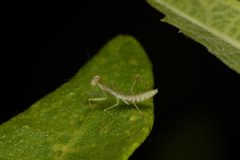
Temperate complete development from hatchling to breeding in approximately 4-6 months under favorable conditions, though lifespan may extend to 6 months to a year. () deposited on vegetation; nymphs pass through multiple instars before adulthood.
Behavior
Males are strongly attracted to lights at night and fly in numbers during breeding season; females are flightless and do not come to lights. Females adopt 'calling' posture with elevated , exposed intersegmental between tergites 6 and 7, and extruded to release volatile . emission is not tied to consistent time of day but is more likely when females are virgin and food-deprived. Males locate females via chemical cues at long range and visual cues at short range. Sexual occurs, with probability influenced by female nutritional status—poorly-fed females are more likely to attack males.
Ecological Role
in terrestrial ; contributes to of and other insects. Serves as prey for birds, bats, and other vertebrate predators.
Human Relevance
Considered a beneficial insect in gardens and agricultural settings due to on pest insects. Used in contexts. Subject of scientific study for , chemical , and -prey dynamics.
Similar Taxa
- Stagmomantis carolinaOverlapping range in some areas; distinguished by more protruding and different facial plate proportions in S. carolina.
- Tenodera sinensisIntroduced Chinese mantis overlaps in range; larger size, different wing venation, and more robust build distinguish T. sinensis.
- Mantis religiosaIntroduced European mantis overlaps in California; males of M. religiosa have different body proportions and wing patterns, and occupies different microhabitat (lower foliage and ground level).
Sources and further reading
- BugGuide
- Wikipedia
- GBIF taxonomy match
- iNaturalist taxon
- NCBI Taxonomy
- Catalogue of Life
- How This Tiny Warrior Crashed the Hammock Lab Water Balloon Battle | Bug Squad
- 2023: These Are a Few of My Favorite Things | Bug Squad
- Meet a Male Mantis in a Patch of Blanket Flowers | Bug Squad
- Love Makes the World--and the Bugs--Go 'Round | Bug Squad
- Magical Mantis Moments | Bug Squad
- Meet 'Mantis Master Keeper' Andrew Pfeifer | Bug Squad
- Biology of the Bordered Mantid, Stagmomantis Limbata Hahn (Orthoptera, Mantidae)
- Examinations of Female Pheromone use in Two Praying Mantids,Stagmomantis limbataandTenodera Aridifolia Sinensis(Mantodea: Mantidae)
- Effects of female feeding regime in a sexually cannibalistic mantid: fecundity, cannibalism, and male response in Stagmomantis limbata (Mantodea)
- Consequences of Intraspecific Variation in Female Body Size inStagmomantis limbata(Mantodea: Mantidae): Feeding Ecology, Male Attraction, and Egg Production
- A synoptic review of the genus Stagmomantis (Mantodea: Mantidae)