
Ctenarytaina eucalypti
(Maskell, 1890)
Bluegum psyllid, Eucalyptus psyllid
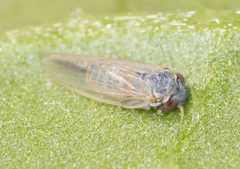
Ctenarytaina eucalypti is a small (jumping plant louse) native to Australia that has become an pest of Eucalyptus trees worldwide. It feeds on phloem sap, causing damage to young foliage and producing honeydew that promotes growth. The has established in Europe, North America, South America, and elsewhere, often threatening ornamental and commercial Eucalyptus plantations. Its includes multiple overlapping per year with complex strategies involving and nymphs in temperate climates.
Pronunciation
How to pronounce Ctenarytaina eucalypti: //ktɛ.nəˈrɪ.taɪ.nə juː.kəˈlɪp.taɪ//
These audio files are automatically generated. While they are not always 100% accurate, they are a good starting point.
Identification
Distinguished from other psyllids by association with Eucalyptus plants and specific damage on young foliage. Identification to level requires examination of morphological characters not detailed in available sources; expert taxonomic verification recommended. In regions where multiple Eucalyptus-feeding psyllids occur, microscopic examination or molecular methods may be necessary for definitive identification.
Images
Appearance
Habitat
Eucalyptus trees in cultivated settings, including ornamental plantings, commercial foliage plantations, and forestry plantations. In invaded temperate regions, occurs primarily in urban and suburban environments where Eucalyptus is cultivated. Occupies young branches and leaves, with nymphs aggregating on shoot tips and young foliage. In Ireland, found in Co. Kerry and Dublin area plantations.
Distribution
Native to Australia. Established in Ireland (early 1990s), United Kingdom, continental Europe, North America, South America (Chile, Colombia), and other regions with cultivated Eucalyptus. GBIF records document presence in the Azores.
Seasonality
In Ireland, exhibits complex seasonal dynamics with two largely overlapping cohorts. and nymphs resume activity in early February before significant temperature increases, suggesting -mediated dormancy rather than temperature-dependent . Peak nymphal populations occur in summer months. Multiple per growing season (two to three generations) with continuous breeding from spring through autumn in favorable conditions. In temperate regions, activity suppressed in winter with retarded development.
Diet
Phloem sap of Eucalyptus . Specific documented include Eucalyptus gunnii, Eucalyptus niphophila, Eucalyptus pauciflora subsp. niphophila, and Eucalyptus stuartiana. Feeding concentrated on young foliage and shoot tips.
Host Associations
- Eucalyptus gunnii - plantDocumented in Ireland
- Eucalyptus niphophila - plantDocumented in Ireland
- Eucalyptus pauciflora subsp. niphophila - plantDocumented in Ireland
- Eucalyptus stuartiana - plantDocumented in Ireland
- Eucalyptus globulus - plantDocumented in Colombia
- Psyllaephagus pilosus - Australian encyrtid introduced as agent; effective of nymphs
- Syrphidae - Two unidentified documented as in Colombia
- Hemerobiidae - One unidentified documented as in Colombia; less efficient than syrphid predators based on preliminary laboratory tests
Life Cycle
(hemimetabolous) with five nymphal instars. laid in clusters on young foliage and leaf axils. In temperate invaded regions, complex strategy with eggs and nymphs entering state of reduced development or temporary dormancy. Dormancy of short duration; resumption of activity in early spring potentially mediated by changing plant nutritional quality and rather than temperature alone. Two to three per growing season with overlapping cohorts. In Ireland, individual egg and nymphal overwintering cohorts alternate in completing generations. in some reported to overwinter in bark crevices and sheltered locations.
Behavior
Nymphs aggregate on young foliage and shoot tips, with distribution shifting seasonally in response to and competition for preferred feeding sites. Greater densities occur on upper shoots compared to lower-placed shoots. possess jumping ability using enlarged hind . Produces honeydew (excretory waste) that accumulates on foliage and supports growth of fungi. Active between trees occurs. In Ireland, adults migrate to bark crevices for in some accounts, though other sources emphasize and nymph overwintering.
Ecological Role
Herbivore and pest of ornamental and commercial Eucalyptus. Honeydew production supports fungi, potentially reducing photosynthetic capacity of trees. Sustained feeding pressure may affect tree vigor, particularly in nursery and young plantation settings. Serves as host for introduced agent Psyllaephagus pilosus and where present. In invaded regions, occupies with limited indigenous natural enemy pressure, contributing to .
Human Relevance
Significant economic pest of ornamental Eucalyptus foliage production industry, as documented in Ireland. Threatens commercial Eucalyptus plantations in forestry and nursery contexts in multiple invaded regions. Subject of programs, including successful introduction of Psyllaephagus pilosus in Ireland and Chile. Monitoring and management required in commercial settings due to potential for in absence of effective natural enemies.
Similar Taxa
- Other Ctenarytaina speciesCongeneric may share Eucalyptus associations and similar ; requires expert identification
- Other Eucalyptus-feeding psyllids (Aphalaridae, Psyllidae)Multiple feed on Eucalyptus; identification requires record verification and morphological examination
More Details
Biological Control Success
The Australian Psyllaephagus pilosus was successfully introduced to Ireland in 1998, achieving nearly 100% rates by late October of the release year and naturally colonizing sites up to 70 km distant. Establishment failures at two sites were attributed to late-season arrival preventing establishment before winter. Once established, the parasitoid demonstrated excellent survival and capability.
Invasion History
First recorded in Ireland in the early 1990s, threatening a newly developing ornamental foliage production industry. In Colombia, detected in E. globulus plantations around Bogotá in 1994. In Chile, established in eucalyptus plantations in the V Region. Introductions to Europe and the Americas date to the 1800s according to some accounts. Part of broader pattern of Hemiptera from Palaearctic origin dominating non-native insect in Chile, linked to agriculture and forestry trade .
Dormancy Mechanism
Irish exhibit retarded development and early spring activity resumption that appears partially independent of temperature, strongly suggesting mediation by plant nutritional quality changes and rather than purely thermal cues. This represents an adaptive response to temperate conditions outside the native Australian range.
Sources and further reading
- BugGuide
- GBIF taxonomy match
- iNaturalist taxon
- NCBI Taxonomy
- Catalogue of Life
- Where did all those insects come from? Tracking insect invasions
- Surviving winter, Part IV: A Monarch Christmas in Monterey, Danaus plexippus — Bug of the Week
- Life history and phenology of the eucalyptus psyllid, Ctenarytaina eucalypti in Ireland
- Contribution to the Knowledge of Biology, Natural Enemies and Damage of Ctenarytaina Eucalypti (Homoptera: Psyllidae)
- Parasitoidismo de Psyllaephagus pilosus Noyes (Hym.: Encyrtidae) Sobre el Psílido del Eucalipto Ctenarytaina eucalypti (Maskell) (Hem.: Psyllidae) en Plantaciones de Eucaliptos en la V Región
- Release and establishment of a biological control agent, Psyllaephagus pilosus for eucalyptus psyllid (Ctenarytaina eucalypti) in Ireland