
Ctenarytaina
Ferris & Klyver, 1932
eucalyptus psyllids, blue gum psyllids
Species Guides
3- Ctenarytaina eucalypti(Bluegum psyllid)
- Ctenarytaina longicauda(Tristania Psyllid)
- Ctenarytaina spatulata(Rose Gum Psyllid)
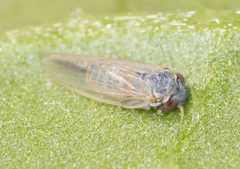
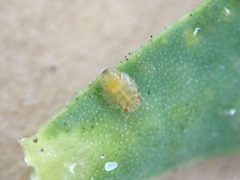
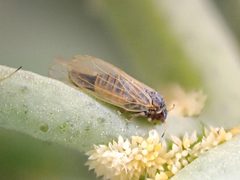
Ctenarytaina is a of jumping plant lice (psyllids) in the Aphalaridae, native to Australia and associated primarily with Myrtaceae. The genus includes economically significant pest that have been introduced to multiple continents, particularly Ctenarytaina eucalypti, which threatens eucalyptus forestry and ornamental foliage industries. Several species have established outside their native ranges, with documented impacts in Ireland, Chile, Colombia, and other regions. The genus exhibits strong plant associations, with most species being monophagous or narrowly oligophagous on Eucalyptus, Syzygium, and other Myrtaceae.
Pronunciation
How to pronounce Ctenarytaina: /tʰɛ.nɛr.ɪˈtaɪ.nə/
These audio files are automatically generated. While they are not always 100% accurate, they are a good starting point.
Identification
require microscopic examination of genitalic structures for definitive identification; male paramere shape is taxonomically diagnostic. Nymphal identification relies on fifth instar where described. Ctenarytaina eucalypti can be recognized by its association with Eucalyptus, yellowish-green adult coloration, and the presence of nymphs on young expanding leaves. Distinguishing between requires reference to original species descriptions and taxonomic keys; C. bipartita is separable by its distinctive paramere with lobe. Molecular methods may assist where morphological characters are ambiguous.
Images
Habitat
Native to Australian eucalypt forests and woodlands; occur in eucalyptus plantations, ornamental foliage production facilities, and urban plantings of Myrtaceae. Nymphs develop specifically on young, actively growing shoots and expanding leaves. In Ireland, established in commercial eucalyptus foliage plantations. In Colombia, found in nursery and second-growth Eucalyptus globulus plantations around the Sabana de Bogotá.
Distribution
Native to Australia (widespread across states including New South Wales, Victoria, Tasmania, South Australia, Queensland, Australian Capital Territory). established in: Europe (Ireland, France, Italy, Portugal, Spain), North America (USA: California), South America (Chile, Colombia, Brazil: Paraná, Uruguay), and Oceania (New Zealand). About one fifth of described have adventive populations outside their natural range.
Seasonality
Activity patterns vary by climate. In temperate Ireland, Ctenarytaina eucalypti exhibits year-round presence with peak in late summer to early autumn; occurs as adults with reduced development or temporary dormancy. Activity resumes in early February, triggered by changing day length and plant nutritional quality rather than temperature alone. In warmer climates, multiple overlapping occur with continuous breeding during favorable periods.
Diet
Phloem sap of plants; feeding restricted to young, actively growing tissues including expanding leaves and terminal shoots. Specific host associations documented for Eucalyptus (multiple), Syzygium species (multiple), Boronia megastigma, Lophostemon confertus, and other Myrtaceae. Some species also associated with Onagraceae, Rutaceae, and Theaceae.
Host Associations
- Eucalyptus - primary Multiple including E. globulus, E. kitsoniana, E. viminalis; major for C. eucalypti, C. spatulata, C. bipartita
- Syzygium - primary for multiple including C. baliota, C. daleae, C. loebli, C. melanota, C. picea, C. taylori; some species induce witches' broom
- Boronia megastigma - Primary for C. in Tasmania; cultivated for production
- Lophostemon confertus - for C. longicauda in Australia and California (ornamental plantings)
- Lophostemon suaveolens - Native for C. longicauda in Queensland
Life Cycle
to development in approximately 4 weeks at 20°C. Five nymphal instars; nymphs develop on young expanding leaves and terminal shoots. Multiple per year in favorable climates; two to three generations documented in Ireland and Colombia. strategy varies: C. eucalypti overwinters as adults in Ireland, with evidence of two largely overlapping cohorts overwintering as eggs and nymphs respectively in states of reduced development. for feeding sites intensifies in later nymphal stages.
Behavior
Nymphs are sedentary phloem feeders producing copious honeydew; high lead to development on foliage. are active, capable of jumping , and disperse to locate new host growth. Oviposition occurs specifically on young expanding leaves and terminal shoots; host quality and shoot architecture influence oviposition site selection. Heavy feeding by nymphs or adults reduces shoot attractiveness for subsequent oviposition through honeydew accumulation and sooty mold development. In the absence of natural enemies, can increase until limited by resource exhaustion. Adults may emigrate when host quality deteriorates.
Ecological Role
Herbivore and potential pest of Myrtaceae forestry and ornamental industries. Acts as prey for diverse natural enemies including (Psyllaephagus pilosus, Encyrtidae), predatory Syrphidae (Diptera), and Hemerobiidae (Neuroptera). Some (C. fomenae, C. melanota) induce witches' broom growth on Syzygium , potentially mediated by phytoplasma association. Honeydew production supports fungi and associated micro-. regulated by and parasitoids at low densities; -dependent regulation disengages at high densities.
Human Relevance
Significant economic pest in eucalyptus forestry and ornamental foliage production. Ctenarytaina eucalypti threatens Ireland's developing eucalyptus foliage industry; C. causes substantial losses in Tasmanian boronia oil and flower production, with documented 41.7% flower loss and suppressed oil yield. for year-old boronia plants established at 8 mature nymphs per terminal shoot. Subject to programs: Psyllaephagus pilosus successfully established in Ireland and Chile for C. eucalypti management. programs developed for C. thysanura in Tasmania achieved benefit-cost ratios of 22.4:1 through natural enemy conservation. Several have potential for further export as pests to eucalyptus-growing regions.
Similar Taxa
- PsyllaephagusEncyrtid of Ctenarytaina; rather than psyllids, but frequently encountered in association with Ctenarytaina in contexts
- AcizziaAnother associated with Acacia and other ; distinguished by different host associations and morphological features of the forewing
- BlastopsyllaEucalypt-associated ; distinguished by different nymphal and genitalic structures
More Details
Taxonomic History
The Ctenarytaina was established by Ferris & Klyver in 1932. Recent taxonomic revision (Burckhardt, 2020) proposed Eurhinocola as a junior synonym of Ctenarytaina, resulting in new combinations including Ctenarytaina gravelyi. The genus currently includes over 30 described with ongoing discovery of new species from Southeast Asia and Africa.
Invasion Biology
Ctenarytaina exemplify the role of economic activities in shaping non-native insect . Introductions to Chile and other regions linked to forestry development and intercontinental trade. Acceleration of introductions since 1950 correlates with post-WWII agricultural development and increased air traffic. Database of nearly 600 non-native insects in Chile identifies Hemiptera, particularly Palaearctic species associated with agriculture and forestry, as components.
Biological Control
Psyllaephagus pilosus, an Australian encyrtid , has been successfully introduced to multiple countries for C. eucalypti control. In Ireland, establishment occurred within one growing season with peak rates approaching 100%. Parasitoid up to 70 km documented. Timing of release is critical: late-season colonizers failed to establish due to insufficient time before winter. Similar establishment reported in Chile's V Region.
Sources and further reading
- BugGuide
- GBIF taxonomy match
- iNaturalist taxon
- NCBI Taxonomy
- Catalogue of Life
- Where did all those insects come from? Tracking insect invasions
- Ctenarytaina spatulata . [Distribution map].
- Factors affecting Ctenarytaina thysanura oviposition on Boronia megastigma terminal shoots
- Life history and phenology of the eucalyptus psyllid, Ctenarytaina eucalypti in Ireland
- Ctenarytaina bipartita sp. n. (Hemiptera, Psylloidea), a new eucalypt psyllid from Southeast Australia
- LIFE HISTORY AND BIOLOGY OF CTENARYTAINA THYSANURA FERRIS AND KLYVER (HEMIPTERA: PSYLLIDAE) ON BORONIA MEGASTIGMA NEES EX BARTL. (RUTACEAE) IN TASMANIA
- Acizzia errabunda sp. nov. and Ctenarytaina insularis sp. nov.: Descriptions of two new species of psyllids (Hemiptera: Psylloidea) discovered on exotic host plants in New Zealand
- Contribution to the Knowledge of Biology, Natural Enemies and Damage of Ctenarytaina Eucalypti (Homoptera: Psyllidae)
- Parasitoidismo de Psyllaephagus pilosus Noyes (Hym.: Encyrtidae) Sobre el Psílido del Eucalipto Ctenarytaina eucalypti (Maskell) (Hem.: Psyllidae) en Plantaciones de Eucaliptos en la V Región
- CTENARYTAINA LONGICAUDA SP. N. (HOMOPTERA: PSYLLOIDEA) FROM LOPHOSTEMON CONFERTUS (R. BROWN) IN AUSTRALIA AND CALIFORNIA
- FEEDING BEHAVIOUR AND PEST STATUS OF CTENARYTAINA THYSANURA (FERRIS AND KLYVER) (HEMIPTERA: PSYLLIDAE) ON BORONIA MEGASTIGMA (NEES) IN TASMANIA
- Development and application of an integrated pest management programme for the psyllid, Ctenarytaina thysanura on Boronia megastigma in Tasmania
- Release and establishment of a biological control agent, Psyllaephagus pilosus for eucalyptus psyllid (Ctenarytaina eucalypti) in Ireland
- Life Table and Key Factor Studies of Ctenarytaina thysanura Ferris and Klyver (Hemiptera: Psyllidae) on Boronia megastigma Nees. ex Bartl. (Rutaceae) in Tasmania
- <p><strong>A review of jumping plant lice of the genus <em>Ctenarytaina</em> (Hemiptera, Psylloidea, Aphalaridae) associated with <em>Syzygium</em> (Myrtaceae)</strong></p>