
Bactericera maculipennis
(Crawford, 1910)
psyllid, jumping plant louse
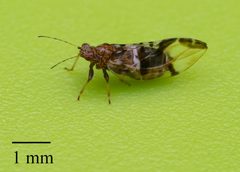
Bactericera maculipennis is a in the Triozidae, native to western North America. It is a confirmed of 'Candidatus' Liberibacter solanacearum, the bacterium that causes zebra chip in potatoes. The species develops primarily on plants in the Convolvulaceae family, with field records documenting association with Convolvulus arvensis (field bindweed) throughout the western United States. Unlike the related potato psyllid B. cockerelli, B. maculipennis has not been documented as a direct economic threat to solanaceous crops, though it shares with that species.
Pronunciation
How to pronounce Bactericera maculipennis: //bækˌtɛrɪˈsɛrə ˌmækjʊlɪˈpɛnɪs//
These audio files are automatically generated. While they are not always 100% accurate, they are a good starting point.
Identification
Bactericera maculipennis can be distinguished from the closely related B. cockerelli (potato ) by morphological features and associations. Both occur on overlapping host plants in the Convolvulaceae and Solanaceae, but B. maculipennis shows stronger fidelity to Convolvulaceae in field observations. Diagnostic confirmation requires molecular methods; 16S rDNA sequencing has been used to detect associated bacterial endosymbionts including and Sodalis strains that differ from those in B. cockerelli haplotypes.
Images
Habitat
Associated with weedy and cultivated environments where plants in the Convolvulaceae occur. Documented field found on Convolvulus arvensis (field bindweed) in the Pacific Northwest. Nymphs tend to feed on stems rather than leaves of host plants.
Distribution
Western North America. Documented from California, Idaho, Oregon, Utah, and Washington based on GBIF distribution records. Widespread throughout the western United States according to field surveys.
Diet
Phloem-feeding on plants in the Convolvulaceae, specifically Convolvulus arvensis. Feeding occurs primarily on stems.
Host Associations
- Convolvulus arvensis - primary field field bindweed; nymphs feed on stems
- Convolvulaceae - confirmed plants for development and
Behavior
Nymphs exhibit stem-feeding , positioning on stems rather than leaves of plants. have been observed to harbor 'Candidatus' Liberibacter solanacearum at rates up to 50%.
Ecological Role
of 'Candidatus' Liberibacter solanacearum to Convolvulaceae. Acts as a non-crop for the that causes zebra chip in potatoes. May facilitate pathogen persistence in agricultural landscapes through association with weedy Convolvulaceae.
Human Relevance
Potential indirect agricultural significance as a for 'Candidatus' Liberibacter solanacearum, the causing zebra chip in potatoes. Not considered a direct pest of solanaceous crops. Monitoring of B. maculipennis on field bindweed may provide information about pathogen presence in agricultural regions.
Similar Taxa
- Bactericera cockerelliCongeneric that the same ('Candidatus' Liberibacter solanacearum) and shares some plants; distinguished by stronger association with Solanaceae crops and different endosymbiont
- Bactericera arbolensisAnother congeneric western North American associated with Shepherdia (buffaloberry); distinguished by plant and wing venation features including medial size
Sources and further reading
- BugGuide
- GBIF taxonomy match
- iNaturalist taxon
- NCBI Taxonomy
- Catalogue of Life
- Encyrtid Holdings | Entomology Research Museum
- UC Davis Researcher Targeting Zebra Chip: It's Not a Chip You Want | Bug Squad
- Looking for Lygus | Bug Squad
- Grasshoppers of Colorado
- Beauveria Endophytes Can Curb Grasshopper Pests
- Bug Eric: It's Always Something....
- “CandidatusLiberibacter solanacearum” Associated With the Psyllid,Bactericera maculipennis(Hemiptera: Triozidae)
- Bacterial Endosymbionts of Bactericera maculipennis and Three Mitochondrial Haplotypes of B. cockerelli (Hemiptera: Psylloidea: Triozidae)
- Bactericera maculipennis (Hemiptera: Triozidae) is a vector of “ Candidatus Liberibacter solanacearum” to species within the Convolvulaceae (Solanales)