
Heteropsylla
Crawford, 1914
Species Guides
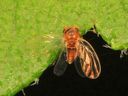
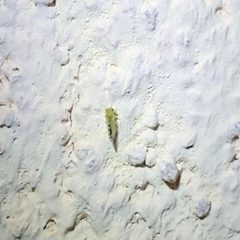
4Heteropsylla is a of legume-feeding psyllids within the Ciriacreminae. The genus comprises approximately 40 described , with 39 recognized in a comprehensive taxonomic revision that included 21 newly described species. Species are predominantly associated with plants in the legume subfamily Mimosoideae, with rare exceptions in Caesalpinioideae. The genus is neotropical in origin, though at least one species, H. cubana, has become widely distributed as a pest of Leucaena in tropical regions worldwide.
Pronunciation
How to pronounce Heteropsylla: /hɛtɛroʊˈpsɪlə/
These audio files are automatically generated. While they are not always 100% accurate, they are a good starting point.
Identification
Heteropsylla are distinguished from related by characters of both and final instar larvae. A revised generic was established using morphological features of these life stages. Keys to identification of adult males, adult females, and final instar larvae have been published for the genus.
Images
Distribution
The is primarily neotropical in distribution. Heteropsylla cubana, the most economically important , has been introduced widely and occurs in Africa, Asia, Australasia, Pacific Islands, North America, Central America, Caribbean, and South America.
Host Associations
- Mimosoideae - primary plants35 of 39 ; legume
- Caesalpinioideae - exceptional plantsthree only
- Leucaena leucocephala - of H. cubanaprimary of the most economically important
- Leucaena pallida - of H. cubanaless preferred than L. leucocephala
- Leucaena diversifolia - of H. cubana
- Leucaena salvadorensis - of H. cubana
- Prosopis (mesquite) - of H. texana
Life Cycle
Final instar larvae of 22 have been described and illustrated. and early instar nymphs of H. cubana are concentrated on the first fully expanded leaf and 1-2 adjacent unexpanded leaves on the terminal; later instar nymphs migrate to the stem and leaves closer to the bud.
Behavior
H. cubana have been observed to distinguish among Leucaena varieties over a distance, showing significantly higher attraction to L. leucocephala than to L. pallida or hybrid varieties. treatment increases plant attractiveness to adults.
Ecological Role
Heteropsylla function as phytophagous insects on leguminous plants. H. cubana serves as host for multiple species including Tamarixia leucaenae and Psyllaephagus yaseeni, and is preyed upon by introduced and native .
Human Relevance
Heteropsylla cubana is a destructive pest of Leucaena used as cattle fodder, shade trees in tropical plantations, and for other agroforestry purposes. The species has been subject to programs using introduced and . H. texana has been investigated as a potential biological control agent for mesquite (Prosopis) weeds.
Similar Taxa
- LimbopsyllaH. boquetensis was transferred from Limbopsylla to Heteropsylla; generic boundaries were revised based on and larval characters
More Details
Taxonomic revision
A comprehensive revision of the recognized 39 , with 21 newly described, and transferred one species from Limbopsylla
Sampling methods
Accurate estimation of H. cubana nymphs requires alcohol washing of leaves to dislodge specimens; visual rating methods are unsuitable
Sources and further reading
- BugGuide
- Wikipedia
- GBIF taxonomy match
- iNaturalist taxon
- NCBI Taxonomy
- Catalogue of Life
- Heteropsylla cubana . [Distribution map].
- Heteropsylla cubana . [Distribution map].
- Legume-feeding psyllids of the genus Heteropsylla (Homoptera: Psylloidea)
- The host range and biology of the mesquite psyllid Heteropsylla texana
- Isyndus heros Fab.: A new predator to Heteropsylla cubana, a sap sucker of Subabool
- Biology and Potential of Curinus coeruleus Mulsant, an introduced predator of Heteropsylla cubana Crawford
- Tamarixia leucaenae sp. n. (Hymenoptera: Eulophidae) parasitic on the leucaena psyllid Heteropsylla cubana Crawford (Hemiptera) in Trinidad
- A study in Cuba of the biology, ecology and agroecological management of Heteropsylla cubana Crawford in Leucaena leucocephala (Lam.) de Wit
- AN IMPROVED SAMPLING METHOD FOR HETEROPSYLLA CUBANA CRAWFORD (HEMIPTERA: PSYLLIDAE) ON LEUCAENA LEUCOCEPHYLLA
- First record of Heteropsylla tenuata from Argentina (Hemiptera: Psyllidae), and additional notes on other psyllid species
- Ecology ofHeteropsylla cubana(Homoptera: Psyllidae): Psyllid Damage, Tree Phenology, Thermal Relations, and Parasitism in the Field
- Life History Parameters of the Leucaena Psyllid Heteropsylla Cubana (Crawford) (Homoptera: Psyllidae) under Various Temperature and Relative Humidity Regimes
- Discrimination among host plants ( Leucaena species and accessions) by the psyllid pest Heteropsylla cubana and implications for understanding resistance
- AN OVERVIEW ON SOME BIOTIC AND ABIOTIC FACTORS AFFECTING THE POPULATION DYNAMICS OF LEUCAENA PSYLLID, Heteropsylla Cubana Crawford (HOMOPTERA: PSYLLIDAE): CONTRIBUTORY FACTORS FOR PEST MANAGEMENT
- Competition betweenPsyllaephagus yaseeniandTamarixia leucaenaetwo parasitoids of the leucaena psyllid(Heteropsylla cubana)