
Heteropsylla texana
Crawford, 1914
Mesquite Psyllid
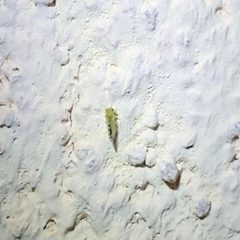
Heteropsylla texana is a ( Psyllidae) native to Texas, USA, that feeds on Prosopis (mesquite). It was introduced to Australia as a agent for mesquite weeds. The species is highly -specific, with sustained only on Prosopis spp. It causes severe distortion of growing leaf and floral shoots through phloem feeding.
Pronunciation
How to pronounce Heteropsylla texana: /ˌhɛtəroʊˈsɪlə tɛkˈsænə/
These audio files are automatically generated. While they are not always 100% accurate, they are a good starting point.
Images
Habitat
Rangeland environments associated with Prosopis ; native to Texas, USA, with introduced in Australia for purposes
Distribution
Native to Texas, USA; introduced to Australia for testing and proposed release
Diet
Phloem-feeding on plants; causes severe distortion to growing leaf and floral shoots of Prosopis spp.
Host Associations
- Prosopis pallida - true sustains complete development and
- Prosopis velutina - true sustains complete development and
- Prosopis juliflora - true sustains complete development and
- Prosopis spp. - true general
- Dichrostachys spicata - poor limited development to one with low numbers and longer development times
- Acacia bidwillii - poor limited development to one with low numbers and longer development times
Life Cycle
to development takes 13–17 days; nymphs pass through five instars, developing to adults in 7–8 days
Behavior
can survive on non-target plants without ovipositing; oviposition occurs only on true (Prosopis spp.); causes severe shoot distortion on primary hosts through feeding
Ecological Role
Proposed agent for Prosopis weeds in Australian rangelands
Human Relevance
Imported to Australia as a potential agent for introduced rangeland weeds in the Prosopis; subject to extensive range testing on 60 plant to assess safety for release
More Details
Host Range Testing
Laboratory trials on 60 plant demonstrated that while could survive on 45 non-target plants, oviposition only occurred on Prosopis spp., Dichrostachys spicata, and Acacia bidwillii. Field risk to non-target plants was deemed negligible due to inability to sustain beyond one on non-Prosopis .
Reproductive Output
Females produce up to 100 .