
Proconiini
Stål, 1869
sharpshooters
Genus Guides
5- Cuerna
- Egidemia
- Homalodisca(sharpshooters)
- Oncometopia(sharpshooters)
- Paraulacizes(sharpshooters)
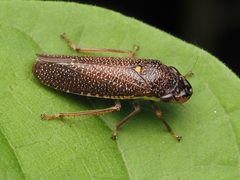
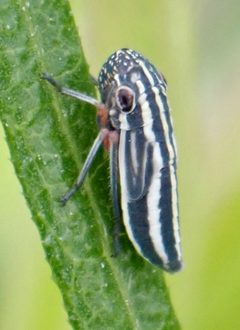
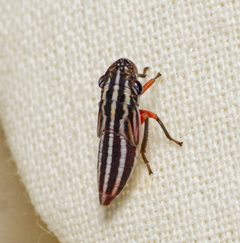
Proconiini is a large tribe of xylem-feeding leafhoppers (Cicadellidae: Cicadellinae) comprising approximately 422 in 58 , restricted to the New World. Members are commonly known as sharpshooters due to their rapid, directed patterns. The tribe includes major agricultural pests and of Xylella fastidiosa, a phytopathogenic bacterium causing in citrus, grapes, almonds, and other crops. Proconiini species exhibit distinctive morphological adaptations including brachyptery in high-altitude Andean forms and unique brochosome production for offspring protection.
Pronunciation
How to pronounce Proconiini: /proˈkoʊni.aɪnaɪ/
These audio files are automatically generated. While they are not always 100% accurate, they are a good starting point.
Identification
Sharpshooters can be distinguished from other Cicadellidae by their large body size relative to other leafhoppers, robust build, and the presence of closely spaced rows of fine spines on the hind legs. -level identification relies on male genitalia and, in females, brochosome characteristics—ultramicroscopic reticulate lipoprotein bodies with species-specific structural types (spherical, , or ). Some exhibit and intraspecific color variation that complicates visual identification.
Images
Habitat
Diverse from sea level to 4,000 m elevation, including tropical and subtropical forests, agricultural landscapes, and anthropically-modified environments. High Andean cloud forests harbor brachypterous adapted to extreme conditions. Six are restricted to Paraná Forest (evergreen forest, 500–1,800 m elevation). Vineyard and citrus orchard in Brazil and Argentina support multiple pest species.
Distribution
Strictly New World distribution. Documented from Canada through Argentina, with highest diversity in Neotropical regions. Argentina records 40 in two primary zones: northeastern-mideastern and northwestern-midwestern strips north of 40°S latitude. Brazilian records include Serra Gaúcha region (Rio Grande do Sul) and Pará State (Amazonian region). Southernmost records: Tapajosa rubromarginata and T. doeringi.
Diet
Xylem-feeding; with documented plants spanning 24 plant including Rutaceae (citrus), Vitaceae (grapes), Rosaceae (almonds, peach, plum), Rubiaceae (coffee), Fabaceae, Poaceae, and others. Host-switching maximizes nutrient uptake from dilute xylem sap.
Behavior
Production of brochosomes—ultramicroscopic, reticulate, lipoprotein bodies synthesized by and stored as convex masses on the forewings. Females use macrobristles on metathoracic tibiae to transfer brochosomes onto egg masses or oviposition scars, potentially signaling previous oviposition to conspecifics. Rapid, directed patterns characteristic of the group.
Ecological Role
Major of Xylella fastidiosa, transmitting: Citrus Variegated (CVC), Pierce's of grapes (PD), Almond Leaf Scorch (ALS), Phony Peach Disease (PPD), Plum Leaf Scald (PLS), and Coffee Leaf Scorch (CLS). serve as for (Mymaridae, Trichogrammatidae) and (Dermaptera), contributing to local .
Human Relevance
Significant agricultural pests threatening citrus, grape, almond, and coffee industries worldwide. programs target (Gonatocerus spp. and other Mymaridae) for management of glassy-winged sharpshooter (Homalodisca vitripennis) and related . and efforts ongoing in California and other regions to prevent Xylella fastidiosa establishment.
Similar Taxa
- CicadelliniBoth are tribes within Cicadellinae; Proconiini distinguished by larger body size, xylem-feeding specialization, brochosome production, and more robust hind leg spination. Cicadellini generally lack brochosomes and exhibit different associations.
- Deltocephalinae of Cicadellidae with smaller, more gracile body form; phloem-feeding rather than xylem-feeding; lack the distinctive brochosome system and large size characteristic of Proconiini.
Sources and further reading
- BugGuide
- iNaturalist taxon
- NCBI Taxonomy
- Catalogue of Life
- Publications | Entomology Research Museum
- Egg Brochosomes of Proconiini (Hemiptera: Cicadellidae, Cicadellinae) species associated with cultivation of grapevines
- New records of Proconiini Stål, 1869 (Hemiptera: Cicadellidae: Cicadellinae) from Pará State, Brazil
- Proconiini Sharpshooters of Argentina, with Notes on Its Distribution, Host Plants, and Natural Enemies
- Short-winged mysteries from Andean cloud forests: a new genus and two new species of brachypterous sharpshooters (Hemiptera: Cicadellidae: Cicadellinae: Proconiini) from Colombia
- Tretogonia Melichar (Hemiptera: Cicadellidae: Proconiini): two new species from South Brazil and a description of T. dentalis Emmrich, 1988
- Species delimitation and taxonomic revision of Abana Distant, 1908 (Hemiptera: Cicadellidae: Proconiini): Intraspecific color variation and pseudocryptic diversity in Andean sharpshooters
- Brochosomes-for-eggs of the Proconiini (Hemiptera: Cicadellidae, Cicadellinae) species associated with orchards of Citrus sinensis (L.) Osbeck in Rio Grande do Sul, Brazil
- New Records on the Geographical Distribution of South American Sharpshooters (Cicadellidae: Cicadellinae: Proconiini) and their Potential as Vectors ofXylella fastidiosa
- Egg Parasitoids of Proconiini (Hemiptera: Cicadellidae) in Northwestern Mexico, with Description of a New Species ofGonatocerus(Hymenoptera: Mymaridae)
- Spatial and seasonal distribution of egg parasitoids of the sharpshooter Tapajosa rubromarginata (Hemiptera: Cicadellidae: Proconiini) on feral Johnson grass and commercial citrus host in Argentina