
Homalodisca
Stål, 1869
sharpshooters
Species Guides
5- Homalodisca elongata
- Homalodisca ichthyocephala
- Homalodisca insolita(johnsongrass sharpshooter)
- Homalodisca liturata(smoketree sharpshooter)
- Homalodisca vitripennis(Glassy-winged Sharpshooter)
Homalodisca is a of large leafhoppers (sharpshooters) in the Cicadellidae, tribe Proconiini. The genus contains approximately 18 described distributed primarily in the Americas. The most economically significant species is (formerly H. coagulata), commonly known as the , a major agricultural pest and of Xylella fastidiosa bacteria causing Pierce's in grapevines and other plant diseases. Members of this genus are characterized by their relatively large size among leafhoppers, xylem-feeding habits, and strong capabilities.
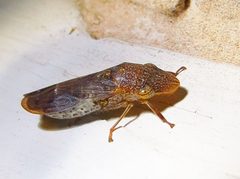
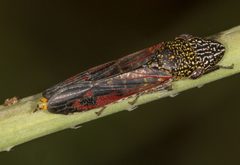
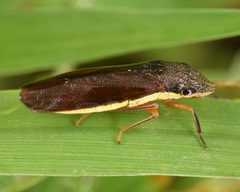
Pronunciation
How to pronounce Homalodisca: /hɔməloʊˈdɪskə/
These audio files are automatically generated. While they are not always 100% accurate, they are a good starting point.
Identification
Distinguished from other proconiine sharpshooters by larger body size, wing venation patterns, and coloration. H. vitripennis specifically identified by combination of: large size (12 mm), dark body with yellow/cream markings, translucent wings with reduced pigmentation, and specific male genitalia structure. Differentiation from congeneric requires examination of male genitalia and detailed wing venation. are laid in masses under leaf , with nymphs emerging through distinctive exit holes.
Images
Habitat
Found in diverse including riparian corridors, agricultural landscapes, orchards, and urban areas. Associated with woody and herbaceous plants. H. vitripennis thrives in warm climates and has expanded its range into irrigated agricultural areas in California. concentrate in citrus orchards and other evergreen hosts.
Distribution
Native range: southeastern United States and northeastern Mexico. H. vitripennis introduced to California (first detected 1989), Hawaii, French Polynesia, Cook Islands, and Easter Island. Other Homalodisca occur primarily in the Neotropical region, with some extending into the southern United States. Oklahoma represents a recent northern range expansion for H. vitripennis.
Seasonality
H. vitripennis is active year-round in warm climates, with peak in summer. seek shelter in citrus and other evergreen vegetation. laying occurs primarily in spring through fall, with embryonic development rates temperature-dependent (optimal around 31°C). time varies with temperature, with multiple generations possible annually in favorable climates.
Diet
Strict xylem feeders; and nymphs insert stylets into plant xylem tissue to extract dilute sap containing , organic acids, and inorganic ions. Highly , feeding on hundreds of plant across multiple . Preferred include Lagerstroemia indica (crape myrtle), Euonymus japonica, citrus, grapevines, and numerous ornamental and native plants.
Host Associations
- Lagerstroemia indica - preferred feeding Crape myrtle; major in southeastern US native range
- Euonymus japonica - preferred oviposition Japanese euonymus; favored for laying
- Vitis spp. - agricultural Grapevines; critical for Pierce's transmission in California
- Citrus spp. - Citrus orchards provide essential for in California
- Xylella fastidiosa - vectored Bacterium causing Pierce's , phony peach disease, and other plant diseases
Life Cycle
Hemimetabolous development with , nymph, and stages. Eggs laid in masses (typically 10-20 eggs) inserted under leaf , covered with waxy secretion. Embryonic development requires approximately 104-111 above threshold temperatures of 12.0-12.6°C. Five nymphal instars precede adult . Nymphs feed on xylem sap like adults. Total development time from egg to adult varies with temperature, approximately 2-3 months under favorable conditions. Adults are long-lived, surviving several months, with females producing multiple egg masses.
Behavior
Strong fliers capable of dispersing several kilometers. Aggregative , particularly on preferred and during . Males produce substrate-borne vibrational signals for mate location and courtship. Defensive behaviors include rapid jumping and when disturbed. Feeding involves prolonged insertion of stylets into xylem, with of large volumes of dilute liquid (honeydew) as characteristic '' rain.
Ecological Role
Major of Xylella fastidiosa, a xylem-limited bacterium causing economically devastating in grapevines, stone fruits, citrus, and ornamentals. High feeding rates and polyphagy facilitate spread across diverse plant . Serves as for specialized in the Mymaridae and Trichogrammatidae, which regulate in native range and have been introduced for . Honeydew production supports growth and associated insect communities.
Human Relevance
H. vitripennis is a critical agricultural pest threatening the California grape and wine industry through Pierce's transmission. Management costs and vine losses exceed millions of dollars annually. Subject to intensive programs including applications, with introduced (Cosmocomoidea ashmeadi, C. walkerjonesi, Gonatocerus spp.), and area-wide coordination. regulations restrict movement of plants from infested areas. Research focus on sustainable management due to insecticide resistance development.
Similar Taxa
- OncometopiaAnother large proconiine with similar body form and xylem-feeding habits; distinguished by different color patterns, wing venation, and genitalia structure
- Cuerna with overlapping distribution; generally smaller with different pronotal and wing markings
- TapajosaNeotropical proconiine with similar ; distinguished by morphological features of and genitalia
Misconceptions
Homalodisca coagulata and H. vitripennis were long considered separate but are now synonymized, with H. vitripennis (Germar, 1821) having priority over H. coagulata (Say, 1832). Earlier literature may use either name for the .
More Details
Biological Control
programs have introduced several from the native range of H. vitripennis into California and French Polynesia. Cosmocomoidea ashmeadi (formerly Gonatocerus ashmeadi) has achieved rates of 80-100% and significantly reduced pest . C. walkerjonesi provides complementary control in cooler coastal regions. These parasitoids are tiny in the Mymaridae that attack exposed eggs.
Insecticide Resistance
in California have developed resistance to imidacloprid and other neonicotinoid , necessitating of chemical classes and increased reliance on and cultural practices.
Temperature Requirements
Embryonic development in H. vitripennis and H. liturata is temperature-dependent with minimum thresholds of approximately 12°C and optimal development around 31°C. Extreme temperatures (below 11.5°C or above 40°C) cause developmental failure or desiccation.
Sources and further reading
- BugGuide
- Wikipedia
- GBIF taxonomy match
- iNaturalist taxon
- NCBI Taxonomy
- Catalogue of Life
- Publications | Entomology Research Museum
- Specimen Preparation | Entomology Research Museum
- How Jeff Smith’s 'Neighborly' Project Will Benefit the Bohart Museum of Entomology | Bug Squad
- Homalodisca vitripennis Archives - Entomology Today
- A New Guide for Understanding Insect Vectors of Plant Pathogen Xylella fastidiosa
- Pierce's Disease: Areawide Project Shows IPM Success for 20 Years
- Homalodisca coagulata . [Distribution map].
- Glassy-winged sharpshooter, Homalodisca vitripennis (Germar)
- Egg Parasitoids of Homalodisca coagulata (Homoptera: Cicadellidae)
- Egg Stage of Homalodisca vitripennis and Homalodisca liturata (Hemiptera: Cicadellidae): Ovometrics, Embryonic Development, and Nonparasitic Mortality
- New Distribution Records of the Glassy-Winged Sharpshooter, Homalodisca vitripennis (Germar)1, in Oklahoma
- Glassy-Winged Sharpshooter (suggested common name), Homalodisca coagulata (Say) (Insecta: Hemiptera: Cicadellidae: Cicadellinae)
- Suitability of non-fertilized eggs of Homalodisca vitripennis for the egg parasitoid Gonatocerus morrilli
- The competitive ability of three mymarid egg parasitoids (Gonatocerus spp.) for glassy-winged sharpshooter (Homalodisca coagulata) eggs
- Supplementary data for: Plant Water Stress Effects on Stylet Probing Behaviors of Homalodisca vitripennis (Hemiptera: Cicadellidae) Associated With Acquisition and Inoculation of the Bacterium Xylella fastidiosa
- 649 PB 419 UTILIZATION OF XYLEM FLUID DURING DEVELOPMENT BY THE LEAFHOPPER VECTOR, HOMALODISCA COAGULATA
- Genetic differentiation among geographic populations of Gonatocerus ashmeadi, the predominant egg parasitoid of the glassy-winged sharpshooter, Homalodisca coagulata
- Temporal Distribution of Egg Hatch for TwoHomalodiscaSpp. (Hemiptera: Cicadellidae) Under Constant Temperatures