
Paraulacizes
Young, 1968
sharpshooters
Species Guides
1- Paraulacizes irrorata(speckled sharpshooter)
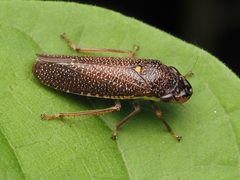
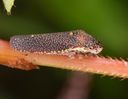
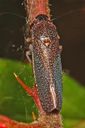
Paraulacizes is a of sharpshooters (leafhoppers) in the Cicadellidae, established by Young in 1968. The genus comprises approximately 11 described distributed primarily in the Americas. Species in this genus are relatively large, robust leafhoppers with distinctive coloration patterns. Paraulacizes irrorata, the speckled , is among the most recognizable and well-studied species, serving as a representative for understanding the of this genus.
Pronunciation
How to pronounce Paraulacizes: /ˌpæɹəˌjuːləˈsaɪziːz/
These audio files are automatically generated. While they are not always 100% accurate, they are a good starting point.
Identification
Members of Paraulacizes are distinguished from other by their relatively large size and robust body form. Paraulacizes irrorata is particularly recognizable by its speckled coloration pattern. The genus can be separated from the closely related Draeculacephala by genitalic and external morphological features established in Young's 1968 revision. -level identification requires examination of male genitalia and color pattern details.
Images
Habitat
Grasses in pastures and meadows. Paraulacizes irrorata has been observed in riparian woodlands and early spring vegetation.
Distribution
The Americas. Paraulacizes irrorata is distributed across North America.
Seasonality
active in early spring; multiple per year with nymphal development approximately 30-40 days depending on temperature. occurs as in grass stems.
Diet
Phloem sap of grasses (Poaceae). Paraulacizes irrorata feeds specifically on grass phloem.
Host Associations
- Poaceae - primary food sourcegrasses in pastures and meadows
Life Cycle
, five nymphal instars, . Eggs are inserted into grass stems and serve as the stage. Nymphal development takes approximately 30-40 days depending on temperature. Adults have a preoviposition period of 1-2 weeks. Multiple occur per year.
Behavior
Nymphs exhibit strong positive . readily take when disturbed.
Ecological Role
Grass-feeding leafhopper with potential as a of plant . Serves as for in the Eulophidae (Hymenoptera).
Similar Taxa
- DraeculacephalaClosely related proconiine with similar size and preferences; distinguished by genitalic and external morphological features
More Details
Type species
Paraulacizes thunbergii (Stål, 1864)
Notable species
Paraulacizes irrorata (Fabricius, 1794), the speckled , is the most studied and serves as a model for understanding the of this . Other described species include P. aurantiaca, P. confusa, P. figurata, P. lugubris, P. mutans, P. panamensis, P. piperata, P. pollinosa, P. sparsa, and P. thunbergii.
Parasitoid associations
The first recorded for P. irrorata is a in the Eulophidae (Hymenoptera), documented in 2006.
Sources and further reading
- BugGuide
- Wikipedia
- GBIF taxonomy match
- iNaturalist taxon
- NCBI Taxonomy
- Catalogue of Life
- Oedemeridae | Beetles In The Bush
- Life History of Four Draeculacephala Species and Paraulacizes irrorata (Homoptera: Cicadellidae)1
- FIRST RECORD OF AN EGG PARASITOID FOR THE NORTH AMERICAN PROCONIINE SHARPSHOOTER PARAULACIZES IRRORATA (HEMIPTERA: CICADELLIDAE), WITH NOTES ON REARING TECHNIQUES