
Euwallacea perbrevis
(Schedl, 1951)
tea shot-hole borer
Euwallacea perbrevis, the tea shot-hole borer, is an ambrosia beetle native to South and Southeast Asia through Australia. It is part of the Euwallacea fornicatus cryptic , distinguished from its three (E. fornicatus, E. fornicatior, and E. kuroshio) primarily through rather than . The cultivates symbiotic fungi in galleries bored into trees and fungal causing Fusarium branch dieback. It has been introduced to the United States (Florida, Hawaii), Rica, and Panama, where it poses significant economic threats to avocado production and urban trees.
Pronunciation
How to pronounce Euwallacea perbrevis: //juːˈwæleɪsiə pərˈbrɛvɪs//
These audio files are automatically generated. While they are not always 100% accurate, they are a good starting point.
Identification
Reliable identification requires molecular genetic analysis ( or genotyping). Morphological features including pronotum dimensions, proportions, and protibial socketed denticle counts show statistical correlations with identity but overlap substantially among the four cryptic species. Multiple specimens from a single improve confidence of morphological identification. Distinguished from non-cryptic ambrosia beetles by its association with Fusarium and Graphium fungal and its small size.
Images
Appearance
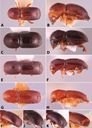
Small ambrosia beetle with body length 2.3–2.5 mm. 1.42–1.68 mm long; pronotum 1.04–1.16 mm long. Pronotum bears 7–10 socketed denticles on the edge of the protibia. Uniformly brown in coloration. Morphologically cryptic: cannot be reliably distinguished from other members of the E. fornicatus complex by appearance alone, as all four range from 1.8–2.9 mm and share similar body proportions.
Habitat
Excavated galleries within the xylem and sapwood of trees. briefly roam on bark surfaces before boring into trees. Inhabits dead tree trunks, sapwood, tea stems, and large fallen timber in native range; in invaded areas, attacks live trees including healthy avocado, mango, and ornamental .
Distribution
Native: American Samoa, Australia, Brunei, China, India, Fiji, Indonesia (Java), Papua New Guinea, Sri Lanka, Japan, Malaysia, Palau, Philippines, Réunion, Singapore, Taiwan, Timor, Vietnam, Thailand. Introduced: United States (Florida since 2010, Hawaii, California), Rica, Panama, Israel. Established in southern Florida commercial avocado production region centered around Homestead.
Seasonality
New emerges approximately 5–6 weeks after . females disperse during daytime. Activity patterns vary with climate and region.
Diet
Cultivates and feeds on symbiotic ambrosia fungi grown in xylem galleries. Documented fungal associates include Fusarium bugnicourtii, Fusarium tumidum, Fusarium rekanum, Ceratocystis fimbriata, and Graphium . Does not consume wood tissue directly.
Host Associations
- Persea americana - primary avocado; major economic in invaded range
- Mangifera indica - mango
- Persea palustris - swampbay
- Delonix regia - royal poinciana
- Camellia sinensis - tea; original reference
- Platanus racemosa - California sycamore
Life Cycle
Complete with all stages occurring inside tree galleries. Female bores entrance tunnel, then constructs bifurcated or simple tunnels in twigs or branches. -laying begins after entrance tunnel completion; eggs laid singly or in small clusters. size varies with climate and region, typically 15–20 individuals, occasionally up to 34. Egg stage: 8–10 days; larval stage: 21–26 days (three instars for females); pupal stage: 10–12 days. Males develop faster than females but are flightless and remain in parental galleries. Young females undergo sibling inbreeding before emerging through original entrance tunnel to disperse. New emerges 5–6 weeks post-.
Behavior
Females are the dispersing sex, flying to new within a range of 30–35 m. carry fungal spores in mycangia (specialized mandibular pockets) when colonizing new trees. Creates distinctive "volcanoes"—white sugary exudates around attack sites on bark. Males occasionally emerge and crawl on bark surfaces; may enter unrelated galleries to mate with females there. Larvae remain in parental galleries throughout development. Adults spend minimal time on bark surface, limiting exposure to contact .
Ecological Role
pest in introduced range. fungal causing Fusarium branch dieback , disrupting xylem transport through phytotoxic secondary metabolites from symbiotic fungi. Mass of branches leads to structural failure and branch drop. In native Asian forests, contributes to natural branch turnover and nutrient cycling; in invaded , causes tree mortality and disruption. Susceptible to by fungi, particularly bassiana.
Human Relevance
Significant economic pest of avocado production in southern Florida and California, and of urban ornamental trees. Causes Fusarium dieback in commercial and landscape settings. Difficult to control with due to protected gallery lifestyle; and contact show limited efficacy. using bassiana products (particularly Velifer ES) shows laboratory promise. Poses ongoing threat to urban tree and agricultural industries in invaded regions.
Similar Taxa
- Euwallacea fornicatusCryptic in the same complex; distinguished by genetics and subtle morphometric differences, native to southern Southeast Asia
- Euwallacea fornicatiorCryptic ; previously confused under the same name, distinguished molecularly
- Euwallacea kuroshioCryptic , the Kuroshio shot hole borer, native to Japan, Indonesia, and Taiwan; introduced to Mexico and California
- Euwallacea whitfordiodendrusFormerly E. aff. fornicatus or shot hole borer, now recognized as distinct ; mass colonizes branches causing structural failure
- Xyleborus glabratusRedbay ambrosia beetle, similar and ambrosia lifestyle, but Raffaelea lauricola causing laurel wilt, distinguished by association with Lauraceae and different fungal
Misconceptions
Formerly lumped with other members of the E. fornicatus complex under the single name "tea shot hole borer" or confused with the " shot hole borer." The assumption that ambrosia beetles are harmless in their native ranges has been disproven—E. perbrevis causes significant branch damage and tree mortality in Asian forests.
Sources and further reading
- BugGuide
- Wikipedia
- GBIF taxonomy match
- iNaturalist taxon
- NCBI Taxonomy
- So Many Shot Hole Borers: New Research Charts Four Nearly Identical Species
- Xyleborus glabratus and Euwallacea fornicatus - Entomology Today
- four species of Euwallacea - Entomology Today
- Euwallacea fornicatus Archives - Entomology Today
- Search Continues for Methods to Control Fungus-Farming Beetle in SoCal Trees
- Forest Pest Invasions Can—And Should—Be Studied Before They Happen
- Invasive Shot Hole Borers Euwallacea fornicatus, E. kuroshio, and E. perbrevis (Coleoptera: Curculionidae: Scolytinae)
- Evaluation of Spore Acquisition, Spore Production, and Host Survival Time for Tea Shot-Hole Borer, Euwallacea perbrevis, Adults after Exposure to Four Commercial Products Containing Beauveria bassiana
- First Record of Graphium Species Associated with Euwallaceae perbrevis in Australia