
Phloeosinus
Chapuis, 1869
cedar bark beetles, cypress bark beetles
Species Guides
12- Phloeosinus antennatus
- Phloeosinus armatus
- Phloeosinus canadensis(northern cedar bark beetle)
- Phloeosinus cristatus
- Phloeosinus cupressi(cypress bark beetle)
- Phloeosinus dentatus(eastern juniper bark beetle)
- Phloeosinus pini
- Phloeosinus punctatus(western cedar bark beetle)
- Phloeosinus scopulorum(Juniper Bark Weevil)
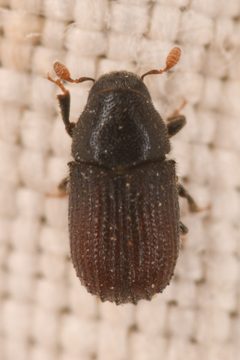
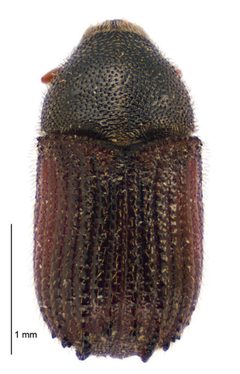
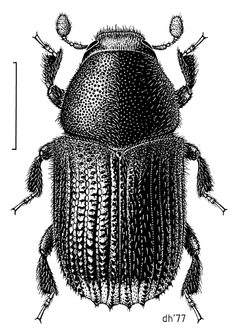
Phloeosinus is a of bark beetles (Curculionidae: Scolytinae) comprising at least 20 described . Species in this genus are specialized on conifers in the Cupressaceae, including genera such as Cupressus, Thuja, Juniperus, and Chamaecyparis. Several species have become significant pests, causing economic damage to ornamental trees and forest . The genus exhibits specialized chemical , with species using plant volatiles and for mate and host location.
Pronunciation
How to pronounce Phloeosinus: /flɪoʊˈsaɪnəs/
These audio files are automatically generated. While they are not always 100% accurate, they are a good starting point.
Identification
identification within Phloeosinus relies on detailed examination of elytral declivity patterns, with males typically bearing small, individual, sparse, sharply pointed tubercles on odd interstriae, and females showing smaller, blunt, nippled tubercles. Phloeosinus metasequoiae is distinguished by deeply , coarse frontal and prothoracic surfaces with reticulate texture, and deeply V-shaped basal margin of the .
Images
Habitat
Associated with Cupressaceae conifers including cypresses, junipers, arborvitae, and related ornamental and forest trees. occupy bark and phloem tissues of trees, with some preferring stressed, dying, or dead wood while others attack living trees.
Distribution
Native range includes North America, Mediterranean region, and Asia. Multiple have established : P. aubei across temperate Europe; P. cupressi in Australia, New Zealand, and Panama; P. serratus in Jamaica. Climate modeling indicates potential for further range expansion under warming scenarios.
Seasonality
P. aubei shows bimodal activity: females search for declining trees to establish breeding galleries in April–May, while adults of both sexes visit healthy trees to bore tunnels from August to October.
Diet
Phloem tissues of trees. feed on phloem and bore into bark and small twigs.
Host Associations
- Cupressus - primary
- Thuja occidentalis - including cultivar 'Smaragd'
- Juniperus communis - older, damaged trees with stems >3 cm diameter
- Juniperus flaccida - confirmed primary for P. deleoni
- Juniperus deppeana - confirmed primary for P. deleoni, with direct feeding observed
- Chamaecyparis lawsoniana -
- Platycladus orientalis -
- Metasequoia glyptostroboides - for P. metasequoiae
- Pinus nigra subsp. laricio - for P. laricionis, the only Palaearctic known from pine
Life Cycle
Females initiate gallery construction in bark, creating chambers and breeding galleries. Larvae develop within phloem tissue. P. aubei overwinters as in small tunnels bored into healthy trees. Some show preference for dead or dying host material for .
Behavior
use volatile organic compounds for location, with distinct responses to volatiles from healthy versus stressed trees. P. aubei detects α-thujone from healthy trees, and α-pinene, α-thujene, β-pinene, myrcene, limonene, and p-cymene from infested or stressed trees. P. cupressi bore into small twigs creating downward-extending tunnels while preserving thin outer bark, causing twig breakage that attracts conspecifics. P. aubei males produce cis-verbenol and verbenone as components upon mating, which interact with female-produced components and host to mediate .
Ecological Role
As primary bark borers on Cupressaceae, contribute to tree mortality and nutrient cycling in native . In invaded ranges, several species function as destructive pests causing significant economic losses and aesthetic damage to ornamental plantings and urban forests. P. dentatus serves as alternate for hymenopterous that primarily attack southern pine beetle and Ips species.
Human Relevance
Multiple are significant economic pests of ornamental trees in nurseries and urban green spaces. P. aubei and P. cupressi are particularly damaging in Europe, Australia, and New Zealand. P. aubei is monitored using blends containing myrtenol, α-pinene, and cis-verbenol. Climate change is projected to expand suitable for invasive species, necessitating and monitoring programs.
Sources and further reading
- BugGuide
- GBIF taxonomy match
- iNaturalist taxon
- NCBI Taxonomy
- Catalogue of Life
- Predicting Phloeosinus cupressi (Coleoptera: Curculionidae: Phloeosinus) Distribution for Management Planning Under Climate Change
- Phloeosinus serratus (Coleoptera: Scolytidae) Attacking Cupressus lusitanica in Jamaica: A New Host Record
- Changing volatile profile of arborvitae, Thuja occidentalis, by drying up and infestation: selective olfactory cues for the cypress bark beetle, Phloeosinus aubei
- Figure 2 from: Cervantes-Espinoza M, Maya-Ramos J, Atkinson T, Ruíz EA, Armendariz-Toledano F (2025) Exploration of the distribution and host range of Phloeosinus deleoni Blackman (Curculionidae, Scolytinae) through collection records, field collections and modelling of potential distribution. Biodiversity Data Journal 13: e164908. https://doi.org/10.3897/BDJ.13.e164908
- Description of Phloeosinus laricionis sp. n. (Coleoptera: Curculionidae, Scolytinae), a new bark beetle species from southern Europe
- HYMENOPTEROUS PARASITOIDS OF THE EASTERN JUNIPER BARK BEETLE, PHLOEOSINUS DENTATUS (COLEOPTERA: SCOLYTIDAE)
- Occurrence of the Invasive Bark Beetle Phloeosinus aubei on Common Juniper Trees in the Czech Republic
- PHLOEOSINUS ARMATUS REITTER (COLEOPTERA CURCULIONIDAE SCOLYTINAE) AND ITS ASSOCIATED FUNGAL COMMUNITY COLONIZING CUPRESSUS SEMPERVIRENS L. IN TUSCANY (ITALY)
- cis-Verbenol and verbenone as male-produced pheromone components of the cypress bark beetle, Phloeosinus aubei: Identification and behavioral tests in combination with the female-produced pheromone components
- Phenology, behavior and infestation levels of the invasive small cypress bark beetle, Phloeosinus aubei, on some cultivars of Thuja and Juniper spp., in Hungary
- Figure 3 from: Cervantes-Espinoza M, Maya-Ramos J, Atkinson T, Ruíz EA, Armendariz-Toledano F (2025) Exploration of the distribution and host range of Phloeosinus deleoni Blackman (Curculionidae, Scolytinae) through collection records, field collections and modelling of potential distribution. Biodiversity Data Journal 13: e164908. https://doi.org/10.3897/BDJ.13.e164908
- ¿p#1 Predicting the Potential Habitat Suitability of Phloeosinus aubei Perris in China Using BIOMOD2: Implications for Forest Pest Management.
- Phloeosinus metasequoiae sp. nov. (Coleoptera, Curculionidae, Scolytinae, Phloeosinini), a new insect pest of Metasequoia glyptostroboides in China
- Exploration of the distribution and host range of Phloeosinus deleoni Blackman (Curculionidae, Scolytinae) through collection records, field collections and modelling of potential distribution
- Figure 1 from: Cervantes-Espinoza M, Maya-Ramos J, Atkinson T, Ruíz EA, Armendariz-Toledano F (2025) Exploration of the distribution and host range of Phloeosinus deleoni Blackman (Curculionidae, Scolytinae) through collection records, field collections and modelling of potential distribution. Biodiversity Data Journal 13: e164908. https://doi.org/10.3897/BDJ.13.e164908
- Chemical Ecology of Host- and Mate-Finding in the Cypress Bark Beetle Phloeosinus aubei, with Notes on Congeneric Species.
- Assessing Habitat Suitability for Phloeosinus aubei Perris in China: A MaxEnt-Based Predictive Analysis.