
Phloeosinus canadensis
Swaine, 1917
northern cedar bark beetle
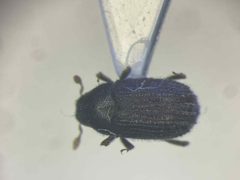
Phloeosinus canadensis, commonly known as the northern cedar bark beetle, is a of crenulate bark beetle in the Curculionidae. It is native to North America, with documented records from Canada (New Brunswick, Ontario, Québec) and the United States (Vermont). The species belongs to the Phloeosinus, a group of bark beetles associated with coniferous trees. As a member of the weevil family, it exhibits the characteristic elongated snout typical of Curculionidae.
Pronunciation
How to pronounce Phloeosinus canadensis: /floɪoʊˈsaɪnəs ˌkænəˈdɛnsɪs/
These audio files are automatically generated. While they are not always 100% accurate, they are a good starting point.
Identification
As a Phloeosinus , this can be recognized by features typical of the : small size, cylindrical body form adapted for living under bark, and with a distinct club. The specific epithet 'canadensis' indicates its northern distribution, which may help distinguish it from related southern species. Definitive identification to species level requires examination of morphological details such as elytral declivity structure and other fine characters used in bark beetle . The 'northern cedar bark beetle' suggests association with cedar (Thuja) , though this requires verification.
Images
Habitat
Based on the and -level , this likely inhabits coniferous forests where its trees occur. Phloeosinus species are generally found beneath the bark of living or recently dead conifers, particularly in the cambium layer where larvae feed and develop.
Distribution
Documented from North America, specifically: Canada (New Brunswick, Ontario, Québec) and the United States (Vermont). The specific epithet and suggest a primarily northern distribution within the continent.
Host Associations
- Thuja - suspectedInferred from 'northern cedar bark beetle'; Phloeosinus includes associated with Thuja and other Cupressaceae
Ecological Role
As a bark beetle, this likely functions as a cambium feeder in coniferous trees. Depending on its specific , it may act as a primary colonizer of stressed or dying trees, or as a secondary agent following other disturbances. Phloeosinus species contribute to nutrient cycling through wood decomposition and serve as food for various and .
Human Relevance
The economic or forest health significance of this is not well documented. Some Phloeosinus species can be pests of ornamental or forest conifers, but the impact of P. canadensis specifically is unknown.
Similar Taxa
- Other Phloeosinus speciesMembers of this share similar and ; differentiation requires detailed examination of elytral and pronotal characters
- Other Scolytinae bark beetlesNumerous small cylindrical bark beetles occupy similar ; Phloeosinus can be distinguished by antennal club structure and other Scolytinae-specific characters
More Details
Taxonomic Note
The was described by J.M. Swaine in 1917. The Phloeosinus is sometimes classified in the Scolytinae (bark beetles) within Curculionidae, though this varies by taxonomic authority.
Data Limitations
Published biological information for this is extremely sparse. Most available records are taxonomic listings and museum specimens rather than ecological studies. The 'northern cedar bark beetle' appears in Wikipedia but its origin and verification status are unclear.