
Colydiinae
Billberg, 1820
Cylindrical bark beetles
Tribe Guides
4- Colydiini
- Nematidium
- Rhagodera(cylindrical bark beetles)
- Synchitini(cylindrical bark beetles)
Colydiinae is a large of beetles within Zopheridae, historically treated as the . The subfamily contains approximately 140 worldwide and represents the majority of diversity in the expanded family Zopheridae. Its taxonomic placement has been contentious, with phylogenetic analyses producing conflicting results regarding its relationship to Zopherinae and even its monophyly. The group has a fossil record extending to at least the Middle Eocene.

Pronunciation
How to pronounce Colydiinae: /kɒˈlaɪdiːˌiːniː/
These audio files are automatically generated. While they are not always 100% accurate, they are a good starting point.
Identification
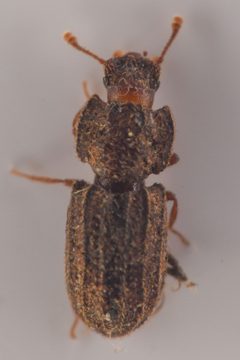
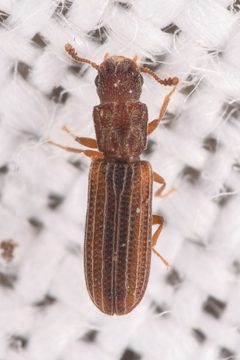
are generally cylindrical in form, consistent with their . The lacks convincing morphological synapomorphies, making definitive identification based on external alone difficult. Delimitation from other Zopheridae lineages is usually straightforward, though the tribe Pycnomerini presents ongoing taxonomic uncertainty. Tribal-level identification requires examination of detailed morphological characters, with up to nine tribes recognized by some authors.
Images
Habitat
Members of the tribe Synchitini have been observed in rotting wood, under bark, and in leaf-litter . Information for other tribes is sparse.
Distribution
Worldwide distribution with approximately 140 . About 35 genera are known from the Australian region. Europe contains 20 genera, many with few . Western Palearctic species of the genus Colydium have documented distributions.
Diet
Feeding habits vary among lineages. Members of the tribe Synchitini are known to be mycophagous or detritivorous. Some colydiines feed on fungi; others are and consume small arthropods including bark beetles.
Similar Taxa
- ZopherinaeSister group within Zopheridae; phylogenetic analyses remain inconclusive regarding precise relationship to Colydiinae
- PycnomeriniSmall lineage of disputed placement, formerly considered an independent ; placement as Pycnomerinae, tribe within Colydiinae, or tribe within Zopherinae remains disputed
More Details
Taxonomic instability
The has been treated historically as within Tenebrionoidea. Current placement as subfamily within Zopheridae is supported by some phylogenetic studies but contested by others. The monophyly of Colydiinae itself is suspect due to lack of morphological synapomorphies, and the tribe Synchitini may be with respect to other colydiine tribes.
Tribal classification
Up to nine tribes are accepted by various authors: Acropini, Adimerini, Colydiini, Gempylodini, Nematidiini, Orthocerini, Rhagoderini, Rhopalocerini, and Synchitini. Some authors synonymize certain tribes, and Synchitini is sometimes merged into Colydiini. The Synchitini is the largest tribe with 115 .
Fossil record
Xylolaemus sakhnovi was described from Baltic amber dating to the Middle Eocene, representing the first fossil record for that . The extinct genus Paleoendeitoma, belonging to the extant tribe Synchitini, is known from Cenomanian-aged Burmese amber of Myanmar.
Sources and further reading
- BugGuide
- Wikipedia
- GBIF taxonomy match
- iNaturalist taxon
- NCBI Taxonomy
- Catalogue of Life
- The genus Colydium Fabricius in Europe (Coleoptera, Zopheridae, Colydiinae) with description of a new species, Colydium noblecourti sp. nov.
- <p><strong>A new species of <em>Paleoendeitoma </em>(Coleoptera: Zopheridae: Colydiinae)<em> </em>from mid-Cretaceous Burmese amber</strong></p>