
Zopheridae
Solier, 1834
Ironclad beetles
Subfamily Guides
2- Colydiinae(Cylindrical bark beetles)
- Zopherinae(ironclad beetles)
is a of beetles in the superfamily Tenebrionoidea, commonly known as ironclad beetles. The family has expanded considerably in recent years to include the former families Monommatidae and as or tribes. It comprises approximately 190 and 1700 distributed worldwide. Members are characterized by exceptionally hardened that make specimens difficult to pin for collection. The family includes diverse feeding habits, with many species associated with rotting wood or fungus, while some Colydiinae are predatory or feed on living plant tissue.
Pronunciation
How to pronounce Zopheridae: /zoʊˈfɛrɪdiː/
These audio files are automatically generated. While they are not always 100% accurate, they are a good starting point.
Identification
can be distinguished from similar darkling beetles (Tenebrionidae) and ground beetles (Carabidae) by their exceptionally hardened, often and concealed beneath the . The is difficult to characterize with single diagnostic traits due to its taxonomic expansion. Former (now Colydiinae) are typically small, cylindrical bark beetles with antennal clubs. Former Monommatidae are recognized by their distinctive mandibular structure. The ironclad beetles proper (Zopherinae) are notably robust with extremely dense . Use of dichotomous keys is recommended for reliable identification to or .
Images
Appearance
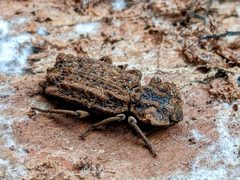
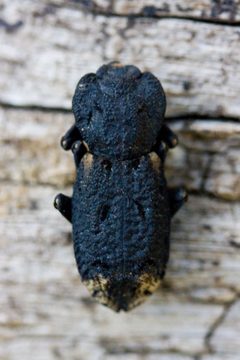
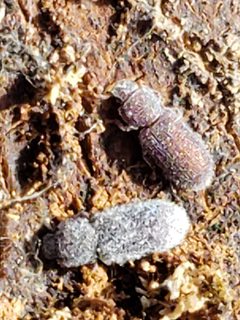
are characterized by heavily sclerotized, often cylindrical or somewhat flattened bodies with exceptionally hard —hence the "ironclad beetles." The dense exoskeleton can be so rigid that entomologists have extreme difficulty pinning collected specimens. Body form varies considerably due to the 's expanded circumscription, ranging from small cylindrical bark beetles (Colydiinae) to larger, more robust forms (Zopherinae). are typically bead-like or slightly clubbed. Many exhibit dark, often black or brown coloration, though some display patterns or metallic reflections.
Habitat
are diverse across the 's expanded circumscription. Many are associated with forested environments, particularly rotting wood and dead trees. Dendrophilous (tree-associated) species occur in both lowland and montane forests. Some species inhabit old-growth forests, while others occupy temperate forest or aridland environments. The family shows particular diversity in association with decaying wood and fungal substrates.
Distribution
Worldwide distribution with approximately 190 and 1700 . Documented from North America (including eastern and western forests), Central America, South America, Europe (including Baltic amber fossils and modern montane ), Asia (Russia's Primorskii Krai, Korean peninsula, Japan, China, Iran's Hyrcanian Forest), Australia, and Pacific islands (French Polynesia, though some species are likely extinct). The has fossil representatives from Eocene Baltic amber and Cretaceous Burmese amber.
Diet
Feeding habits are diverse across the . Many members feed on rotting wood or fungus associated with rotting wood. Some members of Colydiinae are predatory. Other Colydiinae feed on living plant tissue including roots, stems, flower stalks, and fruit. Specific dietary information for many remains undocumented.
Life Cycle
Behavior
Many are and can be found on tree trunks at night. Some species exhibit slow, lumbering movement rather than rapid when disturbed, relying on their dense for protection. Specific behavioral documentation beyond general activity patterns is sparse for most species.
Ecological Role
Decomposers of rotting wood and associated fungal material. Some predatory members may contribute to of other insects. As wood-associated beetles, they participate in nutrient cycling in forest . Their exceptional represent an extreme for defense against .
Human Relevance
Ironclad beetles are featured in museum petting zoos and educational displays due to their remarkable durability and intriguing appearance. The has been subject to extensive taxonomic revision, reflecting its importance in . Some are likely extinct due to destruction, highlighting conservation concerns for forest . Their hardened bodies make them challenging specimens for entomological collections, requiring specialized preparation techniques.
Similar Taxa
- Tenebrionidae (darkling beetles)Formerly included as a ; both share bead-like and concealed , but Zopheridae have exceptionally hardened, often . Some Tenebrionidae now classified in Zopheridae (Ulodinae, Usechinae) create identification challenges.
- Carabidae (ground beetles)Both can be dark, ground-dwelling beetles, but Carabidae have exposed, forward-directed and longer, more filamentous segments, plus typically rapid running compared to the slow, armored movement of .
- ChalcodryidaeHistorical confusion in classification; Sirrhas was moved from Chalcodryidae to Perimylopidae based on phylogenetic analysis, and Ulodinae was elevated from to rank, demonstrating close relationships and past taxonomic uncertainty.
More Details
Taxonomic instability
The 's circumscription has changed dramatically, with and Monommatidae subsumed within . Classification schemes vary: some authors recognize up to six , while others merge all except Colydiinae into Zopherinae. Subfamilies currently recognized include Colydiinae, Zopherinae, Ulodinae, and Usechinae, though Ulodinae has been elevated to family rank by some authorities.
Fossil record
The oldest confirmed fossils are Paleoendeitoma ( Colydiinae, tribe Synchitini) and Cretomysteria from early Late Cretaceous (Cenomanian) Burmese amber. Eocene Baltic amber contains four described : Xylolaemus legalovi, X. richardklebsi, Diodesma slipinskii, and Endophloeus gorskii.
Conservation concern
Two Pycnomerus from Rimatara, French Polynesia (P. rimatara and P. prebblei) are considered likely globally extinct due to single-island and destruction, representing one of few documented extinctions attributed to human activity.
Sources and further reading
- BugGuide
- Wikipedia
- GBIF taxonomy match
- iNaturalist taxon
- NCBI Taxonomy
- Catalogue of Life
- Hissers: Big, Bold and Beautiful | Bug Squad
- Bohart Museum Open House on 'Many Legged Wonders': How Many Legs Does an Isopod Have? | Bug Squad
- UC Davis Picnic Day: Let's Go on an Insect Scavenger Hunt! | Bug Squad
- A Birthday Visit to the Bohart | Bug Squad
- Bug Eric: ID Tip: Ground Beetle or Darkling Beetle?
- Oecanthidae | Beetles In The Bush
- New Zopheridae (Coleoptera: Tenebrionoidea) from Baltic amber
- Taxonomic revision of Australian Pristoderus Hope (Coleoptera, Zopheridae)
- New Pycnomerus Erichson (Coleoptera: Zopheridae: Pycnomerini) from Rimatara, French Polynesia
- A revision of the genus Phellopsis LeConte (Coleoptera: Zopheridae)
- Relationships and higher classification of some Tenebrionidae and Zopheridae (Coleoptera)
- A new species of Tarphius Erichson, 1845 (Coleoptera: Zopheridae) from Iran
- A New Mexican Species and Distributional Comments of Verodes Casey (Coleoptera: Zopheridae: Zopherinae)
- A phylogenetic analysis of the tribe Zopherini with a review ofthe species and generic classification (Coleoptera: Zopheridae)
- The larva of Sirrhas variegatus , sp.nov., with notes on the Perimylopidae, Ulodidae (stat. nov.), Zopheridae and Chalcodryidae (Coleoptera : Tenebrionoidea)
- The genome sequence of the cylindrical bark beetle, Colydium elongatum (Fabricius, 1787) (Coleoptera: Zopheridae).