
Pycnomerus
Erichson, 1842
ironclad beetles
Species Guides
4- Pycnomerus haematodes
- Pycnomerus reflexus(Reflexed Ironclad Beetle)
- Pycnomerus sulcicollis(ironclad beetle)
- Pycnomerus thrinax(ironclad beetle)
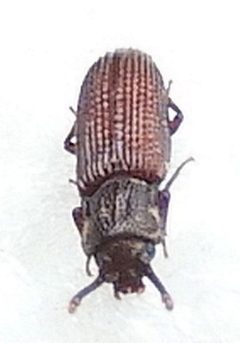
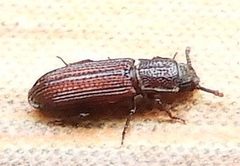
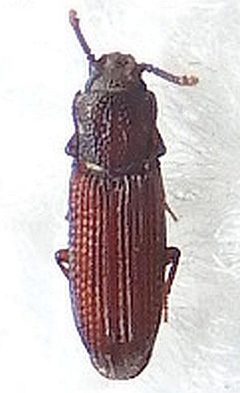
Pycnomerus is a of ironclad beetles ( Zopheridae) comprising more than 20 described . Members are small, elongated beetles with hardened, often sculptured typical of the family. The genus includes both widespread and highly restricted species, with some island endemics now considered extinct due to loss. Several species are associated with dead wood habitats and are classified as saproxylic.
Pronunciation
How to pronounce Pycnomerus: //pɪkˈnɒmərəs//
These audio files are automatically generated. While they are not always 100% accurate, they are a good starting point.
Images
Habitat
in this occupy forested environments, particularly those with dead wood resources. P. italicus occurs in humid forest environments with fallen trunks of Abies alba. P. fuliginosus inhabits the space under bark of conifers and hardwood trees, associated with rotten plant material. The extinct P. rimatara and P. prebblei likely inhabited lowland forest on Rimatara prior to forest destruction.
Distribution
The has a broad but patchy global distribution. P. fuliginosus is native to Australia and has been introduced to Britain and Ireland. P. italicus is to Italy, with in southern regions including Calabria. Two (P. rimatara and P. prebblei) were endemic to Rimatara island in the Austral Archipelago of French Polynesia. Additional distribution records exist from Sweden and Norway based on GBIF data.
Ecological Role
Members of this function as saproxylic organisms in forest , dependent on dead wood . As part of the saproxylic , they contribute to wood decomposition processes and may serve as prey for other organisms.
Human Relevance
P. fuliginosus was accidentally introduced to Britain in 1964 via horticultural commerce and has become established, representing a case of human-mediated range expansion. P. italicus is listed as endangered on the Red List of Italian Saproxylic Beetles, with conservation recommendations including protection of humid forest and appropriate forest management. Two described from French Polynesia are considered likely globally extinct due to human-caused , particularly the use of fire to clear lowland forests.
Similar Taxa
- Other Zopheridae generaPycnomerus can be distinguished from related ironclad beetles by tribal characters; members of Pycnomerini have specific morphological features including tarsal formulae and genal structure, though precise identification requires examination of detailed anatomical characters.
- Tenebrionidae (darkling beetles)P. fuliginosus in particular has a tenebrionid-like, elongated, parallel-sided appearance that may cause superficial confusion; however, Zopheridae are distinguished by their extremely hardened, often sculptured and other -level characters.
More Details
Genomic resources
A high-quality -level assembly (359.22 Mb, 11 chromosomal pseudomolecules including X ) has been generated for P. fuliginosus as part of the Darwin Tree of Life Project, providing a genomic foundation for the .
Taxonomic note
The was established by Erichson in 1842 and is classified in the tribe Pycnomerini within Zopherinae. The tribe Pycnomerini has been suggested to have predatory habits based on Denux and Zagatti 2010, though this inference requires confirmation at the level.
Sources and further reading
- BugGuide
- Wikipedia
- GBIF taxonomy match
- iNaturalist taxon
- NCBI Taxonomy
- Catalogue of Life
- New Pycnomerus Erichson (Coleoptera: Zopheridae: Pycnomerini) from Rimatara, French Polynesia
- Pycnomerus italicus (Coleoptera: Zopheridae), an Endemic Endangered Species: A New Report on Its Presence in Southern Italy
- The genome sequence of a beetle, Pycnomerus fuliginosus Erichson, 1842.