
Zopherus
G.R. Gray in Griffith & Pidgeon, 1831
ironclad beetles, living jewel beetles
Species Guides
10- Zopherus championi
- Zopherus concolor(concolor ironclad beetle)
- Zopherus elegans(ironclad beetle)
- Zopherus gracilis(ironclad beetle)
- Zopherus granicollis(ironclad beetle)
- Zopherus nodulosus(Ironclad beetle)
- Zopherus sanctaehelenae
- Zopherus tristis(ironclad beetle)
- Zopherus uteanus(ironclad beetle)
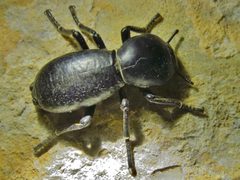
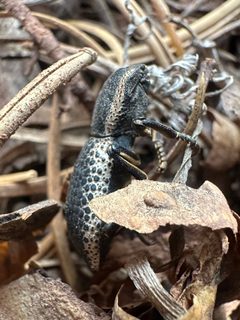
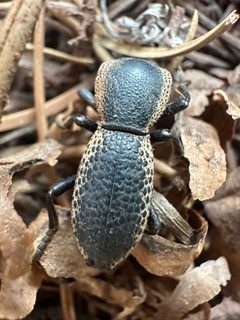
Zopherus is a of 19 of highly armored beetles distributed from the southern United States through Venezuela. These beetles are renowned for their extraordinarily thick, that form an impenetrable shell—so dense that entomologists must drill holes to mount specimens. The genus was erected by George Robert Gray in 1832 and has undergone significant taxonomic revision, with three former genera now synonymized under it. Species exhibit striking geographic color variation: temperate North American forms are uniformly black, while tropical species display bold black-and-white patterns. The beetles are strictly flightless and , adapted for wood-boring in coniferous and desert woodland .
Pronunciation
How to pronounce Zopherus: //ˈzoʊ.fər.əs//
These audio files are automatically generated. While they are not always 100% accurate, they are a good starting point.
Identification
Zopherus can be distinguished from other cylindrical, dark beetles by three key features: (1) into a single rigid shell with no visible line, (2) largely hidden beneath the pronotum with only the surface exposed, and (3) extraordinarily thick, hard elytra that resist standard entomological pins. From darkling beetles (Tenebrionidae), which they resemble in general form, Zopherus differs in the fused elytra and concealed . The habit of climbing tree trunks separates them from most ground-active beetles. identification requires examination of subtle differences in pronotal and elytral sculpturing, best accomplished with reference to Triplehorn's 1972 monograph.
Images
Habitat
Primarily associated with coniferous woodlands, especially ponderosa pine (Pinus ponderosa) and pinyon-juniper . Also found in desert riparian zones, such as under bark of desert tamarisk (Tamarix ramosissima) in the Colorado Desert. Elevation range extends from low desert valleys to high-elevation pine forests above 8000 feet. Beetles are specifically associated with living or recently dead woody vegetation, where are found on tree trunks at night and larvae bore into wood.
Distribution
Western Hemisphere distribution limited to the Americas, ranging from Venezuela northward through Central America and Mexico to the southwestern United States. In the United States, ten occur, with five species restricted to California. The reaches its northern limit in the southwestern states (Arizona, Utah, Nevada, New Mexico, California, Texas) and shows greatest in the arid regions of the southwestern U.S. and Mexico.
Seasonality
are active from late spring through early fall, with peak activity during summer months. Field observations indicate activity on warm nights, with beetles found on tree trunks from June through September. Specific varies by elevation and latitude, with lower-elevation desert active earlier in the season than high-elevation montane populations.
Host Associations
- Pinus ponderosa - climb trunks of living trees at night; larval association presumed but not confirmed
- Pinus monophylla - observed on trunks of single-leaf pinyon pine
- Pinus jeffreyi - larval Z. granicollis bores into root crowns
- Juniperus osteosperma - found on trunks of Utah juniper
- Tamarix ramosissima - Z. tristis lives under bark of desert tamarisk in Colorado Desert
Behavior
Strictly , with ascending tree trunks after dark. During daylight hours, adults presumably shelter in leaf litter or other ground-level cover at the base of trees, though this has not been directly observed. Adults move slowly and deliberately, not exhibiting rapid escape responses. The prevent ; occurs through and possibly passive transport via wood movement. Larvae are wood-borers, with some reported to bore into sound (living) wood rather than solely dead or decaying wood—a relatively unusual habit among wood-boring beetles.
Ecological Role
As wood-boring insects, larvae contribute to the decomposition and recycling of woody , though their capacity to bore into sound wood suggests potential role as tree stressors or agents of mortality in drought- or fire-impacted forests. The extraordinary physical defense provided by their makes essentially invulnerable to by vertebrates and most , representing an extreme example of defensive armor evolution in insects. Their presence on tree trunks may contribute to nutrient cycling through mechanical abrasion of bark surfaces.
Human Relevance
Z. chilensis from Yucatán, Mexico, has been exploited as "living jewels"—adorned with gold or silver appliqués and worn as jewelry while still alive, capitalizing on their extreme durability. The beetles' remarkable hardness has made them subjects of biomechanical research and popular interest in insect defensive adaptations. Their presence in pine forests has been monitored by entomologists as indicators of forest health and biodiversity, though they are not economically significant as forest pests. The difficulty of specimen preparation has made them notorious among collectors and museum curators.
Similar Taxa
- Eleodes (Tenebrionidae)Similar cylindrical body form and slow movement, but Eleodes has separate with visible , exposed , and distinctive head-standing defensive . are bead-like in both, but Eleodes are concealed rather than exposed.
- Moneilema (Cerambycidae)Mimics Eleodes and superficially resembles Zopherus in slow, deliberate movement and habits, but has extremely long (longer than body), separate , and feeds on cactus pads rather than wood.
- Iphthiminus (Tenebrionidae)Found in similar on pine trunks, but has separate , more exposed , and less extreme body armor.
Misconceptions
Historically classified within Tenebrionidae due to superficial resemblance to darkling beetles, but molecular and morphological studies confirm placement in Zopheridae. The authorship has been frequently misattributed to Laporte de Castelnau, who emended the spelling from Gray's original "Zophorus" to "Zopherus"; correct authorship remains Gray, 1832. Some popular accounts exaggerate the "living jewel" practice as widespread across , but documented use appears restricted to Z. chilensis.
More Details
Taxonomic history
The has undergone substantial revision, with Triplehorn's 1972 monograph recognizing 19 and synonymizing three former genera (Megazopherus, Zopherinus, Zopherodes). Many species bear numerous synonyms reflecting historical confusion in species limits. The original spelling "Zophorus" was emended by Laporte de Castelnau, leading to persistent misattribution of authorship.
Specimen preparation
The extreme hardness of Zopherus poses unique challenges for museum preparation. Standard entomological pins cannot penetrate the ; preparators must drill starter holes using small bits or nails before pinning. This characteristic has made the beetles legendary among coleopterists for their 'invincible' armor.
Etymology
The name derives from Greek 'zopheros' (ζοφερός), meaning 'dusky,' 'gloomy,' or 'dark'—referring to the uniformly dark coloration of the type and most temperate-zone representatives.